Quick Verdict: Bryson DeChambeau was accused of threatening to call U.S. President Donald Trump while contesting a two-stroke penalty at the 2026 Open Championship, though there is no evidence that a call happened. The R&A did not overturn the ruling: DeChambeau’s score was revised from 66 to 68 after officials found he had improved the area of his intended swing on Royal Birkdale’s fifth hole.
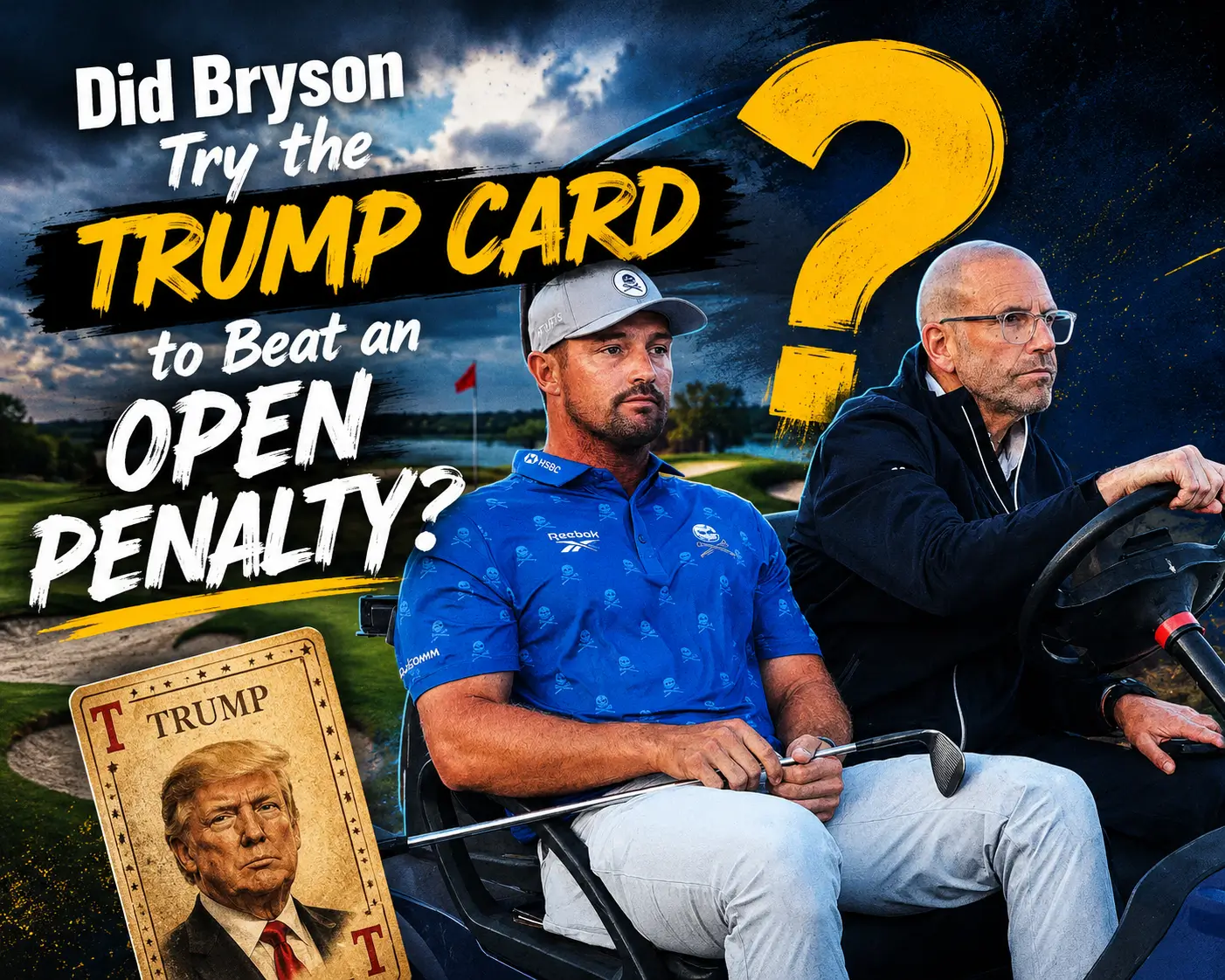
That is the entire point. The alleged Trump angle is a reported claim, not an established phone call or intervention. The penalty, however, was real—and it stayed on the card.
Did DeChambeau call Trump?
No evidence shows that DeChambeau actually called President Trump, and the R&A has not confirmed the allegation that he threatened to do so.
Multiple reports say that, during an extended Friday-night dispute with senior R&A officials, DeChambeau allegedly said he would phone Trump if the matter was not settled in his favour. The claim emerged through reporting attributed to sources familiar with the discussion, not through a public statement from DeChambeau or the White House.
R&A chief executive Mark Darbon was later asked whether he had received a call from the U.S. president. His answer was short: no.
That is where the verified story ends. Anything beyond it—who said what, whether it was a threat, a joke, a frustrated aside, or a serious request—needs to stay labelled as allegation, because neither DeChambeau nor the R&A has publicly supplied a full account.
Why was Bryson penalised?
DeChambeau was handed two penalty strokes after the R&A ruled that he inadvertently improved the area of his intended backswing in thick fescue before playing his second shot on the par-4 fifth hole in round two.
The penalty changed a bogey 5 into a triple-bogey 7. It also changed his round from 66 to 68, moving him from seven under par—one behind the leader—to five under, three strokes back.
| What happened | Why it mattered |
|---|---|
| DeChambeau’s ball finished in long grass at No. 5 | Deep rough does not entitle a player to create a clean route for the club |
| Officials reviewed footage after his round | They ruled he had improved the area affecting his intended swing |
| He originally recorded a bogey 5 | The ruling made it a triple-bogey 7 |
| His 66 was adjusted | His official score became 68 |
Golf’s rules can look absurdly microscopic until you are the golfer standing in waist-high grass with a major on the line. But this was not a judgment on whether DeChambeau meant to gain an advantage. The R&A said the relevant area had been improved. Under the rule, that was enough.
What happened after the ruling?
DeChambeau contested the decision with officials after the round and was allowed to return to the fifth hole with the R&A’s head of governance and a senior referee.
The dispute went on. Television footage showed him in a tense exchange with officials, and reports said he raised the possibility of withdrawing from the championship before later confirming that he would continue. He also hit balls on the driving range after the dispute, long after regular play had ended.
This is the moment the story stopped being a dry rulebook issue and became a proper Open mess. A penalty is painful. A penalty delayed until the night, followed by a prolonged argument and reports of a potential presidential phone call, becomes something else entirely.
Was the R&A’s ruling clear-cut?
Mark Darbon said it was.
“It was an unfortunate decision but really clear-cut from a rules perspective,” the R&A chief executive told the BBC, according to published reports. Darbon said the same decision would have applied regardless of the player involved.
That matters because DeChambeau is not some anonymous qualifier whose mistake went unnoticed. He is a two-time U.S. Open champion, one of golf’s biggest draws, and chairman of the President’s Council on Sports, Fitness, and Nutrition. If the R&A wanted the easy route, it had one: look away, avoid the fight, let the 66 stand.
It did not.
| Question | What is supported by reporting |
|---|---|
| Was DeChambeau penalised? | Yes, two strokes for improving the intended swing area |
| Did he challenge the decision? | Yes, in an extended post-round discussion with officials |
| Did he threaten to call Trump? | Reported by multiple outlets; not confirmed by DeChambeau, the R&A, or the White House |
| Did Trump intervene? | No evidence of intervention; Darbon said he received no call from Trump |
| Was the penalty rescinded? | No. His 66 was changed to 68 |
Why this landed badly
Golf runs on an awkward bargain: the rules can be merciless, but every player is supposed to accept that nobody is bigger than the scorecard.
That is why this story has legs. If DeChambeau merely argued a two-shot penalty, most golfers would understand. They have all felt cheated by a bounce, a ruling, a blade of grass, or a rule written by someone who clearly never played in rain.
But the reported Trump reference hits a different nerve. It suggests an appeal to status, proximity and influence in a sport that likes to sell itself on the idea that a penalty applies equally to every person who tees it up.
Again, the alleged call must be treated carefully. It is not proven. The only indisputable outcome is much simpler: the R&A made its ruling, DeChambeau stayed in the championship, and the two shots never came back.
🚨 The Raw Take
A ball in the fescue does not care who you know.
Maybe DeChambeau mentioned Trump. Maybe he did not. The reports are serious enough to cover, but not solid enough to present as courtroom fact. That distinction matters. What does not need interpretation is this: Bryson fought the ruling, the R&A stood its ground, and his 66 became a 68. At The Open, the grass gets the final word far more often than the powerful people standing in it.