
Key takeaways
- One $1.25 magazine captures a turning point. Persimmon, investment-cast metal and new shaft geometry sat side by side.
- Nicklaus' 1980 comeback was real. He followed a winless 1979 with the U.S. Open and PGA Championship at age 40.
- The ads showed their work. Lynx, Hogan and Spalding printed test details instead of hiding behind vague promises.
- Distance claims need a label. The Top-Flite numbers were Spalding's own tests, not a neutral robot verdict.
- Modern golfers can still copy the lesson. Match the tool to the shot, then show the evidence.
I found these four pages the way you find most good things in golf. By accident, and while looking for something else.
A magazine cover and three ads. That's it. But sit with them for ten minutes and you're back in a pro shop with the door propped open, a persimmon driver in your hand, and a guy behind the counter telling you the new metal heads are a fad.
He was wrong, by the way. Let's go through them.
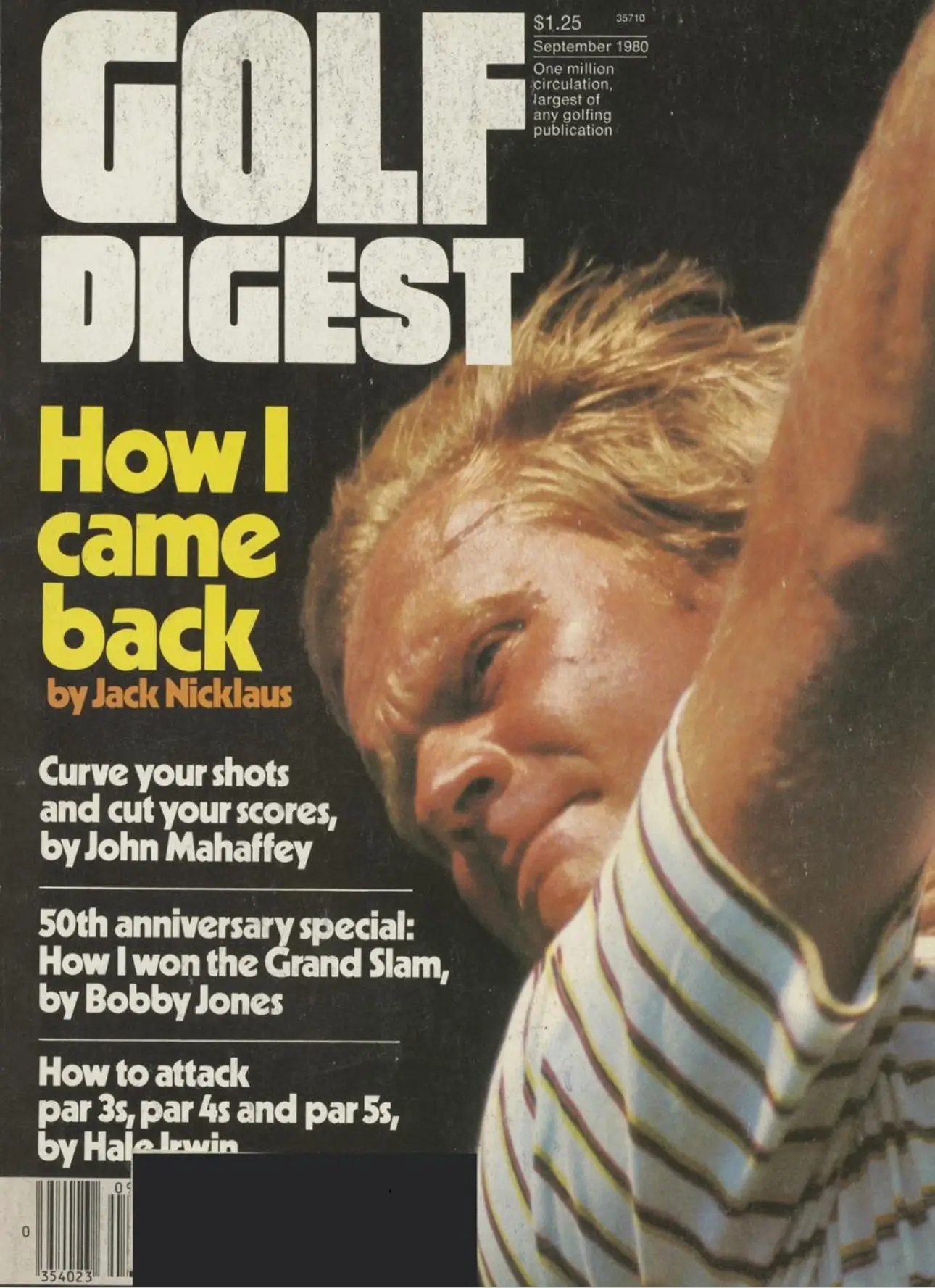
Why does the September 1980 Golf Digest cover matter?
Because of the headline. "How I came back," by Jack Nicklaus.
Nicklaus had gone winless in 1979, the first winless season of his professional career. Then, at 40, he won the 1980 U.S. Open at Baltusrol and the PGA Championship at Oak Hill. The cover landed the month after the PGA, while the story was still warm enough to feel like a confession rather than a retrospective.
John Mahaffey had won the 1978 PGA, Hale Irwin the U.S. Open. The issue also marked the 50th anniversary of Bobby Jones' Grand Slam and claimed a circulation of one million. That is the useful context for the ads: this was a mass-market golf room, not a specialist equipment catalogue, and the equipment companies were speaking directly to everybody in it.
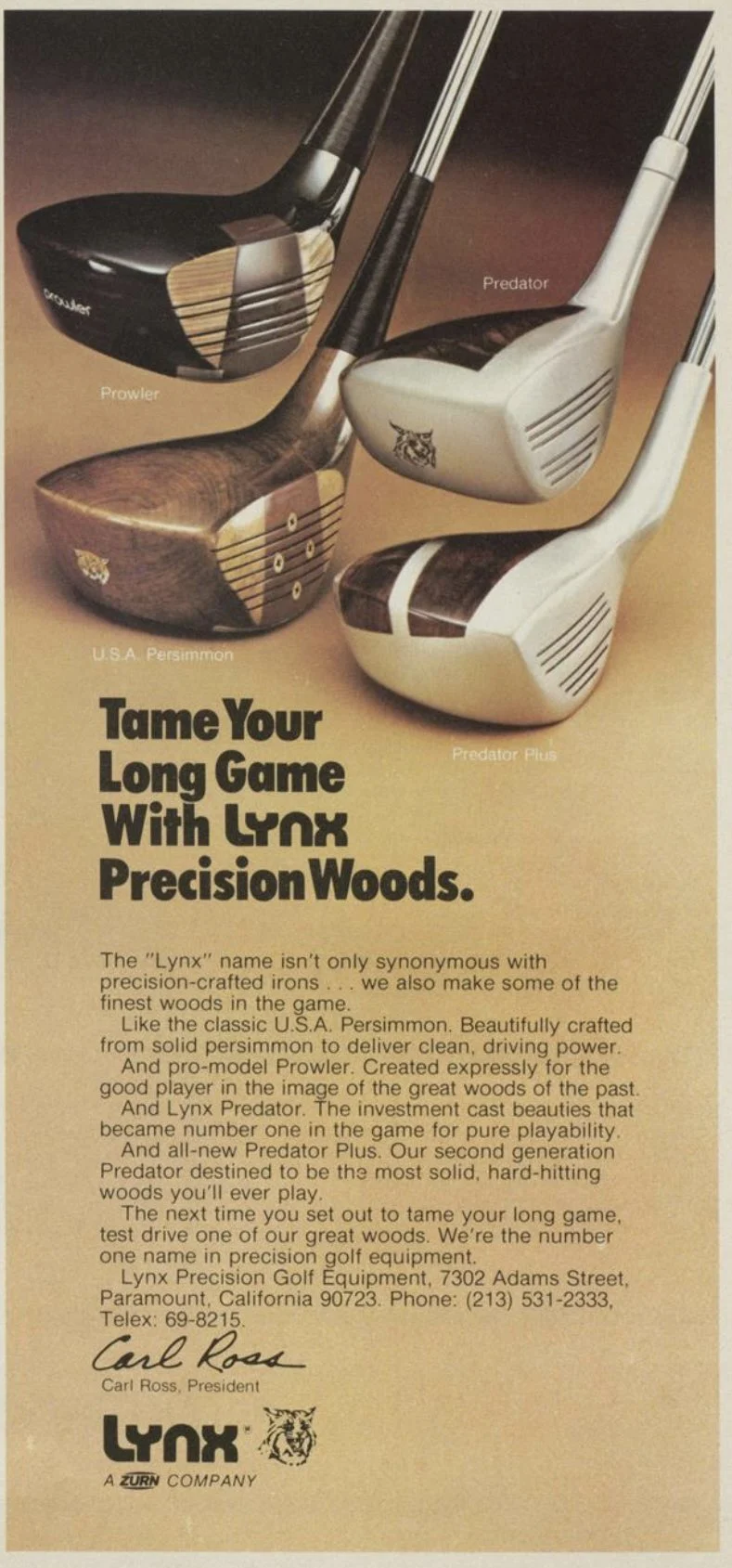
What were Lynx Predator woods and why were they a big deal?
The Lynx page is a little time capsule of a manufacturer trying to make metal feel inevitable without insulting the wood it was replacing. It shows four heads: the Prowler, U.S.A. Persimmon, Predator and Predator Plus.
The Predator was investment-cast stainless steel. The Prowler and U.S.A. Persimmon were still carved from wood. The ad's pitch was not “wood is dead”; it was that a player could choose the head shape and feel that fitted the swing while taking a look at the new metal option.
Lynx listed Carl Ross as president, gave a City of Industry, California address, a phone number and even a telex number. The fine print names the Zurn Company. It is hard to imagine a modern driver ad printing its switchboard details with the same confidence.
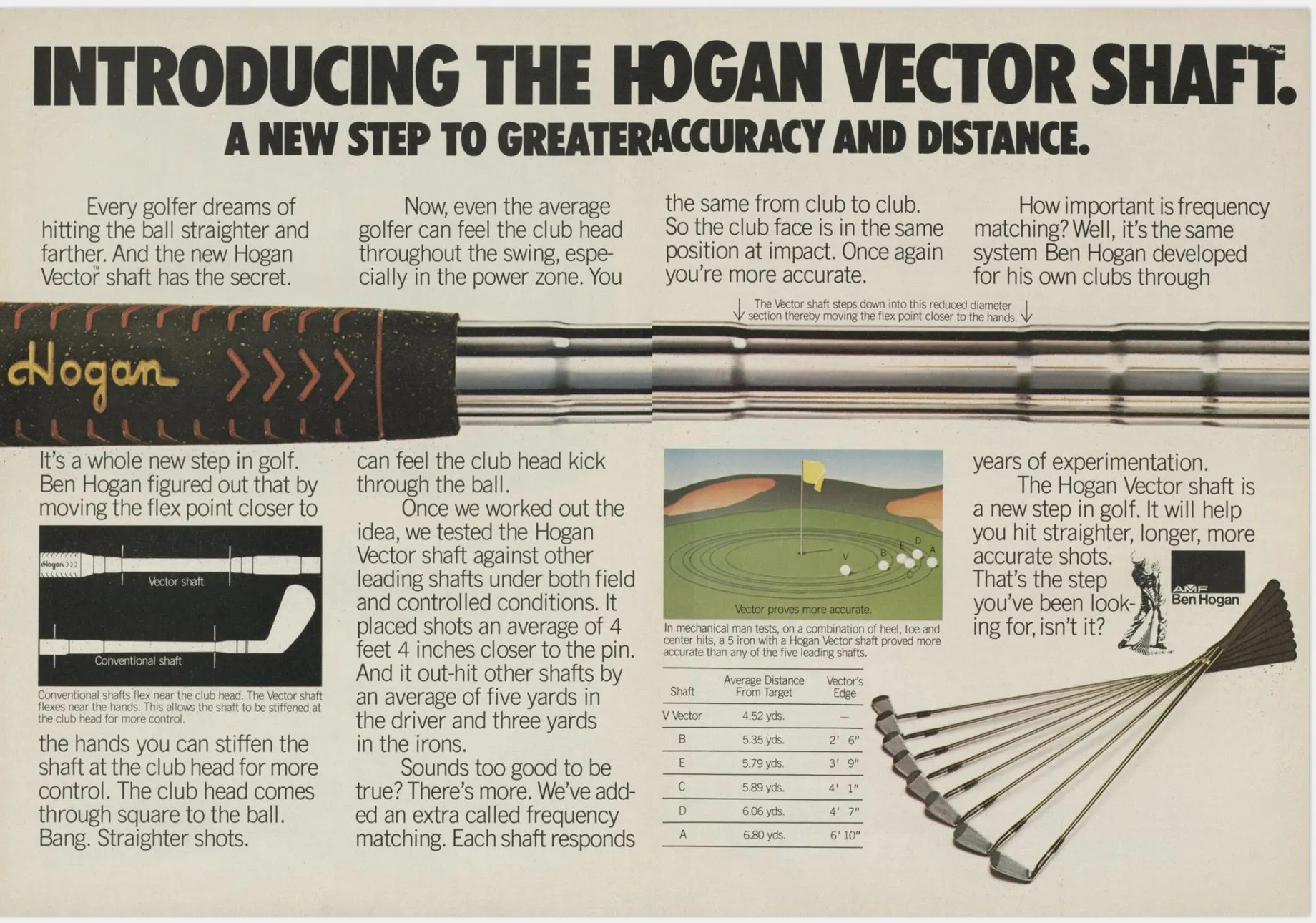
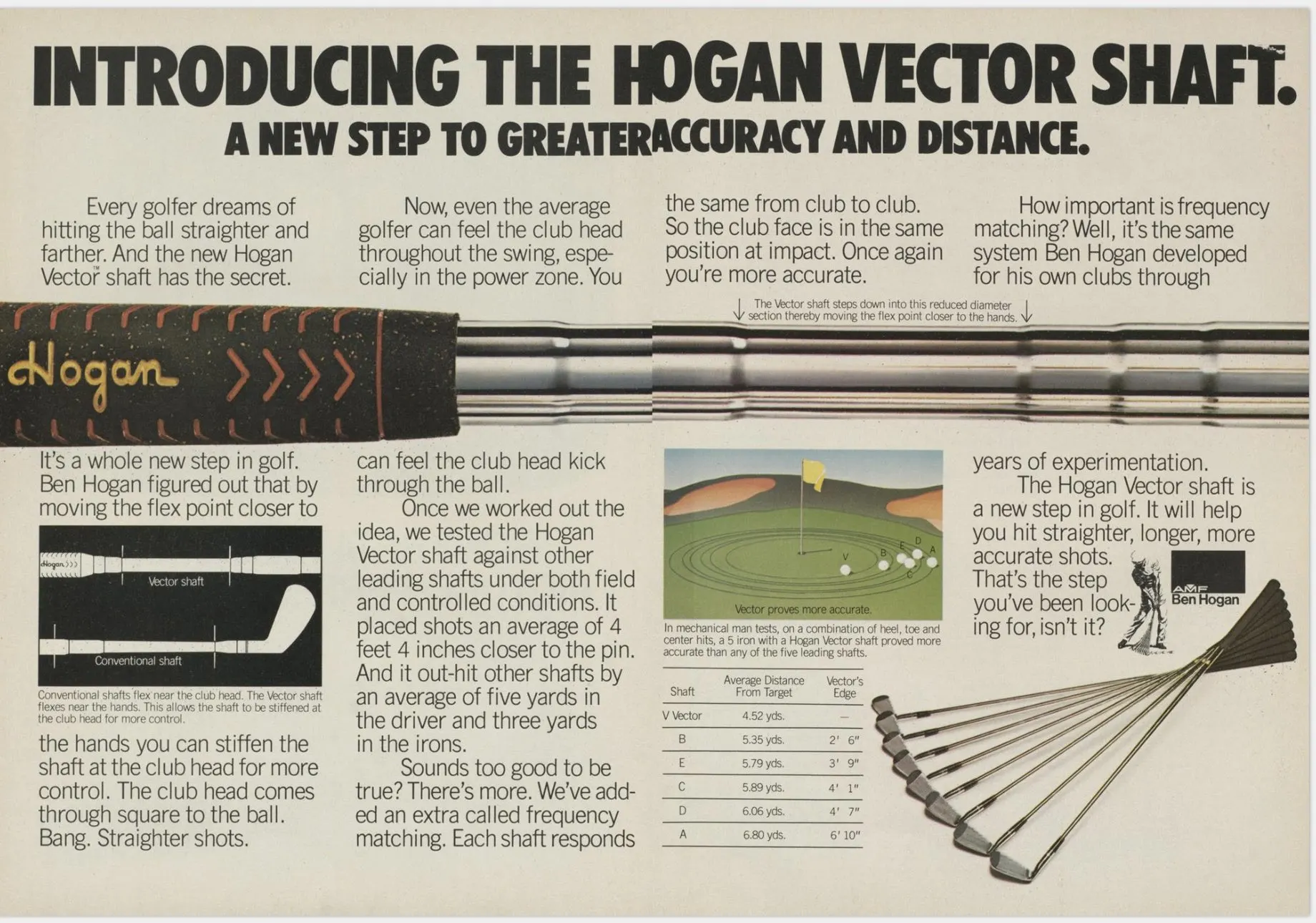
What was the Ben Hogan Vector shaft?
The Vector moved the flex point toward the hands. A stepped-down section made the tip stiffer, which was supposed to give the head more control at impact. The ad did not leave the claim floating in the air; it put a machine test beside it.
| Shaft | Average distance from target |
|---|---|
| Vector | 4.52 yds |
| B | 5.35 yds |
| E | 5.79 yds |
| C | 5.89 yds |
| D | 6.06 yds |
| A | 6.80 yds |
The Vector was 0.83 yards closer than the next shaft — “4 feet 4 inches closer,” in the ad's preferred measurement. That is a tiny number until you are trying to hold a green.
This is also an early example of frequency matching as a selling point. AMF owned Ben Hogan then, so the company could connect the shaft, the club line and the test bench in one piece of copy. The number is impressive; the honest caveat is that it is the manufacturer's machine, not a peer-reviewed field study.
Did Top-Flite really beat Titleist by 12 yards in 1980?
Spalding said it did, and it chose St Andrews as the backdrop. The Top-Flite page splits the ball into two flight families: the original Top-Flite with 336 dimples for a lower flight, and Top-Flite XL with 332 larger dimples for a higher one.
For the lower-flight test, the ad lists Titleist PT at 12.2 yards behind, Hogan Leader at 9.3, Titleist DT at 9.2, Dunlop Blue Max at 8.7, Wilson Pro Staff at 8.2 and Titleist LT at 7.4. For Top-Flite XL's higher flight, Titleist PT sits 14.4 yards back, Dunlop Blue Max 10.9, Titleist LT and Hogan Leader 7.5, Titleist DT 7.4 and Wilson Pro Staff 6.4.
Those were real golfers, according to Spalding, and the company offered to mail the test results. That is more transparent than a modern “longest ball” badge, but it is still a house test. The honest read is that the dimples changed launch and carry; the exact yardage gap belongs to Spalding's protocol.
The ad sells a high road and a low road, Surlyn covers and a sidebar on the old feather ball. It is product science delivered with enough story to make a reader care.
What do these 1980 golf ads tell us about how the game changed?
Metal was arriving, but the old world had not vanished. The Lynx ad puts an investment-cast head next to a persimmon head. The Predator Plus even carries a wood stripe, a visual handshake for players who were not ready to trust a bright steel face.
The language is the bigger change. Companies named rivals, printed the test, and gave you an address. The reader got to decide whether the method was fair. Today's driver launch is faster, cleaner and more precise, but the proof often lives behind a fitting bay's screen.
Here's the 1980 promise: “Here's the club, here's the test, here's the address. Write to us if you don't believe it.” That is a useful standard for any gear claim, especially the ones aimed at amateurs.
Verification block
Confirmed from the scanned issue: the $1.25 cover price, Nicklaus' “How I came back” headline, Lynx's four-head line-up, the Hogan Vector test table and Spalding's two Top-Flite flight lists.
Read with a label: the yardage claims are Spalding's and Hogan's own tests. They show what each company measured, not a neutral comparison of every golfer or ball.
The GolfRaw Take
I'm not going to tell you golf was better in 1980. The balls were rocks, the woods were made of trees, and a stiff-tipped shaft that got you three feet closer to the pin was front-page news.
But flip through these four pages and tell me the sport didn't have a spine. Companies named their rivals in print and showed the test. And the best golfer alive wrote his own comeback story instead of letting a publicist do it.
We'd take a little of that back. Keep the modern driver. Bring back the honesty.
Frequently Asked Questions
How much did Golf Digest cost in 1980?
$1.25 for the September 1980 issue, roughly five dollars in today's money. The cover claimed one million circulation, the largest of any golf publication at the time.
What did Jack Nicklaus come back from in 1980?
A winless 1979 season, the first of his pro career. In 1980, at age 40, he won both the U.S. Open at Baltusrol and the PGA Championship at Oak Hill. The Golf Digest cover story "How I came back" ran right after the PGA win.
Were Lynx Predator woods made of metal?
Yes. The original Lynx Predator was an investment-cast stainless steel wood, and the 1980 ad also introduced the second-generation Predator Plus. Lynx sold them alongside its persimmon Prowler and U.S.A. Persimmon models at the time.
What was special about the Hogan Vector shaft?
It moved the flex point closer to the hands using a stepped-down section in the shaft, which let Hogan stiffen the tip for more control at impact. AMF Ben Hogan's own machine test showed a 5-iron with the Vector landing an average of 4.52 yards from target versus 5.35 to 6.80 yards for five competing shafts.
What was the difference between Top-Flite and Top-Flite XL in 1980?
The original Top-Flite had 336 standard dimples and flew lower. The XL had 332 larger dimples for a higher flight and more carry. Spalding claimed both outdistanced Titleist, Wilson, Dunlop and Hogan balls by 6 to 14 yards in their own tests.
Sources
- Golf Digest, September 1980 issue: cover, circulation and Nicklaus feature.
- AMF Ben Hogan Vector shaft advertisement, September 1980 Golf Digest: machine accuracy table and shaft construction.
- Lynx Precision Woods advertisement, September 1980 Golf Digest: Prowler, U.S.A. Persimmon, Predator and Predator Plus specifications.
- Spalding Top-Flite advertisement, September 1980 Golf Digest: 336/332-dimple flight tests and competitor yardages.
- USGA historical equipment resources: background on the persimmon-to-metal transition and conforming club rules.
- GolfRaw Vintage Golf History: the archive for old equipment, magazines and the game's changing language.
- GolfRaw search: find the related equipment and tournament reporting.
How we reported this. GolfRaw Editorial transcribed the visible copy and tables from the supplied September 1980 pages. Company test results stay attributed to the company.
Author. GolfRaw Editorial is GolfRaw's golf news and verification desk.
Corrections. None at publication. Corrections policy.
Last updated. .