
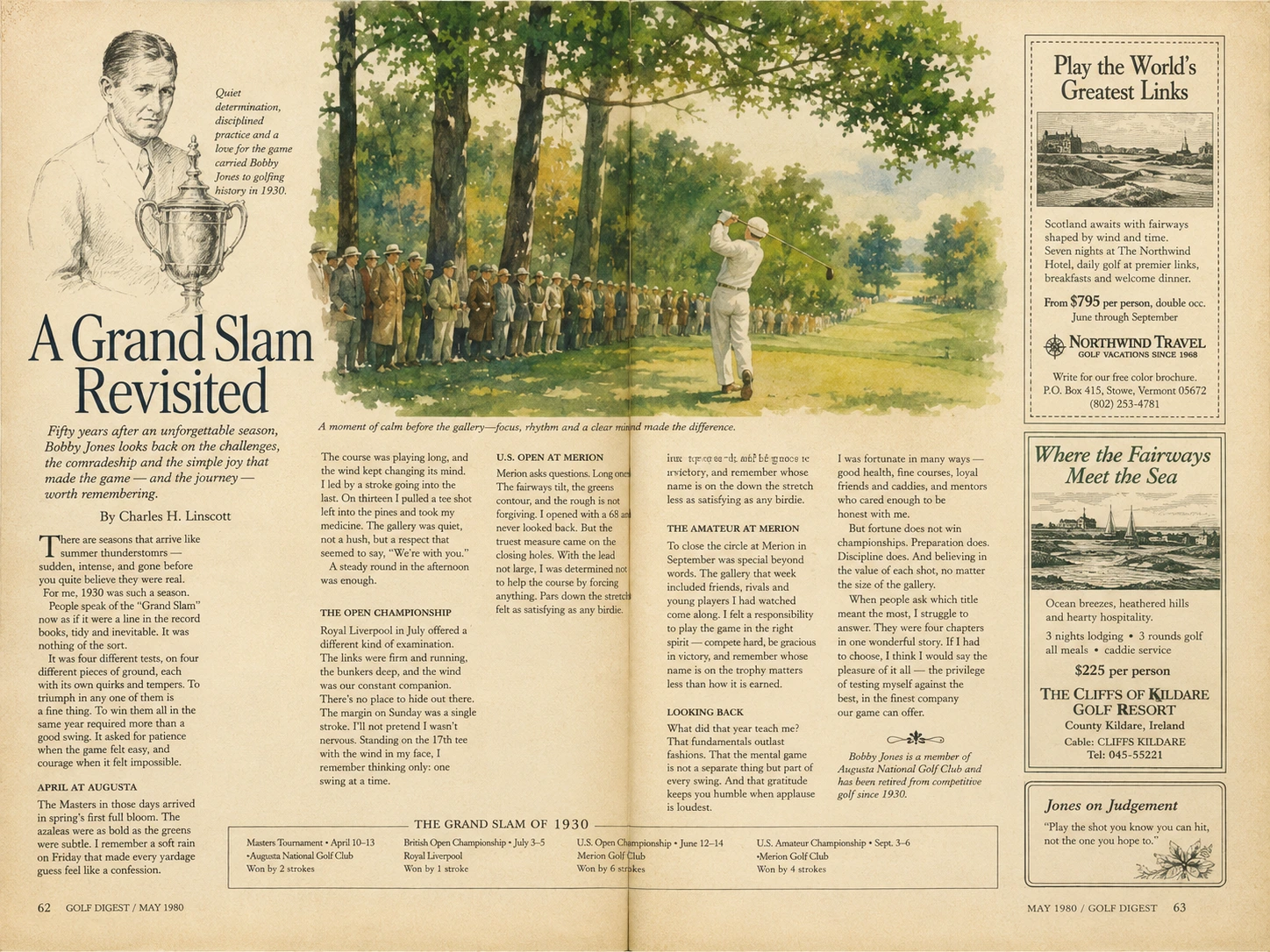
You know the legend. Bobby Jones, amateur, 28 years old, wins all four of golf's biggest events in one summer, walks off the 11th green at Merion and never plays another championship. Nobody's done it since. Fine. Now here's the number nobody puts on the plaque: in the two Opens that made up half that Grand Slam, Jones had the lowest score of the field in exactly one of the eight rounds he played. One. And he won each of them by two strokes.
I've had a September 1980 Golf Digest on my desk for a week. Fifty years after 1930, the magazine reprinted a chunk of Jones' own book, "Golf Is My Game," about the last leg at Merion. It's the least heroic account of the Grand Slam I've ever read, and that's why it's the best one.
What that answer hides is how close it came to not happening, and I don't mean on the golf course. Jones wrote that between July and September of 1930 he had the two nearest brushes with death of his entire life. Both of them are in this magazine. Keep reading and I'll get you there.
Built on: the Bobby Jones excerpt in Golf Digest, September 1980 (from "Golf Is My Game," Doubleday, 1959/1960), USGA Museum records of the 1930 U.S. Amateur, ESPN Classic and Philadelphia Inquirer archive reporting, LPGA and World Golf Hall of Fame records for the ad references.
Why did Bobby Jones think the U.S. Amateur would be the easy one?
Because on paper it was, and he says so without embarrassment.
Jones writes that he'd long considered the American Amateur the easiest of what he called the Big Four. His logic was cold. The draw was semi-seeded, so he wasn't likely to run into a top amateur in the first two 18-hole rounds, and after that every match went 36 holes, where a better player almost always wins. In his mind the hard part was turning up at Merion healthy and in shape. Then the summer tried to kill him.
I want to sit on that for a second, because it's the kind of honesty you don't get from champions now. He's not saying the Amateur was easy. He's saying he thought it would be, and then telling you how wrong he was.
What happened to Bobby Jones at East Lake in the summer of 1930?
Lightning. Twice, and then a chimney.
One afternoon at East Lake in Atlanta, Jones and his group crossed between nines with a thunderstorm building to the southwest. They debated waiting it out and decided to play on. Coming down the 12th, a bolt hit the middle of the 10th fairway, he estimated, about 40 yards from where they stood. He felt the tingle through his spikes. Jones had played through plenty of Georgia storms and wrote that they'd long since stopped scaring him. This one did. They ran for the clubhouse.
A second bolt hit a small tree behind the 13th tee, on the far side, exactly where they'd have been a minute earlier. Then, as they crossed the driveway to the locker room door, a third strike blew apart a big double chimney above their heads. Jones felt nothing at the time except his umbrella collapsing around his head. Inside, somebody noticed the back of his shirt was ripped down to the waist and he had a scratch about six inches long on his shoulder, deep enough to draw blood. Afterward they found the spot littered with brick and mortar, any piece of which could have killed a man, and chimney fragments as far as the 18th green. He paced it off. More than 300 feet.
That's brush with death number one. The Grand Slam holder, three legs in the bag, standing in a brick storm in a torn shirt.
The runaway car outside the Atlanta Athletic Club
A few weeks later Jones walked from his law office to a lunch at the Town House of the Atlanta Athletic Club, seven or eight blocks. He turned off Cone Street onto Carnegie Way. Empty sidewalk. He was, by his own account, somewhere else in his head. Then a voice behind him yelled a warning.
He turned and saw a car mounting the curb, coming straight at him. Jones made a jump he compared to Jesse Owens and the car slammed into the clubhouse wall, passing right over the spot he'd just left. There was nobody in it. It had been parked carelessly about a block and a half up the hill and rolled.
Two things in that story get me. First, "Look out, Mister" is the only reason there's a Grand Slam. Second, Jones writes that after this he started to understand that missed putts might not be the biggest threat to finishing the job. He began wondering what else could go wrong and how he might protect himself. That's the mindset he carried into Merion. Not confidence. Something closer to caution.
How did Bobby Jones actually play at Merion in September 1930?
Uneven, and he's the one saying it.
He loved Merion. He'd played his first U.S. Amateur there in 1916 as a 14-year-old and won his first one there in 1924. The USGA's own account of the 1930 championship confirms both dates. He wrote that he was hitting the ball with freedom and power in practice and scoring well. Yet all week he felt a vague unease, and for the first time in his life he had trouble sleeping.
His first-round opponent was Ross "Sandy" Somerville, the Canadian champion, who Jones rated as possibly the least appreciated amateur in the world at that time. On the way to the first tee, Jess Sweetser asked who he'd drawn. Jones told him. Sweetser's reaction was roughly what yours would be if you drew the best player in the field in round one.
Jones beat Somerville 5 and 4 in the morning. He beat Fred Hoblitzel, another Canadian, by the same score in the afternoon. Here's the detail that matters for anyone who's ever had a great front nine followed by a disaster: Jones played the first nine in 33 in the morning, four under. In the afternoon he played the first nine in 42, five over. Same day. Same winning margin. He called that pattern typical of his whole tournament, very good golf mixed with very bad golf, day after day.
The USGA Museum's summary of that week backs up the shape of it. Jones took the qualifying medal, won both 18-hole matches 5 and 4, then won 6 and 5 in the quarters, 9 and 8 over Sweetser in the semis, and 8 and 7 over Homans in the final. Convincing scores. Jones' own verdict is that he should have closed every match sooner than he did, and that he'd build a lead, slip into something worse than mediocrity, then find his game again only when things got close.
What did Bobby Jones feel when the Grand Slam was over?
Relief. Not joy. Relief.
When Gene Homans stroked his final putt on the 11th green that Saturday afternoon, he came toward Jones with his hand out before the ball had even stopped rolling. Jones writes that what hit him was a release from tension he'd been carrying for a very long time. He wasn't sure what had happened. He only knew he'd finished something strenuous and that on this particular project there could never be anything else to do.
And then the question, from everyone: what now? Would he keep playing or retire?
He says he told them the truth, which was that he didn't know. He'd started playing tournaments for fun and kept going because he enjoyed it. Once he began winning, he felt a duty attached to competitive golf, an expectation every year that he'd be back beating his brains out trying to win the Open or the Amateur. What he wanted was to settle down to law practice and be free of any obligation, express or implied, to play. Standing at Merion, he let himself be quoted saying he expected to keep playing golf, but when and where he couldn't say. The Inquirer's archive account of that day records the same line at the trophy presentation.
He retired from championship golf that November. He was 28.
Bobby Jones on form, luck and the "give-up" shot
The last column of the excerpt is where Jones stops telling stories and starts teaching, and it's the part I'd hand to any golfer who thinks the greats had it figured out.
Jones wrote that form in golf runs in cycles, and you can see it in any week's tournament results. A player gets hot for two or three weeks, running on a formula built around two or three swing thoughts he can control. Then he leans on one of them too hard, something else breaks, and he has to find a new pattern. Jones says the only 1930 tournament where he hit top form was one in Augusta that didn't even count toward the Slam. The four that counted ran from May to September, and he never expected to be good the whole way.
His honest scorecard on the Opens: in the British and American Opens he returned the lowest score of the field in only one of the eight rounds. His winning margin in each was two strokes. In at least two of his matches, with Tolley and Voigt at St Andrews, he wrote that he'd been outplayed throughout. In the final round of both Opens he made what he called mistakes of grievous proportions. He won, in his own words, because when he got into those dire spots he kept driving himself to the finish instead of playing the "give-up" shot, at moments when giving up would have been easy and even pleasant.
Read that again next time you're three over through four holes at your muni and thinking about mailing in the back nine. The greatest amateur who ever lived was three over through nine at Merion with the Grand Slam on the line, and he kept going.
What the ads next to Bobby Jones tell you about golf in 1980
A stat lead, because it's a good one: $76.50.
That's what the Sheraton Palm Coast Resort Inn charged per person, double occupancy, for the Nancy Lopez Golf Package in September 1980. Three days, two nights, two days of unlimited golf, a free cart both days and boat transport from the oceanfront hotel to the course. Single occupancy was $115. Lopez, smiling in a Palm Coast visor, says she may play Pebble Beach but she lives on the fairway in Palm Coast, Florida.
Context on why they put her face on it: by the LPGA's own record, Lopez won nine times in 1978 including five in a row, and took Rookie of the Year, Player of the Year and the Vare Trophy in the same season, which nobody had done before. She won eight more in 1979. In 1980, the year of this ad, she was the biggest name in women's golf and the only one a resort would build a package around.
Below it, Norwegian American Cruises and TravelStar sold "Golf at Sea." A 14-night Caribbean cruise leaving December 6 aboard the Vistafjord, with instruction from Doug Ford, who'd won the 1955 PGA Championship and the 1957 Masters, plus a teaching pro and a video-taped swing analysis. Price: $1,550 to $3,100 per person, double occupancy. You could also play 18 at any of four island courses.
And on the last page, Fripp Island in South Carolina, with a husband kissing his wife on the cheek and a headline about scoring extra points on vacation. Three and a half miles of beach, 14 tennis courts, three 18-hole courses. The copy's closing line, that nobody can play golf all the time, not even you, is better than anything most resorts write today.
I'm not going to convert every number into 2026 dollars because inflation math on a 46-year-old ad is guesswork. Roughly, multiply by four. A $76.50 golf weekend becomes about $300. Still cheap.
Three myths about the Bobby Jones Grand Slam that Jones himself contradicted
- He dominated 1930 from start to finish. He didn't, and he's blunt about it. Lowest round of the field once in eight Open rounds. Two-stroke margins in both. Outplayed in two matches at St Andrews. Jones wrote that he could only have won because he kept an organized effort going through some disastrous lapses. Most "greatest season ever" articles skip that entirely.
- He retired because there was nothing left to win. Partly. But the excerpt says the real reason was obligation. He'd come to feel that winning meant everyone expected him back every year, and he wanted to practice law and play golf when he felt like it. The "he conquered everything and walked away" version is cleaner. It isn't what he said.
- The Amateur was the easy leg. Jones thought so too, before the summer. The scores at Merion look easy. Read the page and you get a man who couldn't sleep, shot 42 on a nine the same afternoon he shot 33, and had spent August thinking about how to avoid being killed by things that had nothing to do with golf.
Frequently Asked Questions
What four tournaments made up the Bobby Jones Grand Slam?
The British Amateur at St Andrews, the Open Championship at Hoylake, the U.S. Open at Interlachen and the U.S. Amateur at Merion, all in 1930. Jones called them the Big Four. The modern professional Grand Slam swapped the two amateur events for the Masters and the PGA Championship, which is why the feat can't be repeated in the same form.
Who did Bobby Jones beat to complete the Grand Slam?
Eugene Homans of New Jersey, 8 and 7, in the 36-hole final of the 1930 U.S. Amateur at Merion on September 27, 1930. Homans conceded a short putt on the 11th green, the 29th hole of the match. USGA records put the gallery that week at around 18,000.
How old was Bobby Jones when he won the Grand Slam?
He was 28. Jones was born in Atlanta on March 17, 1902, remained an amateur throughout his career and practiced law. He retired from championship golf in November 1930, weeks after Merion, then went on to co-found Augusta National and the Masters.
Did Bobby Jones almost die before the 1930 U.S. Amateur?
Twice, by his own account. Lightning destroyed a chimney above his head at East Lake, cutting his shoulder and ripping his shirt. Weeks later a driverless car rolled onto a sidewalk in Atlanta and hit the clubhouse wall where he'd been standing a second earlier. He wrote that he then started worrying about more than missed putts.
Has anyone matched the Bobby Jones Grand Slam?
No. Tiger Woods held all four professional majors at once across 2000 and 2001, but not in one calendar year, and the events were different. No amateur has come close. Jones' 1930 sweep of two Opens and two Amateurs stands alone, which is why the 1980 Golf Digest called it a feat never duplicated.
The Raw Verdict
We've spent 96 years polishing this story until it shines, and the man at the center of it spent his own pages sanding it back down. Jones didn't want you to think 1930 was a victory lap. He wanted you to know he was tired, scared of lightning, three over through nine, and that he won by refusing to play the shot that would have let him off the hook.
That's the part worth keeping. Not the trophy sketch. The 42 after the 33, and the decision to keep grinding anyway. If a 28-year-old amateur lawyer with the whole world watching couldn't put four good rounds together in a row, you can stop beating yourself up about your Saturday.
Sources
- Golf Digest, September 1980 excerpt from Golf Is My Game.
- USGA Museum: 1930 U.S. Amateur records.
- ESPN Classic and Philadelphia Inquirer archive reporting.
- LPGA and World Golf Hall of Fame records.
- GolfRaw Vintage Golf History: archive context and related reporting.
How we reported this. GolfRaw keeps Jones' own account at the center, checks the Merion match record against USGA material, and labels the 1980 advertising prices as historical context rather than a modern comparison.
Author. GolfRaw is GolfRaw's editorial desk.
Corrections. None at publication. Corrections policy.
Last updated. .