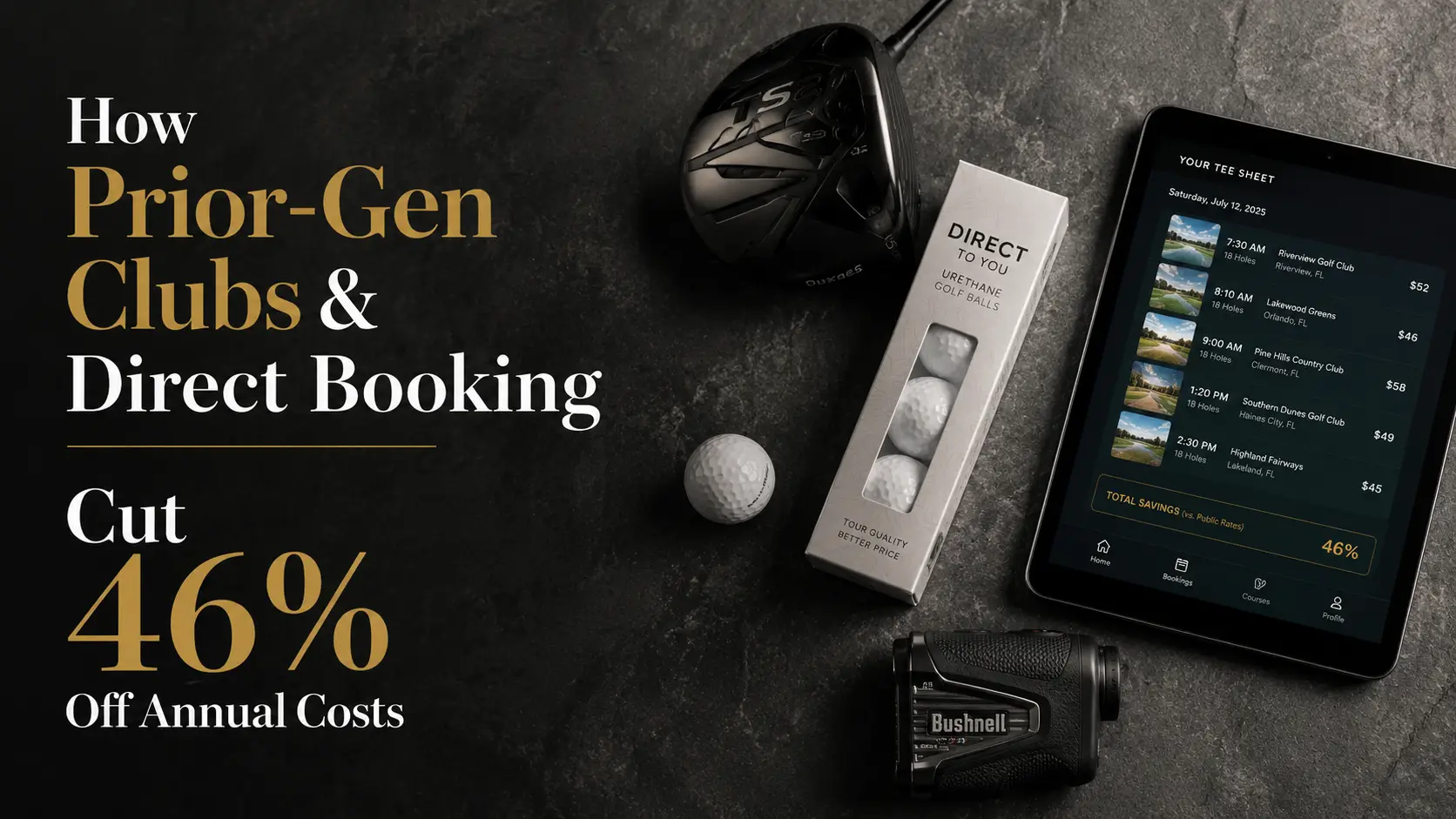
Every spring, the golf industry conducts an identical marketing ritual: $650 drivers promising an extra 4.2 yards, tour-branded golf balls priced at $4.75 apiece, and automated booking engines jacking up green fees with surge algorithms.
If you purchase new flagship clubs every twelve months, lose two dozen premium retail golf balls a season, and tee off exclusively at 9:00 AM on Saturday mornings, the modern game will quietly extract over $4,600 from your bank account every single year.
The engineering data reveals a very different reality: driver face spring (COR) has been legally capped by the USGA and R&A since 2004, direct-to-consumer urethane balls match tour greenside spin within 120 RPM, and afternoon twilight slots deliver identical fairways at a 40% discount.
The $2,176 Annual Cost Calculation
We modeled the annual spending of an active amateur golfer playing 36 rounds per year, hitting the range bi-weekly, and maintaining their equipment. By switching to counter-cyclical equipment upgrades, tour-spec direct balls, and intelligent tee-time booking, the total annual savings reaches $2,176 without dropping a single stroke of performance.
| Spending Category | Standard Spend | Optimized Spend | Annual Savings |
|---|---|---|---|
| Driver & Wood Cycle (3-Yr vs 1-Yr Cycle) | $650 | $217 | $433 |
| Golf Ball Selection (18 Doz. DTC vs Tour Retail) | $990 | $522 | $468 |
| Greens Fees & Tee Times (36 Rounds: Twilight & Muni) | $2,160 | $1,296 | $864 |
| Apparel, Gloves & Spikes (Pre-Season Bulk Packs) | $340 | $175 | $165 |
| Range & Practice Pass (Off-Peak Punch Bundles) | $550 | $304 | $246 |
| TOTAL ANNUAL EXPENDITURE | $4,690 | $2,514 | $2,176 SAVED |
Pillar 1: Equipment Arbitrage & The Legal COR Ceiling
The fundamental secret of modern golf hardware is the regulatory ceiling. The USGA and R&A establish strict physical constraints on clubhead performance:
- Coefficient of Restitution (COR): Capped at 0.830.
- Characteristic Time (CT): Limited to 239 microseconds (with an 18 µs tolerance).
- Maximum Volume: Fixed at 460 cubic centimeters.
This means club manufacturers cannot legally build a driver that produces faster center-face ball speeds than the models released two or three years ago. What changes annually is perimeter weighting, composite crown cosmetics, and aerodynamic marketing nomenclature.
By consulting our comprehensive guide on driver fitting and hardware upgrades, golfers can purchase previous-generation flagship heads at 40% to 60% discounts and invest a portion of the savings into an aftermarket shaft fitting—yielding superior dispersion compared to an un-fitted current-year $650 retail release.
"A fitted shaft in a two-year-old driver head will beat an off-the-rack $650 current release ten times out of ten on launch monitor dispersion."
Pillar 2: The Ball Formulation Truth (Urethane vs Surlyn)
Golf balls represent the highest recurring consumable cost for the average golfer. Over an active 36-round season, losing 1.5 balls per 18 holes requires roughly 18 dozen balls (including practice and warm-up wear).
Paying $55 per dozen for retail green-box tour balls generates an annual recurring cost of nearly $1,000. However, understanding the core chemical differences between cover materials is the fastest way to slash this bill in half:
- Cast / TPU Urethane: Provides maximum friction against wedge grooves for 7,000+ RPM greenside spin and instant check. Direct-to-consumer suppliers offer tour-grade urethane balls at $29 to $32 per dozen.
- Ionomer / Surlyn: Produces low driver spin and exceptional scuff resistance, making it the ideal choice for high-handicappers seeking straight distance at under $22 per dozen.
Read our in-depth analysis in the golf ball deals and buying guide to discover how matching your ball formulation to your actual clubhead speed eliminates unnecessary retail markup.
Pillar 3: Course Booking Strategy & Twilight Optimization
Green fees account for the largest single share of a golfer's annual budget. Automated dynamic pricing algorithms now penalize golfers who book prime Saturday morning tee times with 30% to 50% surcharges.
Transitioning 18 of your annual rounds to late-afternoon windows yields massive compounding savings. Learn how to capitalize on regional municipal cards and off-peak rate tiers in our deep dive into golf deals data and booking strategies:
- The 3:30 PM Golden Window: Most championship public facilities drop their rates by 40% four hours before sunset, leaving ample daylight to finish 18 holes in the summer.
- Municipal Resident & Loyalty Passes: An upfront $50–$100 municipal card frequently knocks $25 off every subsequent round, breaking even within four weeks.
- Weekday Afternoon Walking Loops: Ditching the mandatory $20 cart fee on flat layouts adds physical conditioning while saving $720 over 36 rounds.
Frequently Asked Questions
How does this guide calculate the $2,176 annual savings?
The $2,176 annual savings model is calculated across five core categories: equipment release cycle arbitrage ($433), direct-to-consumer urethane ball selection ($468), off-peak and twilight tee time booking ($864), bulk essential accessories ($165), and range package passes ($246).
Does playing previous-generation drivers compromise ball speed or distance?
No. Due to the USGA and R&A limits on Characteristic Time (CT 239µs + 18µs tolerance) and COR (0.830), modern driver heads have hit maximum legal spring-effect. Differences between current and prior-year releases are predominantly cosmetic and CG tuning, making proper shaft fitting significantly more impactful than new head models.
Are direct-to-consumer urethane golf balls as good as tour-branded balls?
Independent robot testing verifies that cast and TPU urethane golf balls from reputable direct-to-consumer manufacturers produce virtually identical launch angles, spin rates on wedge shots, and green-holding stopping power compared to $55+/dozen tour retail models at nearly half the price.
How can golfers maximize savings on greens fees without playing bad courses?
Leveraging seasonal twilight rates, municipal player cards, mid-day shoulder slots, and weekday 9-hole loops yields 30-50% discounts on top-tier championship layouts without sacrificing course conditions.
When is the best time of year to buy golf equipment on clearance?
Late summer and early autumn (August to November) represent the prime clearance window as major manufacturers prepare for January PGA Merchandise Show announcements, resulting in 30% to 50% price cuts on active inventory.
The Raw Take
Golf is as expensive as you allow the marketing machine to make it. If you believe every commercial claiming a 5-yard breakthrough each January, you will spend thousands of dollars chasing marginal gains that physics cannot deliver.
Keep your driver for three seasons and fit the shaft. Play direct-to-consumer urethane balls that stop on a dime. Walk your local layout when the sun starts dipping on a Thursday afternoon.
Take the $2,176 you saved and spend it on the only thing that actually lowers your handicap: playing more golf.