You search for golf swing drills and get a hundred of them. Towel drills, alignment sticks, weird arm twists, drills with names you forget by lunch. You try ten at once, none of them stick, and your swing feels worse than when you started. Sound familiar?
Here is the honest version. Most golf swing drills work fine. The problem is you do too many, too fast, with no plan. A drill only helps if you do it slowly, on purpose, and stick with it long enough to feel the change.
This is raw golf. A short list of drills that actually fix things, why they work, and how to use them without wasting your time.
What Makes a Golf Swing Drill Actually Work
A drill is not magic. It is just a way to teach your body one feeling until that feeling becomes normal.
That means three things matter more than the drill itself:
- You do it slow. Fast reps teach you nothing. Slow reps build the feel.
- You do one at a time. Five drills at once cancel each other out.
- You repeat it. A feeling needs hundreds of reps to stick, not ten.
So drop the dream that one drill fixes your swing in a session. Real change is slow and a little boring. The good news is that the slow path works, and these golf swing drills give you the right feelings to build on. You do not need a coach or fancy gear for any of these. A club, a towel, and a small space will do.
Golf Swing Drills for Tempo and Rhythm
Most amateurs swing too fast. You rush the top, throw the club, and lose all control. Good golf swing tempo fixes more bad shots than any swing position, so start here.
The pause drill
Swing to the top, hold for one full second, then swing down smooth. The pause kills your rush from the top. It feels slow and strange at first. It works.
The count drill
Count "one" as you swing back and "two" as you swing through. Keep the count even and steady. A smooth rhythm beats a fast one every time. Smooth is not slow. Smooth is in control.
The feet-together drill
Hit small shots with your feet almost touching. You cannot swing hard or you fall over, so this forces balance and a calm tempo. Do ten of these when your swing feels wild and it settles down fast.
Spend a few sessions on tempo alone. A good rhythm makes every other part of your swing easier.
Golf Swing Drills for Sequence and Lag
Here is a simple truth. A good swing moves in the right order. Your lower body starts the downswing, then your chest, then your arms, then the club. A bad swing flips that order, with the arms and club going first. Fixing your golf swing sequence is the next big win after tempo.
The step drill
Start with your feet together. As you swing down, step your lead foot toward the target, then hit. This forces your lower body to lead and your arms to follow. When the lower body starts the move, the club stops getting thrown out early.
The pump drill for lag
From the top, pump the club halfway down two times, slowly, feeling your hands stay ahead of the club head. Then hit on the third move. This builds golf swing lag, which just means the club head trails your hands instead of racing past them. More lag means more speed at the ball, not at the top.
The pause-at-the-top drill, again
Notice the pause drill shows up twice? That is on purpose. A calm change of direction fixes both tempo and sequence at once. If you only ever do one drill, do this one.
Golf Swing Drills for a Straighter Ball
If you slice or pull, your club comes down on the wrong path, from outside the ball and across it. These drills pull your path back toward neutral so you can build a correct golf swing shape.
The headcover drill
Set a headcover or a small towel a few inches outside and behind your ball. Hit shots without clipping it. If your club comes over the top, you hit the headcover. If you drop it in, you miss it clean. Instant honest feedback on every swing.
The right-field drill
Picture a baseball field. Most slicers swing toward third base, left and across. Try to swing the club head out toward right field instead, more toward first base. Flip that if you are left-handed. You will not swing as far right as it feels, but the new feel pulls your path straight.
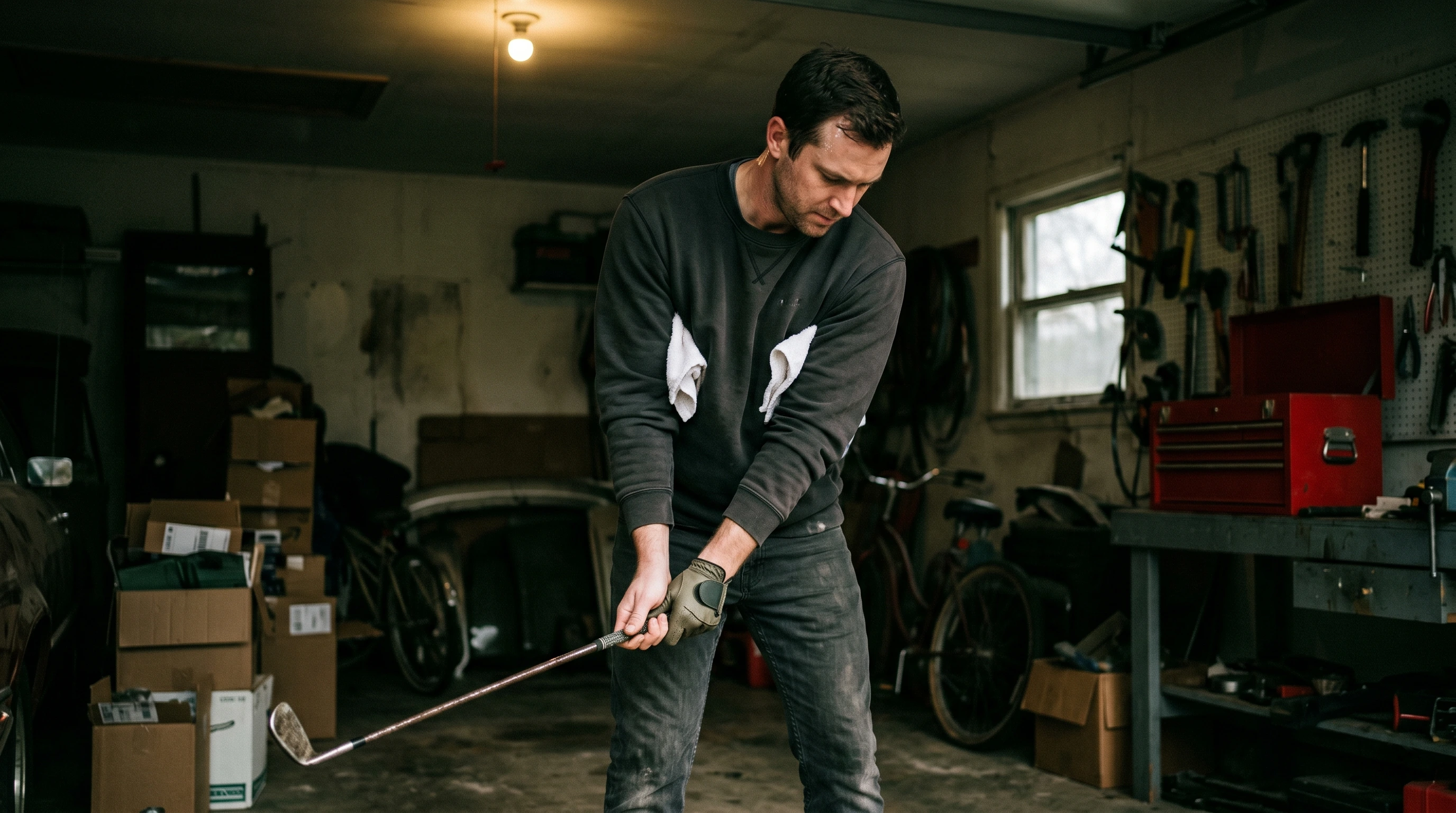
The towel-under-arms drill
Tuck a small towel under both armpits and make slow half swings without dropping it. This keeps your arms connected to your body so they stop flying out and over. Drop the towel and you know your arms got loose.
How to Practice These Drills Without Wasting Balls
You learn faster when you slow down and watch. Most people do the opposite at the range.
- Pick one drill per session. Write it on your phone. Read it between shots. One job at a time is how change sticks.
- Hit one ball, then watch. Where did it start? Which way did it curve? Each ball is a lesson, so do not rake through 50 in a blur.
- Do slow reps with no ball. Half your drill time should have no ball at all. No ball means no pressure to hit it, so you can focus on the feel.
- Film one swing a session. Lean your phone on your bag, film from behind down the target line, and watch it once. Your eyes will tell you the truth fast.
- Go slow on purpose. A smooth half-speed drill with the right feel beats a full-speed swing with the wrong one every time.
What This Looks Like in Real Life
Let me make it concrete.
Your practice session: You get one free hour. You pick the pause drill and nothing else. You do twenty slow swings with no ball, feeling the stop at the top. Then you hit 30 balls, one at a time, keeping that same pause. You leave having worked one feeling deeply. You learned more than the guy next to you who tried six drills and beat 150 balls with no plan.
Your swing on the course: You feel the old urge to rush and smash it. You catch yourself. You think one thought, "pause at the top," from your drill. You make an easy swing. The ball flies straighter than usual. Not perfect. In play. You walk on.
Your bad shot: You yank one because you got fast again. Old you would have grabbed five new drills and made it worse. New you says, "too quick at the top, back to my pause," and you reset on the next swing.
Sharing it online: You post the swing where the drill paid off and the one where it did not. You write what really happened. People trust that far more than a fake highlight reel, because they grind through the same drills you do. A raw golf feed that shows the work, not just the wins, means something a perfect one never will.
"You do not owe anyone a perfect swing. You owe yourself a few good drills and the patience to repeat them."
Your One Small Step
Here is the truth about golf swing drills. They work, but only if you stick with them. A drill you do once does nothing. A drill you do for a month changes your swing. No single drill in this article fixes everything overnight, and any video that promises that is selling you something.
What these drills give you is a short, honest list that actually builds a better swing over time.
So try one small step in your next session. Pick the pause drill. Do twenty slow swings with no ball, holding the top for one full second each time. Feel your rush disappear. That one feeling is the start of a better swing.
Do that, and you have already started using golf swing drills the raw way.