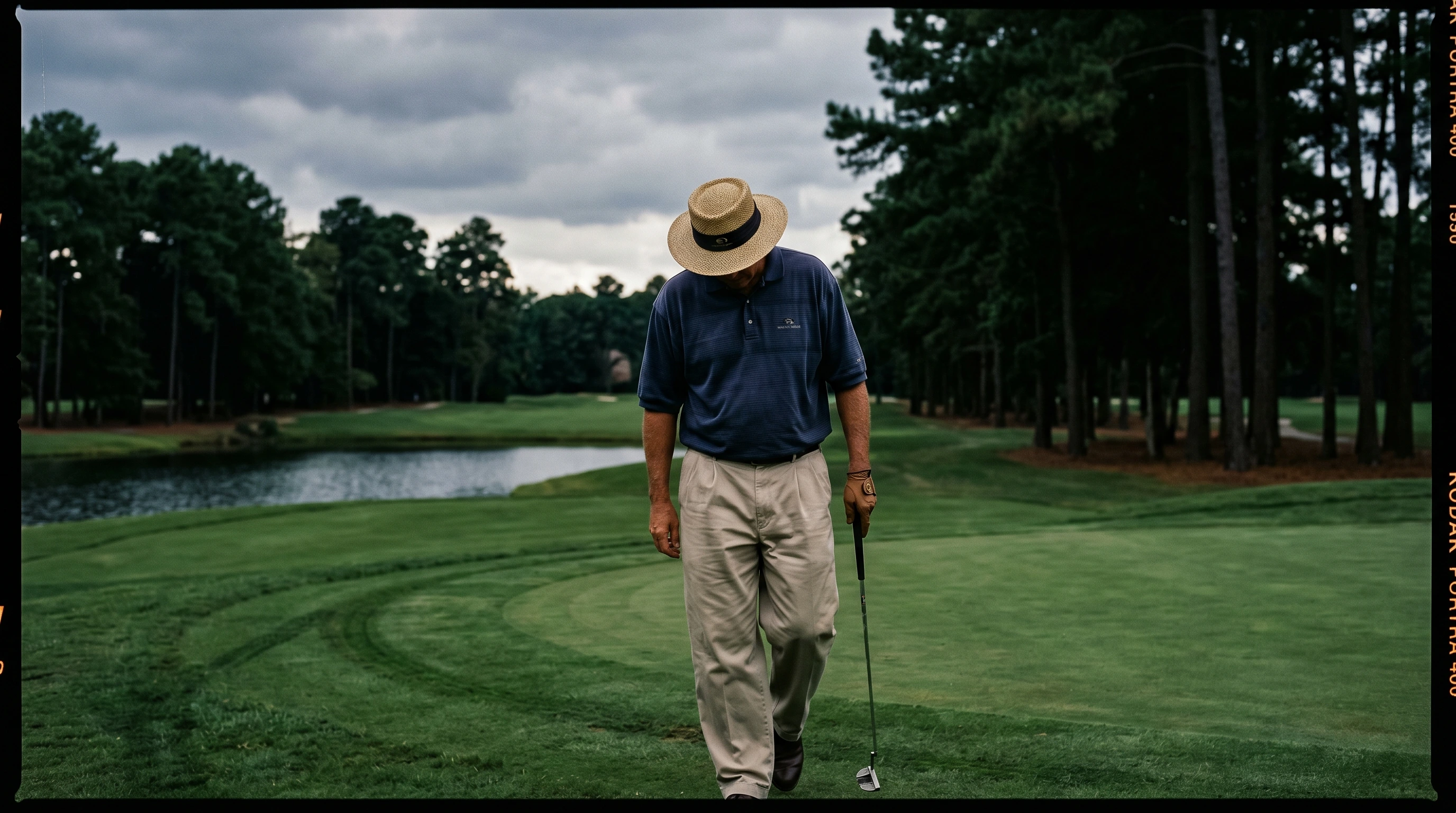
On the Saturday night before the final round of the 1996 Masters, a veteran golf writer ran into Greg Norman and told him, in blunter words than we will use here, that not even he could mess this up now. Norman led by six. The green jacket he had chased his whole life looked, finally, like his.
By Sunday evening he had lost it by five. This is the story of how a six-shot lead turned into the most famous collapse in golf, and what it still teaches us about the game.
The Setup: A Lead That Looked Safe
Greg Norman was the best front-runner in golf and its unluckiest closer, all at once. He spent 331 weeks as world number one. He won two Open Championships. But the majors had a habit of breaking his heart, often through no fault of his own, and the Masters had hurt him the most. He finished second at Augusta in 1986. In 1987 he watched Larry Mize chip in from off the green to beat him in a playoff. The green jacket kept slipping away.
In 1996 it looked different. Norman opened the tournament with a 63, tying the lowest round ever shot in a major at the time. He followed with a 69 and a 71. Round by round his lead grew, from two, to four, to six. He started Sunday at 13 under par. His nearest rival, Nick Faldo, sat six back at 7 under.
Faldo was the opposite kind of player. Cold, precise, relentless. He had beaten Norman head to head before, at the 1990 Open at St Andrews, when the two started the day tied and Faldo simply ground him into the turf. The two were paired together again now, walking off the first tee on Sunday with the whole golf world expecting a coronation.
A six-shot lead at the Masters is enormous. Norman needed only to play steady, even-par golf to win. That was the plan. It did not survive the back nine.
The Round: Where It Came Apart
The cracks showed early but quietly. Norman bogeyed the first hole, then birdied the second to settle himself. He dropped a shot at the fourth, then another at the ninth. None of it was a disaster on its own. He still led. But Faldo, a few feet away, kept making pars and the odd birdie, never flinching, and the gap that had felt like a canyon started to feel like a ditch.
Then came the stretch that golf has never forgotten, the holes from the ninth green through the twelfth, where a three-shot lead became a two-shot deficit.
Norman bogeyed the tenth. He bogeyed the eleventh. Two holes, two dropped shots, and now the air around him had changed. You could see it in his walk, in the long, fidgety routines over the ball, in a swing that had looked so free on Thursday and now looked tight.
The twelfth at Augusta is a short par 3 over Rae's Creek, one of the most beautiful and cruel holes in golf. Norman pulled his tee shot into the water. Double bogey. In the space of those four holes, Faldo had played nothing but careful pars, and that was enough. The man who started the day six behind now led outright.
Norman did not fold completely. He fought. But Faldo answered everything. At the thirteenth, Faldo struck a long iron to the heart of the green and set up a birdie. At the fifteenth, when Norman made birdie, Faldo matched it to stay two ahead with three holes to play. Every time Norman tried to climb back into the room, Faldo quietly closed the door.
The sixteenth ended it. Another par 3, another shot into the water, another double bogey for Norman. Faldo's lead swelled to four. The contest, such as it was, was over. On the last hole Faldo rolled in a 20-foot birdie putt, almost as an afterthought, and signed for a 67, the best score of the day.
Norman signed for a 78.
The Aftermath: Grace in the Wreckage
The numbers are brutal in their plainness. Faldo finished at 12 under par, 276, five shots clear. Norman finished second at 281. Phil Mickelson, a name that would come to know its own Masters heartbreak, took third.
It was the largest final-round collapse in Masters history. A six-shot 54-hole lead, gone. For Faldo it was a third green jacket and his sixth and final major championship. For Norman it was a third runner-up finish at Augusta, and a wound that defined how the wider world remembered him, fairly or not.
What people remember almost as much as the scorecard is what happened on the eighteenth green. Faldo, the ice-cold champion, walked to Norman and pulled him into a long embrace. He told him he did not know what to say, that he just wanted to give him a hug. It was a moment of real human warmth between two rivals, and it softened an afternoon that had been hard to watch.
Norman faced the press for what felt like forever, answering the same painful question a dozen ways. He did not hide and he did not make excuses. "I screwed up. It was my fault," he said, and he gave Faldo full credit for playing great golf. Whatever the day cost him, he paid it standing up.
Why This One Still Matters
Here is the honest reason this round lives in the vault, and it has nothing to do with mocking a great player.
Golf is hard for everyone. That is the lesson hiding inside the most famous collapse in the sport. Greg Norman was one of the finest ball strikers who ever lived, a man who had hit a million pressure shots, and on the day that mattered most, the game still found him. The lead did not protect him. The talent did not protect him. The course and the pressure did what they do, and they do it to all of us.
You will never play Augusta with a six-shot lead. But you know the feeling. You have stood over a short putt to win your match and felt your hands go to stone. You have watched a good round slip away over three bad holes and been unable to stop it. The scale is different. The thing underneath is the same.
So when the wheels come off your round, remember the 1996 Masters. Not to feel worse, but to feel less alone.
"The best player of his generation shot 78 on a Sunday with the world watching. A bad nine holes does not make you a bad golfer. It makes you a golfer."
And remember the other half of the story too, the part that gets lost under the collapse. Norman lost with grace. He owned his mistakes, credited the man who beat him, and walked off the course with his head up. That is the harder skill, and the one worth stealing. You will lose rounds. You will blow leads. How you carry it afterward is the part that is actually in your control.
The six shots got away. The way he handled losing them is why we still tell the story.