
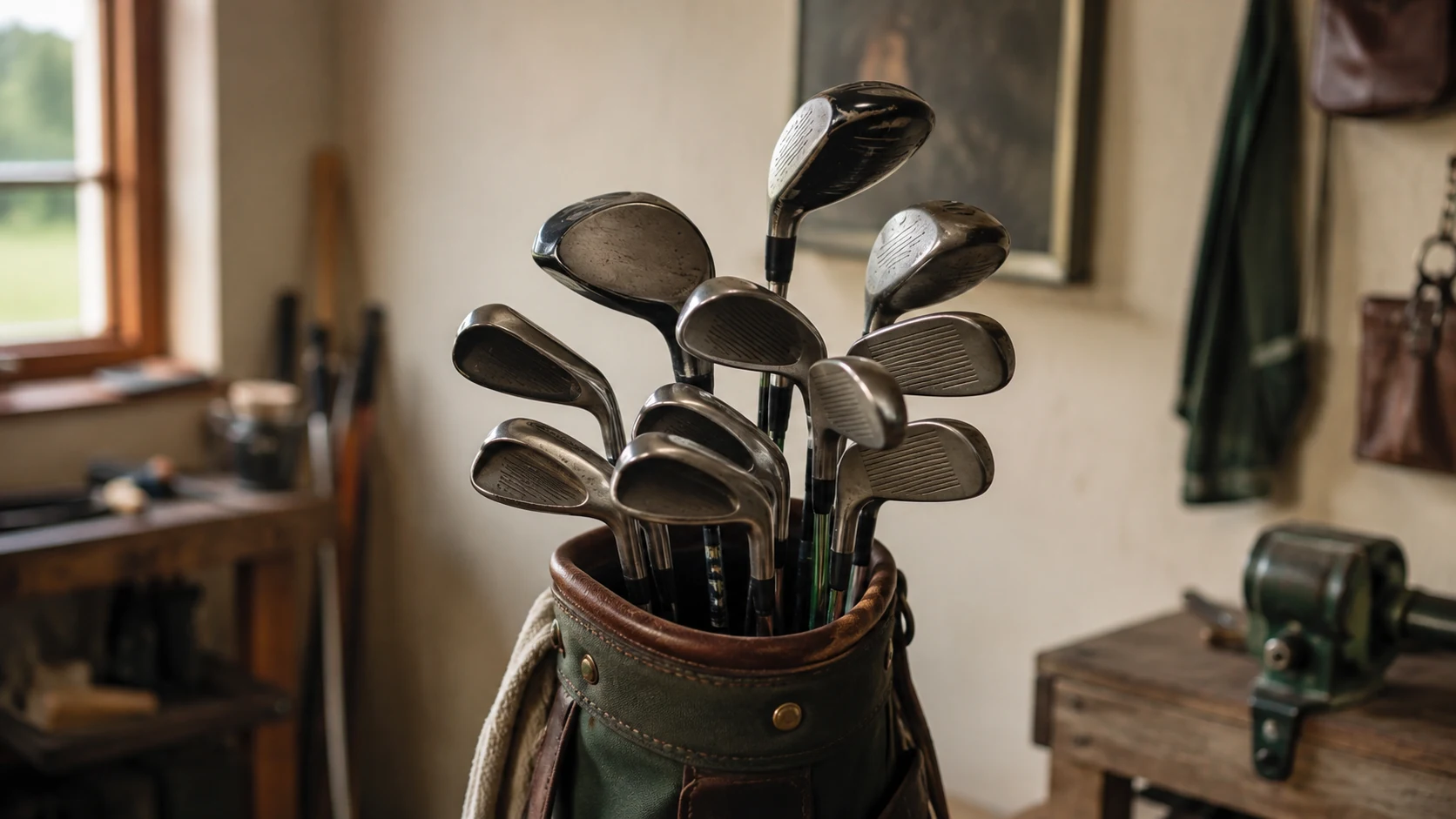
Here's the short version. Putters and irons can last decades. Drivers and fairway woods don't lose distance from age, though a modern head will save you more on mishits. Wedge grooves start losing spin after roughly 75 rounds, and grips go slick after about 40 rounds or a year. Those two are the only parts of your bag with an expiration date.
The rest of this guide shows you the evidence, including what nine Golf Monthly equipment writers, who get handed new clubs every season, still refuse to take out of their bags.
How long do golf clubs last? The short answer by club type
| Club | What actually wears | Typical honest lifespan | What to watch |
|---|---|---|---|
| Putter | Grip, face insert on some models | Indefinite | Grip feel, loose head |
| Irons | Grooves (slowly), grips, lofts drift | 10+ years for most amateurs | Grooves on the 8-iron through PW, loft check every few years |
| Wedges | Grooves, sole grind | Performance drops after ~75 rounds, worse by 125 (Titleist robot testing) | Spin and rollout on short chips |
| Driver / fairway | Grip, shaft, paint | Face doesn't fatigue at amateur speeds (Golf Digest, Wishon) | Rattles, cracks, and a wide forgiveness gap versus new heads |
| Hybrids | Same as fairways | 5 to 10 years | Same as fairways |
| Grips (all clubs) | Rubber hardens and glazes | About 40 rounds or one year (Golf Pride, PGA TOUR Superstore) | Shine, slickness, cracks at the cap |
The "3 to 5 years for a driver, 7 to 10 for irons" numbers you'll see everywhere else are guesses passed from blog to blog. Nobody has published a test that produced them.
What Golf Monthly's oldest clubs tell you about club lifespan
On 4 September 2026, Golf Monthly's news editor Elliott Heath asked eight colleagues for the oldest club still in their bag. These are people who test the newest drivers, irons and wedges every year. Their answers are a better dataset than any lifespan chart.
Two putters top the list: an Odyssey White Hot Tour #2 from 2008 and a Nike Method Converge S2-12 from 2015. The Nike one was a 21st birthday present and has never left the bag. Two fairway woods come next, a TaylorMade RocketBallz Stage 2 3-wood from 2013 with chipped paint and rust that its owner says he'd happily still be hitting in 2033, and a Nike VRS Covert 2.0 Tour 5-wood from 2014, a club from a company that quit making golf equipment years ago.
Then a Ping G400 Max driver from 2018, a Titleist Vokey SM7 58-degree wedge from 2018, a Srixon ZX 3-wood from 2021, and two clubs from 2022, Ping i230 irons and a Titleist TSR4 driver.
Notice the pattern. The oldest survivors are putters and fairway woods, the clubs where feel and confidence matter more than the latest face technology. And the one club whose owner admits it's declining is the wedge. Neil Tappin, the editor, says his SM7's grooves are past their best even though the grind fits his swing perfectly. That's the whole story of club lifespan in one bag.
Do old drivers lose distance?
Not from wear, if you're an amateur. The idea that a titanium face "loses its pop" over time is mostly backwards.
Golf Digest's equipment editors explained in 2020 that driver faces do fatigue, but the direction is the opposite of what golfers assume. Repeated high-speed strikes can make a face more flexible, pushing it past the conforming limit, and eventually it cracks. Cameron Champ broke a driver this way before winning the 2018 Sanderson Farms Championship, swinging at 128 mph. Their conclusion for everyone else was that an everyday golfer would struggle to hit a driver enough times to wear it out.
Club designer Tom Wishon went further in an explanation published by ProjectGolf. A driver face isn't flexed far enough at impact to develop metal fatigue, and most drivers are hit only a few thousand times in their whole life, with a large share of those off-center. Unless the head is physically damaged, he doesn't expect distance loss from age.
So why does a new driver feel longer? Forgiveness. Golf Monthly ran an old-versus-new test in its July 2016 issue using clubs supplied by Golfbidder. A Ping G5 driver carried within about 10 yards of the tester's current Nike driver on center strikes, but cost him roughly 20 yards on low-face hits because the old face didn't spring the same way down there. That gap is what you're buying with a new driver, and it's worth more to a 20-handicapper who mishits half his drives than to a scratch player who doesn't.
The test is ten years old now and used one golfer on a Foresight GC2, so treat it as an illustration, not a law. The principle has held up. Aaron Rai won the 2026 PGA Championship with a TaylorMade M6 driver from 2019, and Brandt Snedeker won the 2026 Myrtle Beach Classic with a 2017 TaylorMade M2 he'd pulled out of his garage. Their faces are fine. They just don't need the forgiveness.
Why wedges are the one club that actually wears out
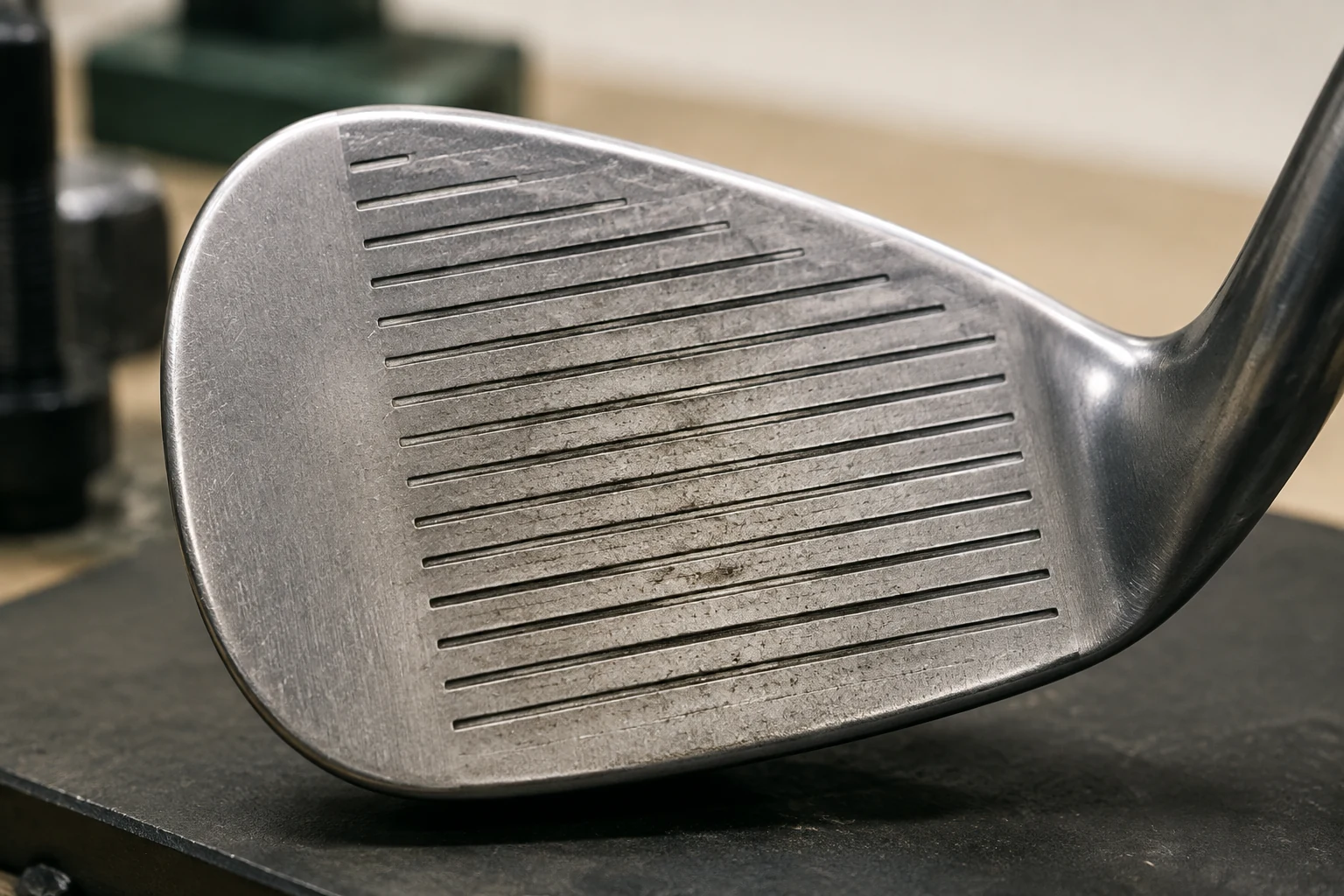
Grooves wear because they hit sand, dirt and range mats thousands of times, and the edge that grips the ball rounds off. Titleist has measured what that does.
Titleist's Vokey R&D team tested wedges with fresh grooves, 75 rounds of simulated wear and 125 rounds on a robot at its Manchester Lane facility. Fresh grooves produced about 8,500 rpm of spin and 10 feet of rollout. At 75 rounds, spin dropped to around 7,400 rpm and rollout grew to 18 feet. At 125 rounds, 6,500 rpm and 24 feet. Titleist simulates 75 rounds with 500 bunker shots and 125 rounds with 1,000. Golf Digest summarized the same data as 30 percent less spin and 140 percent more rollout at 125 rounds.
MyGolfSpy ran its own version in 2025, starting with a new Titleist Vokey SM10 56-degree and beating it with 500 bunker shots, then measuring the spin loss. Their piece is worth reading if you want independent numbers, and their separate guide notes that heavy short-game practicers can burn through a wedge's useful grooves in a single season.
Two practical points before you buy anything. First, Golf Digest cited a test by coach Andrew Rice showing at least a 20 percent spin drop from dirty grooves alone. Clean them before you blame them. Second, don't sharpen grooves yourself. Golf Digest's equipment editors say the hand tools sold for this can't reproduce the edge radius the rules require, and the USGA's groove database only covers clubs in their "as manufactured" condition. A sharpened wedge may spin better and be non-conforming at the same time.
A 2018 SM7 with maybe 200 rounds on it, like the one in Golf Monthly's editor's bag, is exactly the club Titleist's numbers describe. It'll still work. It won't stop the ball where it used to.
Are pre-2010 groove clubs illegal now? The 2024 rule change that didn't happen
No. If you have irons or wedges from before 2010, they're still legal for normal play and handicap rounds. This is the point most "how long do golf clubs last" articles get wrong.
Here's what happened. In 2010 the USGA and R&A tightened groove volume and edge sharpness rules for irons, wedges, hybrids and fairway woods of 25 degrees or more. Older clubs were grandfathered, with a note that the old grooves would stay conforming "until at least 2024." Plenty of sites read that as an expiry date.
On 16 January 2024, the USGA published an update saying the 2010 groove specifications will continue to apply only through Model Local Rule G-2, which tournament committees can adopt for elite events. The R&A confirmed the same position in August 2024. Any future decision to apply the 2010 grooves to all golfers would come with at least four years' notice. So your 2007 Vokey Spin Milled wedges are fine at your club, in your league and for your handicap. They'd only be a problem in a competition that specifically invokes G-2, which in practice means elite amateur and professional events.
You can check any pre-2010 club on the USGA's Informational Club Database if you're curious, but for a weekend golfer the answer is already yes, you can play them.
Grips: the cheap part of an old club that's almost certainly worn
Grips are rubber. Rubber hardens under sun, sweat and hand oils. Golf Pride, which makes the grips on most new clubs sold, recommends replacing them roughly every 40 rounds and says only about 20 percent of golfers regrip annually. PGA TOUR Superstore's repair desk uses the same rule: once a year or 40 rounds, whichever comes first, and they count a range session as a round.
The problem with worn grips is that you don't notice them. You grip tighter to stop the club twisting, which tightens your forearms and costs you speed and face control. Golf.com reported a Golf Pride study putting the damage from two-year-old grips at 3 to 4 shots per round. That's a manufacturer's number about its own product, so take the exact figure with a pinch of salt. The direction is right.
If you're keeping an old club, this is the first thing to fix, and the only purchase this article recommends. It's also the fix that makes a 2013 3-wood feel like a 2026 one in your hands, which is half of what "new club feel" is.
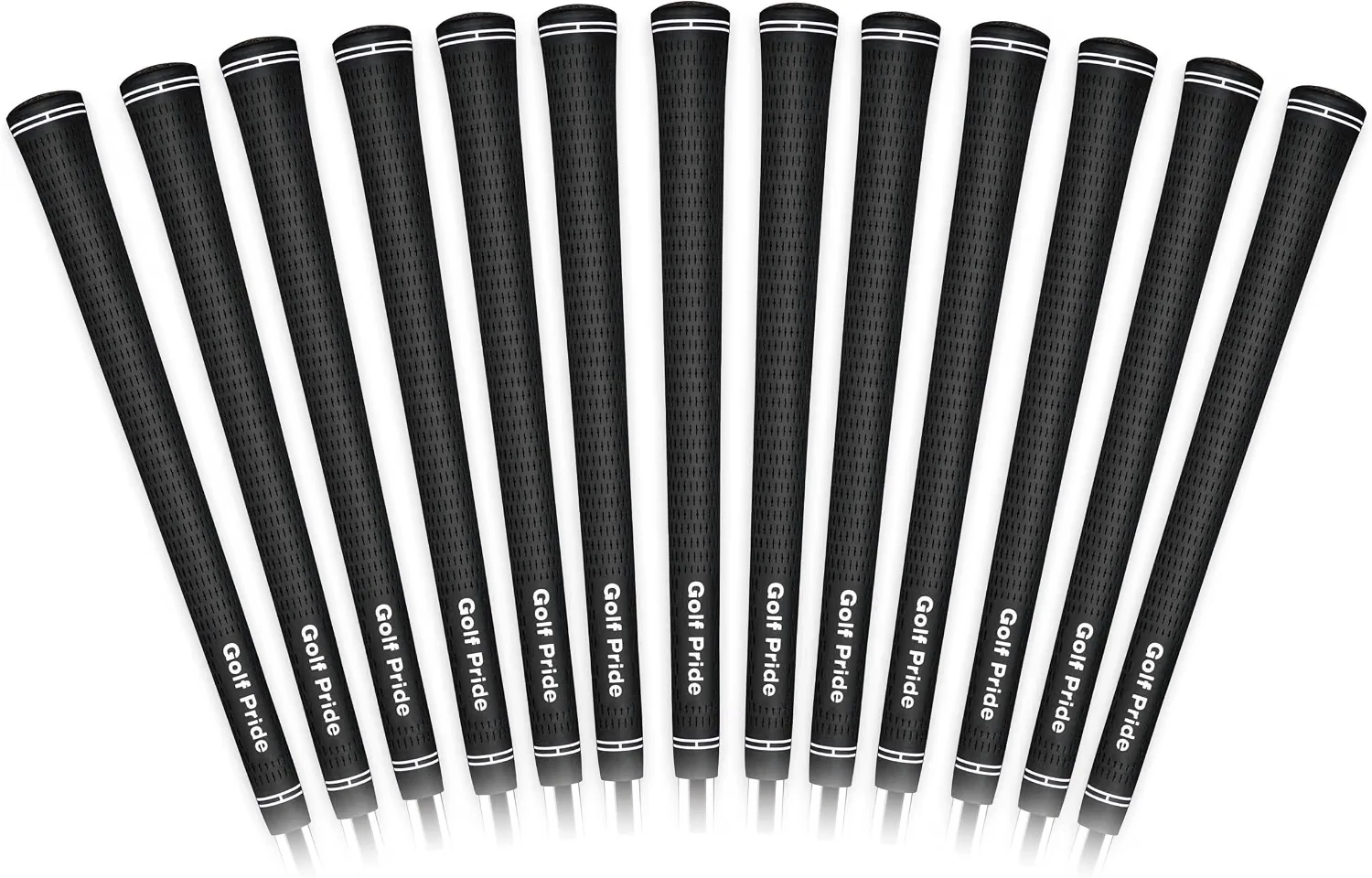
Product 1 · Golf Pride Tour Velvet 360 Golf Grip Kit, 13-Piece, Standard
Golf Pride Tour Velvet 360 Golf Grip Kit
- BEST FOR
- Anyone keeping clubs more than two years old who hasn't regripped, and wants the same grip most tour players use.
- WHY
- The Tour Velvet is Golf Pride's most-played grip on the PGA Tour, with 60 to 70 players using it weekly according to Golf Pride's tour rep. The 360 version has no alignment seam, so it works on adjustable drivers and fairways as well as irons. The 13-piece kit covers a full set in one go.
- WATCH OUT FOR
- Standard size suits average hands. If you wear a large glove, look at midsize instead. You'll also need tape, solvent and ideally a vise, which some kits include and some don't, so check the listing. If you don't want the mess, most golf stores install grips you bring in for a few dollars a club.
How to check an old club before you keep it or buy it used
Run this on your own bag or on anything from a used rack. It takes five minutes. If you want to compare use, trust and distance gaps in one place, audit your set before you decide what to replace.
- Grooves. Run a fingernail across the face of your wedges and short irons. If it glides where it used to catch, spin is gone. Compare against a long iron you rarely hit.
- Grip. Shiny, hard, or cracked at the butt end means replace it. Wash it first with mild soap. Sometimes it comes back.
- Rattle. Shake a driver, fairway or hybrid next to your ear. A rattle is usually loose epoxy or a broken internal rib. Not always fatal, but it's a negotiating point on a used club.
- Face. Look for a hairline crack on a driver face, especially low and toward the heel. Cracked faces are done.
- Loft and lie. Soft forged irons and wedges bend a little over years of turf strikes. A shop can check the set for a small fee. Gapping problems on old irons are often this, not "worn out" heads.
- Shaft. Graphite shafts scratch through the paint over time. Deep scoring near the hosel weakens them. Steel shafts with surface rust are cosmetic. Steel with pitting is not.
- Rules. For clubs from before 2010, you already know the answer from the section above. For drivers, the USGA's List of Conforming Driver Heads is searchable if you ever play in something that checks.
If a club passes all seven, the only remaining question is whether newer technology would help you enough to pay for it.
When buying a new club actually makes sense
There are three honest cases, and none of them is "my clubs are five years old."
- Your driver mishits are costing you real distance and you have the swing speed for a modern head to help. If most of your drives come off low on the face and you carry 200 yards on a good one, a fitted 2024-or-later driver will probably give you back 10 to 20 yards on the bad ones. That's the Golf Monthly 2016 finding, and it's still the best reason to upgrade a driver.
- Your wedges have more than 75 rounds and you chip and pitch a lot. Titleist's data says you're leaving spin on the table, and wedges are the cheapest clubs in the bag to replace. Buy one at a time, starting with the one you use most inside 100 yards.
- You've never been fitted. Several of the Golf Monthly writers say a fitting was the moment a club became a keeper, including the SM7 wedge and the G400 Max driver. A fitting on your current clubs might tell you the shaft is the problem, which is a cheaper fix than a new set.
If none of those apply, keep the bag, change the grips, and spend the money on lessons or balls.
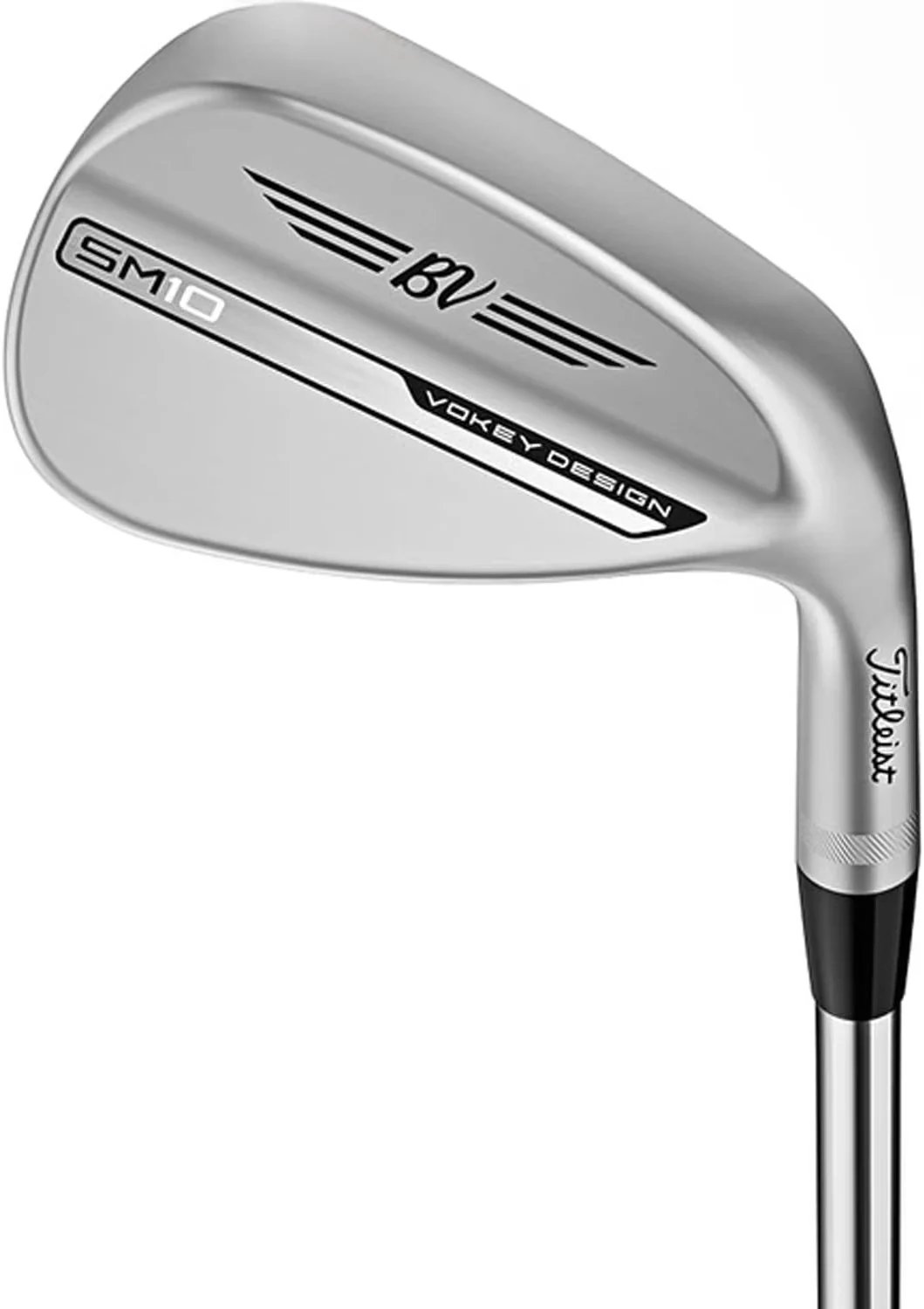
Product 2 · Titleist Vokey Design SM10 Tour Chrome Wedge
Titleist Vokey Design SM10 Tour Chrome Wedge
- BEST FOR
- Golfers whose wedges have surpassed 75 to 125 rounds and are seeing excess rollout on approach and pitch shots.
- WHY
- The gold standard in tour wedge design. Engineered with individually cut TX9 grooves for maximum spin and precision drop-and-stop control, restoring the short-game stopping power that worn wedges lose over time.
- WATCH OUT FOR
- Ensure you select the correct bounce and grind for your swing type and typical turf conditions (F, S, or M grind).
Frequently Asked Questions
How many rounds do wedges last before they lose spin?
Titleist's robot testing shows measurable spin loss at about 75 rounds, roughly 1,100 rpm less than fresh grooves with rollout nearly doubling from 10 to 18 feet. By 125 rounds the drop is around 2,000 rpm and rollout reaches 24 feet. Practice sessions count, and bunker practice wears grooves fastest, so heavy practicers hit those numbers within a season.
Is a 10-year-old driver still good?
Structurally, yes. Golf Digest and club designer Tom Wishon both say amateur golfers don't hit a driver often or hard enough to fatigue the face. The real gap is forgiveness on off-center strikes, which Golf Monthly's 2016 comparison put at around 20 yards on low-face hits for a decade-old head. If you strike it well, keep it.
Can I still use my pre-2010 groove wedges in 2026?
Yes, for normal play and handicap rounds. The USGA confirmed on 16 January 2024 that the 2010 groove specifications apply only when a competition adopts Model Local Rule G-2, which is aimed at elite events. The R&A said the same in August 2024. Any change for everyday golfers would come with at least four years' warning.
How often should you replace golf grips?
Golf Pride and PGA TOUR Superstore both say roughly every 40 rounds or once a year, whichever comes first, and a range session counts as a round. Heat, sweat and sunscreen shorten that. If the grip feels glassy or you're squeezing harder than you used to, it's due, whether or not it looks worn.
Do golf irons wear out?
Slowly. Iron grooves wear like wedge grooves but see far fewer sand and mat strikes, so most amateurs get a decade or more from a set. Lofts and lies on forged irons can drift a degree or two with use, which shows up as gapping problems. A loft and lie check every few seasons fixes that for less than one new iron costs.
The GolfRaw Take
Nine people who get free clubs for a living are still playing putters from 2008 and 2015, a rusty 2013 3-wood and a driver from 2018. Meanwhile the internet keeps telling you to bin your driver every four years. The people with the launch monitors aren't doing that, so you shouldn't either.
Change your grips. Check your wedge grooves against Titleist's 75-round mark. Clean your clubs. If your driver mishits are killing you, get fitted before you buy. And if your old wedge still fits your swing like Neil Tappin's SM7 does, keep it in the bag until the ball stops listening to it.
If your grips are the part that's due, the Tour Velvet 360 kit above is the one most tour players use, and it'll do more for an old set than anything else at that price. Check the current price and pick the size that matches your glove.
Sources
- Golf Monthly, oldest clubs still in the bags of its equipment team, 4 September 2026.
- Golf Digest, driver-face fatigue and groove-wear testing.
- Titleist Vokey R&D, 75- and 125-round wedge wear testing.
- USGA and R&A, groove specifications and Model Local Rule G-2.
- Golf Pride and PGA TOUR Superstore, grip replacement guidance.
- GolfRaw Gear and Guides for related equipment reporting.
How we reported this. We compared manufacturer testing with independent equipment reporting and used Golf Monthly's current equipment-team survey as a real-world check. Prices and availability change; the affiliate cards intentionally show no hardcoded price.
Author. GolfRaw is GolfRaw's editorial desk.
Corrections. None at publication. Corrections policy.
Last updated. .