
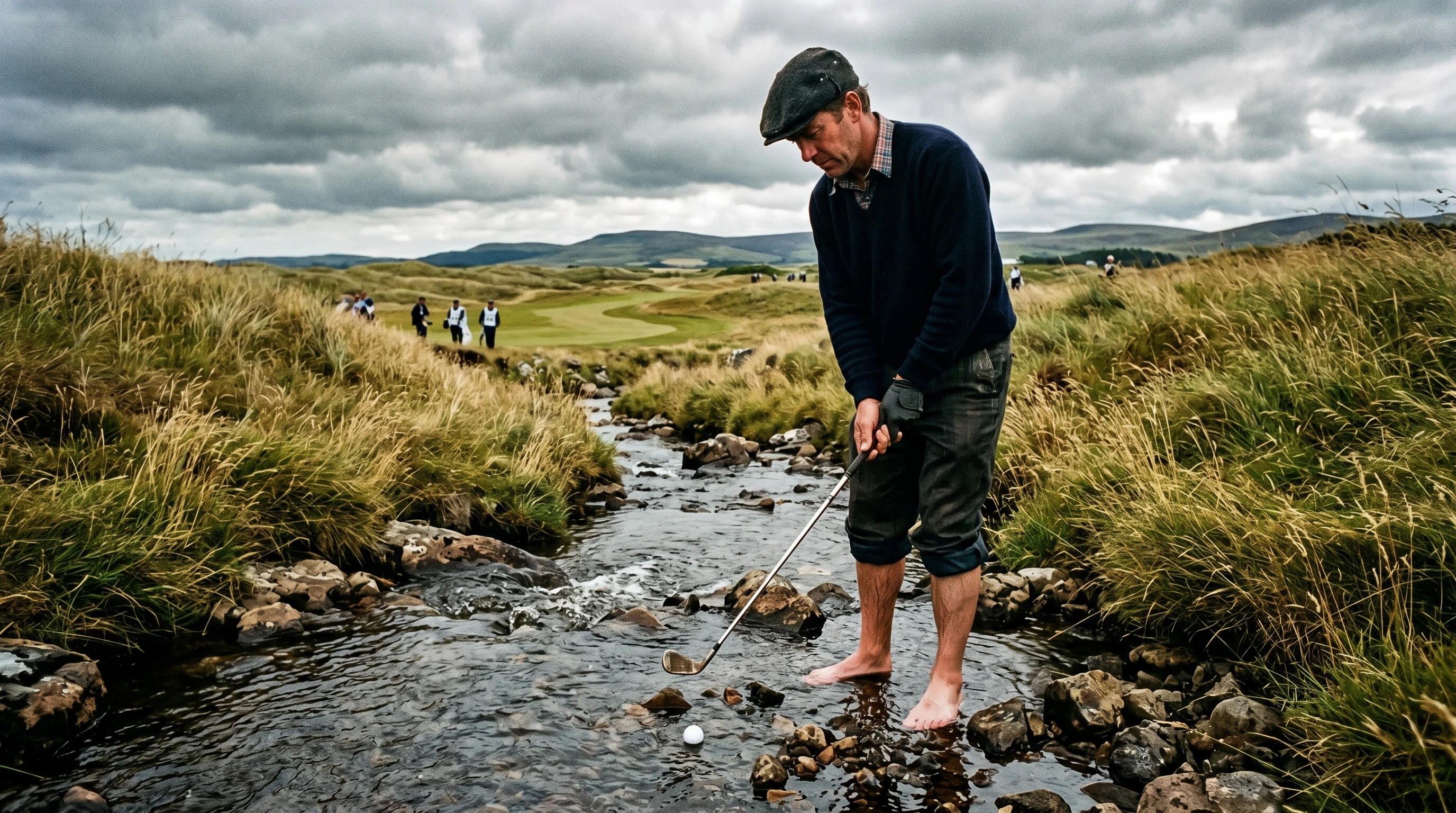
Jean van de Velde stood on the 18th tee at Carnoustie with a three-shot lead and one hole left to win the Open Championship. He could have made a six and still won. He could have made a double bogey, the kind of score that ruins your Saturday with friends, and still walked off as champion golfer of the year. Instead he made a seven, lost in a playoff, and walked into golf history for all the wrong reasons.
This is the story of the most agonizing final hole the game has ever seen, and why it is not the punchline most people think it is.
The Setup: A Frenchman on the Brink of History
In July 1999, almost nobody expected Jean van de Velde to be holding the lead at the Open. He was a journeyman pro with one tour win to his name, not a star. But Carnoustie that week was a monster. The rough was savage, the wind was up, and the scores were brutal. Even par felt like a triumph.
Van de Velde handled the carnage better than almost anyone. A second-round 68 pushed him into the lead. A third-round 70 stretched it to five shots. He was playing the kind of golf that wins majors, steady and brave on a course trying to break everyone around him.
A win would have meant something bigger than a trophy. No French golfer had won the Open since Arnaud Massy in 1907. Van de Velde was one round, then a few holes, then one hole away from ending a 92-year wait for his country.
The final round wobbled, as final rounds do. By the 11th he had been caught and was in danger of falling apart. But he steadied himself, fought back, and by the time he reached the 72nd tee he had rebuilt a three-shot cushion. The Claret Jug was sitting on the table waiting for him. All he had to do was not throw it in the water.
The Hole: A Slow-Motion Disaster
Here is the cruel math. The 18th at Carnoustie is a long par 4, just under 500 yards, with the Barry Burn snaking across it twice. A three-shot lead meant Van de Velde could have hit an iron off the tee, a wedge down the fairway, a chip, and two putts, made a double bogey, and won. The safe play was almost embarrassingly easy.
He pulled out his driver.
The tee shot sprayed right, but he got lucky. It cleared the burn and bounced onto the neighboring 17th hole. He had a chance to recover, to wedge it safely back into play and still cruise home. Instead he went for the green again.
The second shot is the one that broke the day. It flew right and slammed into the railing of a grandstand by the green, and instead of dropping near the putting surface, it ricocheted backward, all the way back over the burn, into deep, tangled rough. Of all the unlucky bounces in golf, this one cost a championship.
Now he was in thick fescue with the water in front of him. He hacked at it, and the ball came out low and dropped straight into the Barry Burn.
What happened next is the image everyone remembers. Van de Velde walked to the edge of the burn, looked down, and saw his ball sitting on the sand below the water. He took off his shoes and socks, rolled up his trousers, and climbed into the creek as if he might actually try to hit it out. The crowd around the green could not believe it. He stood there in the water, club in hand, weighing the most reckless shot of his life with a major on the line.
Sense, finally, arrived. The ball settled deeper, and he climbed back out and took a penalty drop. That left him lying four, still in the rough, still with water between him and the green. His next shot found a greenside bunker. Lying five, in the sand, he now needed to get up and down just to make a seven and force a playoff.
He blasted out to about six feet. Then, somehow, after everything, he holed the putt. Triple-bogey seven. He had not won. But he had not quite lost either. He had dragged himself into a playoff he had no business still being part of.
The Aftermath: The Forgotten Winner and the Famous Loser
The playoff was a four-hole aggregate among three men. Van de Velde, Justin Leonard, and a Scotsman named Paul Lawrie.
Lawrie is the great forgotten figure of this story, and he deserves better. He had started the final round ten shots behind the lead. Ten. He shot a 67 in the Carnoustie meat grinder, posted his number, and waited more than an hour to see if it would matter. His comeback is still the largest in the history of major championship golf. He did not back into the Claret Jug. He birdied the 17th and the 18th in the playoff to win it outright, three clear of Leonard and Van de Velde.
But the world remembers the man who lost. That is the hard truth of the 1999 Open. Lawrie produced one of the greatest final rounds in major history and is a footnote, while Van de Velde's seven is replayed forever.
What makes Van de Velde different from most who suffer a collapse is what he did afterward. He did not hide. He did not break. He faced the cameras with a shrug and a smile, and over the years he has refused to be ashamed of it. He once went back to that 18th hole and proved he could finish it with nothing but a putter, beating his score on the third try, half as a joke, half as a point. He has always insisted that the aggressive golf people mocked is the same golf that gave him the lead in the first place. He made friends in Scotland, he likes to say, because a Scotsman won. There are worse things in life.
Why This One Still Matters
It is easy to laugh at the 1999 Open. Most people do. But the vault keeps this story for a better reason than comedy.
Van de Velde lost because he played the way he had played all week, and that week it had worked. On 71 holes, brave golf had carried a journeyman to the brink of greatness. On the 72nd, the same instinct sank him. The line between hero and cautionary tale was one swing of a driver he did not need to hit.
You know that pull. You are coasting through a good round and the cautious shot feels boring, almost insulting, so you reach for the bold one instead. Sometimes it is the right call. Sometimes it is the Barry Burn.
"The skill that separates good rounds from blown ones is not bravery. It is knowing the one moment when bravery is the wrong tool, and having the discipline to put the driver back in the bag."
There is a second lesson, quieter and harder. Van de Velde lost the biggest moment of his career in front of the world, and he carried it with humor and grace for the rest of his life. He let it be a story he tells, not a wound he hides. Most of us will never lose anything that public. But we will all blow something that matters, and how we walk off afterward is the part we actually control.
He needed a six and made a seven. The hole beat him. It never owned him.