Jack Nicklaus Won 73 Times for Less Than Four Modern Cheques
Nicklaus earned $5.73m across 73 PGA Tour wins. Jackson Koivun banked $1.58m in one afternoon last Sunday. The maths is genuinely absurd.
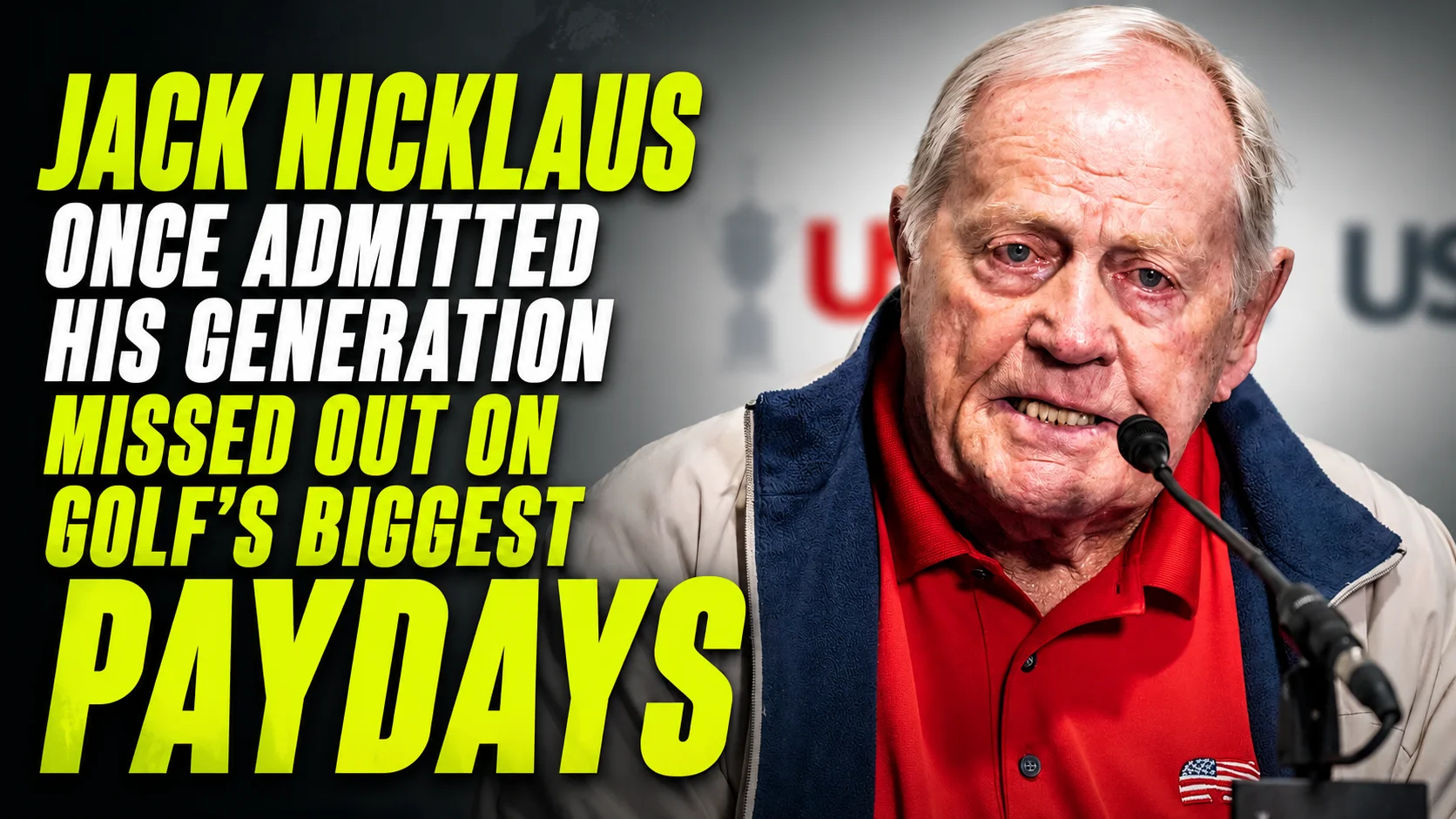
Jack Nicklaus, in an interview on The Big Swing With Jimmy Roberts, said that he, Arnold Palmer and Gary Player never really became wealthy from playing golf. They did very well, he said, with no issues and no complaints — just nothing remotely near today's standard.
He's right, and the numbers are more extreme than the quote suggests.
Nicklaus earned $5,734,031 across 73 PGA Tour victories. Last Sunday, Jackson Koivun earned $1,584,000 for one afternoon at the 3M Open — his third start as a professional, 24 days into his career.
That single cheque is worth about 28% of Nicklaus's entire playing career.
The comparisons, in order of how much they hurt
- Four wins like Koivun's beat Nicklaus's whole career. $5,734,031 divided by $1,584,000 is 3.6. Not four majors. Not four seasons. Four ordinary PGA Tour wins in 2026 money.
- The 1986 Masters paid $144,000. Winning this week's Rocket Classic pays $1,800,000 — a non-signature event, 33rd of 34 on the regular-season schedule, being discontinued after Sunday because the sponsor declined its option.
- $1,800,000 ÷ $144,000 = exactly 12.5.
- Nicklaus at 46, coming home in 30, the loudest roar in the history of the sport, the greatest final round anyone has seen. That was worth one-twelfth of what somebody will collect on Sunday at a course that got rebuilt because it was too easy.
- Tiger Woods earned $120,999,166 from 82 wins. That's about 21 times Nicklaus's career total from nine more victories.
- Per win, it's starker: Nicklaus averaged roughly $78,500 per PGA Tour victory. Woods averaged about $1,476,000 — nearly 19 times more for the same achievement.
- And Koivun, on one win, is already averaging more per victory than Tiger Woods did.
- Palmer's 62 PGA Tour wins brought him $1,861,857. Koivun cleared 85% of that in a single Sunday.
The caveat that matters
These are nominal figures, and inflation is real. $144,000 in 1986 buys considerably more than $144,000 today, and anyone quoting these comparisons without saying so is misleading you.
I'm not going to hand you a conversion, because I'd be inventing a multiplier I haven't verified. But the honest version is this: adjust for inflation and the gap narrows a lot — and it is still enormous. No plausible inflation figure turns a 12.5× gap into parity, or makes 73 wins worth less than four.
The real change isn't inflation. It's that golf's prize money grew far faster than the cost of living, for reasons that have Tiger Woods's name on them.
What Nicklaus actually said, and what he didn't
The quote is gracious and it's worth reading as written. He said his generation did very well. He said he has no complaints. The only thing he claimed was that it wasn't near today's standard.
That's not a grievance. It gets packaged as one — the piece I read is headlined "once admitted," which implies a confession — but a man saying "we did fine, just not like now" is stating a fact about his sport, not asking for sympathy.
The better part of the interview is the bit about Muirfield Village, which he founded and which opened in May 1974.
He said Muirfield was probably the best thing he did, and that he structured it so he couldn't make any money. His reasoning: he was still playing, he wanted his fellow professionals to come and play there, and he didn't want anyone saying Jack was making money off them.
Careful with how that gets reported. You'll see it written as "Nicklaus never earned a penny from the golf club." What he actually described is deliberately structuring the club so he couldn't profit from it, in a specific context — his peers playing his tournament. That's a narrower claim, and frankly a better one. It's a man solving a conflict of interest before anyone accused him of having one.
Why this is worth reading this week
Because the two ends of the comparison both happened in the last seven days.
On Sunday, a 21-year-old out of Auburn won his first PGA Tour event in his third start as a professional and banked $1.58 million. This week, Xander Schauffele said the young players arriving now look like miniature Tour pros and that college golf looked nothing like it in his day. Scottie Scheffler, two days earlier, said the same thing independently.
And here's Nicklaus, from whenever this interview was recorded, pointing out that he and Palmer and Player won 104 majors' worth of golf between them for less than four modern paydays.
Three generations, all describing the same transformation from different ends of it. That's the story. Not a confession.
FAQ
How much did Jack Nicklaus earn in his PGA Tour career?
Reportedly $5,734,031 from 73 wins, which currently ranks him around 349th on the career money list.
How much did he get for the 1986 Masters?
$144,000.
How does that compare to today?
The winner of this week's Rocket Classic — a regular-season event — takes $1,800,000. That's 12.5 times as much.
How much has Tiger Woods earned?
Around $120,999,166 from 82 wins, first on the career money list.
What about Palmer and Player?
Roughly $1,861,857 from 62 PGA Tour wins and $1,834,482 from 24 respectively. Note Player's worldwide win total is far higher than his PGA Tour count.
Are these figures inflation-adjusted?
No. Adjusting narrows the gap significantly but nowhere near closes it.
Did Nicklaus make money from Muirfield Village?
He says he deliberately structured the club so he couldn't, because he didn't want fellow professionals to think he was profiting from them.
When did he say all this?
On The Big Swing With Jimmy Roberts. The date isn't given in the coverage I found, so treat it as an older interview rather than fresh news.
GOLFRAW's Take
The number I can't stop looking at is 3.6. That's how many ordinary PGA Tour wins it now takes to out-earn Jack Nicklaus's entire playing career. Not majors. Not Players Championships. Four regular Sundays at events people forget by Wednesday. And the honest thing to say is that Nicklaus isn't bitter about it, which makes him a better man than most of us would be. He built the golf course, gave away the profits so nobody could accuse him of anything, won eighteen majors, and then watched the sport he dragged into the television age start paying its winners more for one afternoon than he made in thirty years.