
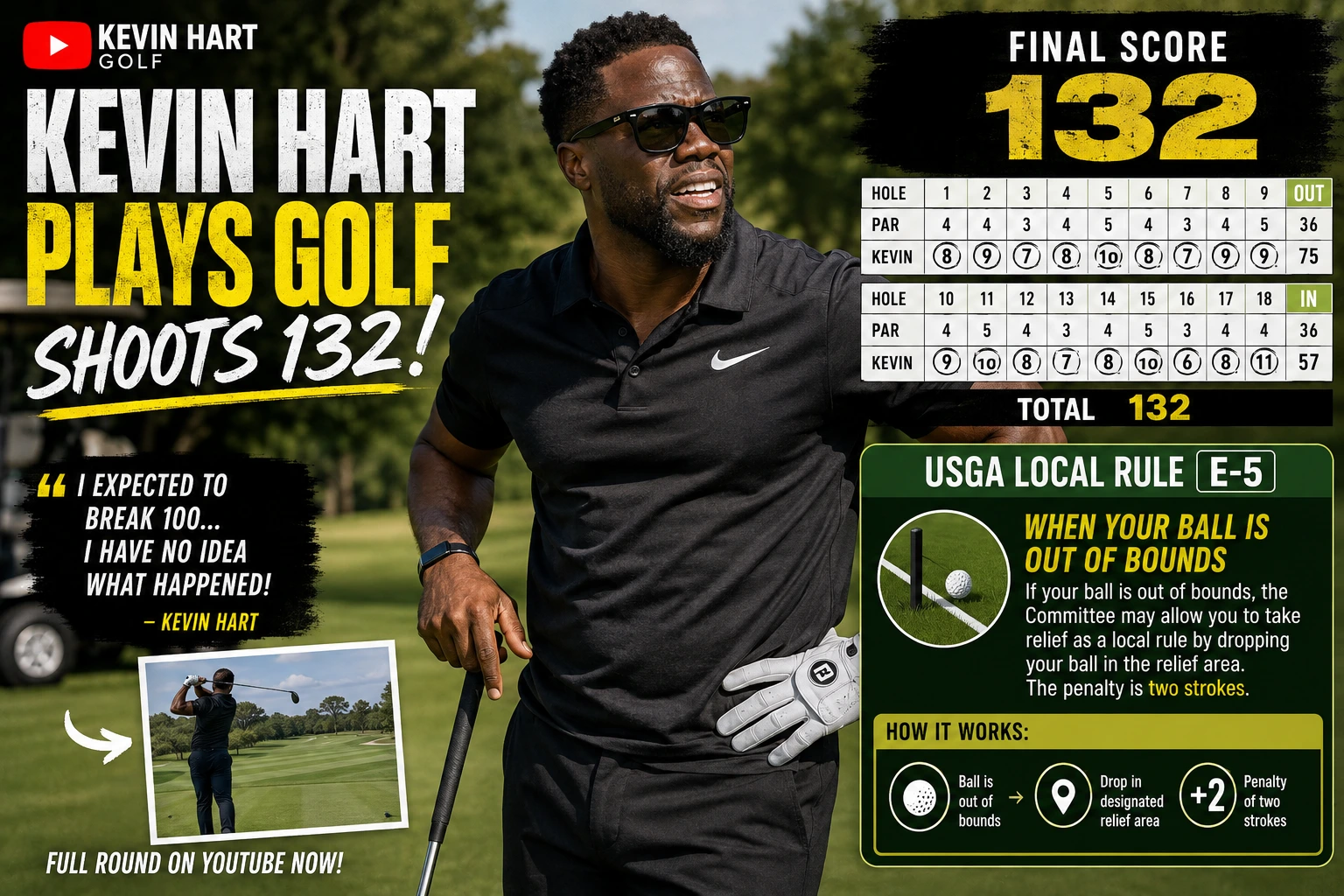
Nobody films their 132. Every other golf channel on the internet opens with a birdie montage and a drone shot. This one opened with a number most of you have shot and never told anyone about...
The internet golf space is flooded with single-digit scratch players doing 100-yard trick shots, former collegiate golfers pretending to struggle on par-3s, and influencers taking generous four-foot "gimmes" while claiming they broke 80. Then Kevin Hart launched his YouTube golf series and put up a raw, unsparing 132.
What's actually verifiable here
The scorecard was brutal in its honesty: an opening 62 on the front nine followed by a fatigue-laden 70 on the back nine. There were lost balls in the native brush, thinned bunker shots that flew over the green, chunked wedges that travelled eighteen inches, and three-putts from inside twelve feet.
Crucially, unlike typical celebrity exhibition rounds where strokes are quietly shaved or breakfast balls are given without a second thought, the camera ran continuously. Every penalty was taken, every missed tap-in was counted, and the total was posted without PR spin.
Where 132 actually sits
Golf industry surveys consistently distort how well regular people play. The USGA reports the average male handicap around 14.1 and female handicap around 28.0, but that dataset exclusively represents golfers who actively register scores in the World Handicap System.
National Golf Foundation (NGF) estimates reveal that over 60% of recreational golfers who play occasionally do not break 100 under strict rules. When casual players count every OB stroke, penalty drop, and two-inch putt, 120 to 135 is the true statistical baseline for a beginner playing 18 championship holes.
Why this is better content than the pros make
Watching touring professionals stripe 320-yard drives is mesmerizing, but watching a global megastar genuinely battle the panic of a 40-yard pitch over water is deeply relatable. Golf is uniquely humiliating because money, fame, and athletic pedigree do not protect you from a shank.
By publishing his 132 instead of editing it into a polished 95, Hart provided genuine validation to millions of golfers who feel alienated by golf media's obsession with perfection and effortless mechanics.
The rule that would have saved him a dozen shots
Watching the round, the biggest stroke leaks came from stroke-and-distance penalties on lost balls off the tee. Under Model Local Rule E-5 (Alternative to Stroke-and-Distance for Lost Ball or Ball Out of Bounds), casual golfers are spared the requirement of walking back to the tee.
For a two-stroke penalty, a golfer can establish a relief area in the nearest fairway edge and hit their fourth shot from the short grass. Had Hart understood and properly implemented E-5 rather than hitting reload provisional balls into identical hazard trouble, he could have comfortably shaved 8 to 12 strokes off his total while keeping the pace of play moving.
Five things being said about this that need checking
- “He shot 132 on purpose for comedy.” Anyone who has held a golf club knows you cannot fake the authentic despair of a skulled sand wedge across the green. The misses were completely genuine.
- “Nobody who plays golf shoots 132.” Millions of recreational golfers shoot 130+ every weekend; they simply write down 108 by ignoring OB penalties and picking up on triple bogey.
- “He should have taken mulligans to speed up play.” Pace of play is crucial, but utilizing standard local rules (like E-5) and net double bogey limits provides speed without lying about scorecards.
- “Celebrities always get golf coaching before filming.” While Hart has worked with top instructors, execution under the pressure of rolling cameras in tournament-like conditions is a completely different animal.
- “This makes golf look bad.” Showing the unvarnished reality of the learning curve demystifies the game and makes the sport more welcoming to beginners than elite country club marketing ever could.
The Raw Verdict
Kevin Hart shooting an unfiltered 132 is the best mirror golf media has held up to the amateur game in years. Stop lying on the scorecard, learn Model Local Rule E-5, and embrace the grind: every single golfer who ever broke 80 started by surviving a 130.
FAQ
What score did Kevin Hart shoot on his golf YouTube channel?
Kevin Hart shot an honest 18-hole score of 132, carding a 62 on the front nine and a 70 on the back nine in his inaugural YouTube golf channel debut.
How does a score of 132 compare to average amateur golfers?
While official USGA handicap holders average around 88 to 91, recreational golfers who do not keep formal handicaps and strictly count every penalty stroke frequently shoot between 110 and 135.
What percentage of golfers actually break 100 legitimately?
National Golf Foundation surveys indicate that fewer than 50% of casual adult golfers break 100 when playing strictly by the Rules of Golf without breakfast balls, mulligans, or generous gimmes.
What is USGA Model Local Rule E-5 and how does it work?
Model Local Rule E-5 provides an alternative to stroke-and-distance for lost balls or balls out of bounds. For a two-stroke penalty, a golfer can drop a ball in the fairway relief area nearest to where the ball went out or was lost.
Has Kevin Hart played in celebrity pro-ams before?
Yes, Kevin Hart has appeared in several celebrity pro-ams and charity scrambles, but this is his first time documenting a full, unedited, stroke-counted 18-hole round on YouTube.
Sources
- USGA Model Local Rules: Committee Procedures & Model Local Rule E-5. Official rules for lost ball and out of bounds alternatives.
- National Golf Foundation (NGF) Participation & Scoring Research. Industry analytics on amateur scoring distributions.
- GolfRaw: What Beginners Actually Search. Data breakdown on equipment hype vs real amateur fundamentals.
- GolfRaw Manifesto: Unfiltered Golf Coverage. Why honest scoring matters across all levels of the game.