
Key takeaways
- LIV Golf says an investor signed a term sheet for $300 million. The investor name, final documents and funding mechanics are still undisclosed.
- Bloomberg reported a loan or credit facility from BC Partners’ credit arm, which would put lenders ahead of player equity in the repayment stack.
- The reported “LIV 2.0” blueprint shrinks the league to 10 events, lowers purses and adds international team majors. It is a plan, not a finished calendar.
- Four vendors are suing over unpaid bills, including claims tied to Fantasy Interactive ($992,000+), Mobii Systems ($209,000), Deltatre and Fresh Tape Media.
- September 1 is the date to watch. Vendor and workforce reporting points to that termination date as the next hard test of the restructure.
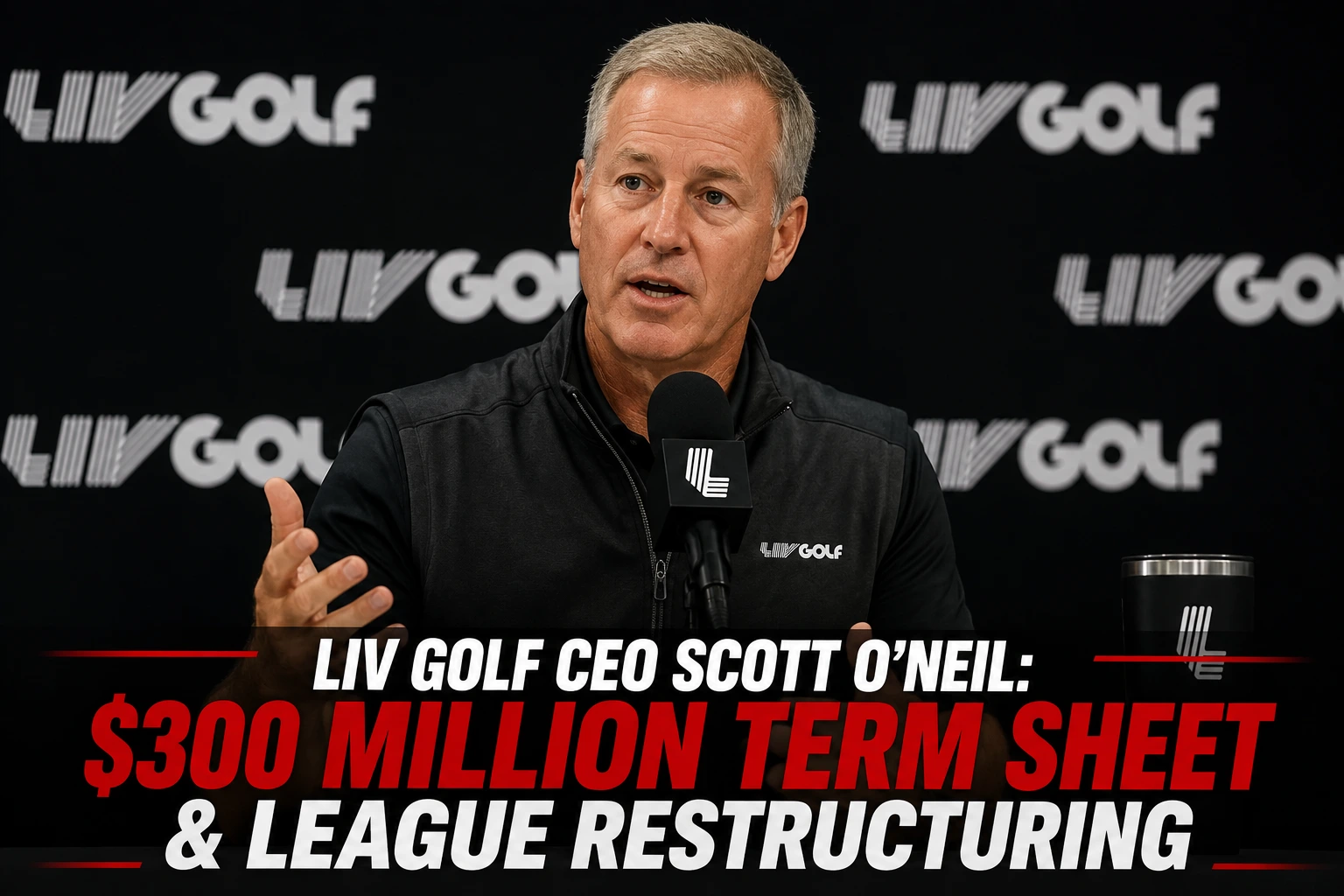
The $300 million headline is real enough to repeat and too vague to treat as cash in the bank. LIV Golf CEO Scott O’Neil said at Bedminster that an investor had signed a term sheet. Bloomberg reported that the backer is using a credit arm, which makes the financing look more like a loan than a clean equity cheque.
Those are not the same thing. A term sheet is a negotiated outline. A definitive agreement is signed financing with conditions, covenants, draw dates and a repayment schedule. Until LIV publishes that detail, the honest answer is the one in the headline: it might be a loan.
For the tournament backdrop around this business story, see Hovland’s 36-hole co-lead and the Friday Tour Championship recap. LIV’s financial reset is unfolding beside the week’s on-course headlines, not in a vacuum.
What did LIV officially announce, and what remains undisclosed?
O’Neil’s Bedminster announcement confirms a signed term sheet and a $300 million funding commitment in principle. It does not, on the supplied record, confirm the investor’s identity, the amount already funded, the interest rate, the maturity date, the security package or the final ownership split.
That missing list is the story. A term sheet can die in diligence. It can also close exactly as described. Calling it “secured equity” or “cash received” would add facts that have not been released. Calling it nothing would ignore the CEO’s statement. Keep both facts in the frame.
Term sheet versus definite deal: what is the difference?
| Question | Signed term sheet | Definitive deal |
|---|---|---|
| Investor | Investor has agreed in principle. | Named parties and ownership are in executed documents. |
| Money | Target commitment, not proof of a full draw. | Funding amount, draw date and conditions are documented. |
| Risk | Terms can change during diligence. | Covenants, security and remedies bind the parties. |
| What to call it | Reported $300M term sheet. | Closed financing, once LIV confirms it. |
Is it debt or equity, and why does that matter to players?
Bloomberg’s reporting points to BC Partners’ credit arm rather than a straightforward equity investment. In plain English, that is lender money. Debt normally sits ahead of equity in the capital stack: interest and principal are paid before owners share whatever remains.
That does not mean a player’s contract disappears. It means any player equity or upside attached to league ownership is economically subordinated to the lenders unless the final documents say otherwise. Players care about the difference because a smaller purse, a covenant or a sale process can change the value of paper equity without changing a single tee time.
Debt versus equity for players
- Debt: scheduled repayment, interest, covenants and lender priority. The league carries the obligation before equity participates.
- Equity: ownership upside with no guaranteed repayment. It can be valuable if the league grows and worthless if the capital structure consumes the value.
- Player takeaway: ask whether the “equity” is common, preferred, pledged or diluted. The term sheet headline does not answer that.
What is the reported “LIV 2.0” blueprint?
The reported blueprint is smaller and more international: 10 LIV events, lower purses and international team majors. That is a different operating model from trying to keep a large, expensive calendar on the road while the league searches for a stable media and commercial engine.
The 2026 versus 2027 distinction is where the press release language gets slippery. The current 2026 structure is the live league plus a signed term sheet. The reported 2027 structure is a proposed 10-event schedule with reduced purses and team majors. No final 2027 calendar or purse grid is confirmed in the supplied record.
| Dimension | 2026 position | 2027 reported blueprint |
|---|---|---|
| Events | Existing LIV league structure. | 10 events reported. |
| Purses | Current commitments remain the reference point. | Lower purses reported. |
| Format | Team league plus individual competition. | International team majors added to the mix. |
| Certainty | Term sheet announced. | Blueprint only, pending financing and approvals. |
What do the vendor lawsuits and layoffs actually show?
The vendor audit is the unglamorous evidence. Fantasy Interactive is tied to claims above $992,000. Mobii Systems is tied to a claim of about $209,000. Deltatre and Fresh Tape Media also appear in the litigation record. Four vendors suing is not a rumour about vibes; it is a cash-flow problem that has reached court.
The workforce side points in the same direction. A WARN notice and layoff reporting name September 1 as a termination date. That does not prove every role ends or that the league stops operating. It does give the restructure a calendar date. Watch which contracts are terminated, which staff remain and whether new financing closes before that date.
The September 1 test
- Before September 1: term sheet language, lawsuits and WARN filings are the evidence.
- On September 1: vendor termination and workforce notices become observable events.
- After September 1: a closed financing and a published 2027 plan would be stronger proof than another announcement.
How did LIV get here? Follow the PIF money and the leadership change.
The historical number is roughly $5 billion of PIF spending on the LIV project and its early operating push. That scale explains why the new $300 million matters, but it also explains why a smaller 10-event model reads like a reset rather than a routine capital raise.
Yasir Al-Rumayyan stepping down from the day-to-day LIV chair role adds another layer. Leadership changes do not tell us whether the league succeeds. They do tell us that the governance model is being reworked at the same moment the financing model is being questioned.
What happened to the Asian Tour alliance and the OWGR pathway?
The Asian Tour alliance was once presented as a route to ranking legitimacy. The later PGA Tour, DP World Tour and Asian Tour partnership stripped LIV of that pathway, leaving LIV events outside the official world ranking system. That is a sporting problem with a business cost: players lose ranking points, majors become harder to access and the league must sell its own relevance.
The funding plan cannot be separated from that fallout. A 10-event international team model may be cheaper and easier to package, but it does not restore OWGR points. The commercial blueprint and the competitive pathway are different problems.
Can LIV players use the PGA Tour door?
Brian Rolapp has discussed a Returning Member Program, but that is a policy route, not a promise that every LIV player walks back in. Jon Rahm and Tyrrell Hatton are useful context because their careers sit at the intersection of LIV contracts, majors and a possible PGA Tour return. They are not a confirmed return list.
For players, the decision is now three-way: contract security, ranking access and the value of any league equity. The answer may be different for a star with major exemptions than for a player whose next start depends on points.
Which four media narratives need correcting?
Fact-check
- “LIV raised $300 million in equity.” Not confirmed. The CEO announced a term sheet; Bloomberg reported a credit facility.
- “The lawsuits prove LIV is finished.” No. They prove vendors allege unpaid bills and that cash-flow pressure is real. They do not predict the league’s final outcome.
- “LIV 2.0 is already the 2027 schedule.” No. Ten events, lower purses and team majors are a reported blueprint until a final calendar is published.
- “A PGA Tour return is guaranteed.” No. Rolapp’s Returning Member Program is a door with rules, not an open invitation.
Verification block
Confirmed or directly supplied: O’Neil’s signed-term-sheet announcement at Bedminster; the $300 million headline; Bloomberg’s credit-arm loan reporting; the 10-event, lower-purse, international-team-major blueprint; vendor claims tied to Fantasy Interactive ($992,000+), Deltatre, Fresh Tape Media and Mobii Systems ($209,000); WARN and layoff reporting with a September 1 termination date; roughly $5 billion in PIF spending; Al-Rumayyan stepping down; the Asian Tour alliance fallout and loss of an OWGR pathway; and Rolapp’s Returning Member Program comments.
Not confirmed: investor identity, final debt or equity documents, amount drawn, interest rate, collateral, player equity terms, a final 2027 calendar, final purses or individual return decisions.
The Raw Verdict
LIV has a financing headline and a financing question. The headline is a signed term sheet. The question is whether the $300 million arrives as lender money, equity money or a structure that puts lenders first while players are asked to believe in future upside.
The lawsuits and September 1 date make this a business story, not a press-release story. If the financing closes and the 10-event plan appears in a real calendar, LIV has a smaller machine to run. If it does not, the $5 billion already spent becomes the expensive preface to a league still looking for its next form.
Frequently Asked Questions
What did LIV Golf announce about the $300 million?
LIV CEO Scott O’Neil announced a signed term sheet with an investor. The investor identity, final documents and whether the money is equity or debt were not disclosed.
Is the LIV Golf funding a loan?
Bloomberg reported that BC Partners’ credit arm is providing a loan or credit facility. LIV has not publicly released final terms, so the structure remains reported rather than fully confirmed.
What is LIV 2.0?
The reported blueprint shrinks LIV to 10 events, lowers purses and adds international team majors, subject to final approvals and financing.
Why does September 1 matter?
September 1 is the termination date named in vendor and workforce reporting. It is the next hard date for understanding which contracts and roles survive the restructure.
Can LIV players return to the PGA Tour?
Brian Rolapp has described a Returning Member Program, but eligibility and timing remain controlled by PGA Tour policy. Rahm and Hatton are context, not a confirmed return list.
Sources
- LIV Golf’s official lead-investor announcement. The league’s statement on its board-approved agreement and the information it has not disclosed.
- Bloomberg News’ report on BC Partners’ credit arm. Reporting on the prospective lending structure and its unresolved terms.
- GOLF.com’s report on LIV vendor litigation. Reporting on the four vendors and the unpaid-service claims described in the article.
- GolfRaw: LIV Golf desk. O’Neil’s Bedminster announcement, league structure and continuing funding coverage.
- GolfRaw: Latest News. Reporting index for the funding, vendor and workforce timeline.
- GolfRaw: PGA Tour desk. Rolapp’s Returning Member Program context and player pathways.
- GolfRaw: Tournament coverage. The sporting and schedule context for LIV’s event model.
- GolfRaw search. Search the archive for PIF spending, OWGR access and player coverage.
- Record checks for this report: Scott O’Neil’s term-sheet statement; Bloomberg’s BC Partners credit-arm report; court claims naming Fantasy Interactive, Deltatre, Fresh Tape Media and Mobii Systems; WARN and layoff notices; PIF and Al-Rumayyan history; Asian Tour, OWGR and PGA Tour partnership reporting.
How we reported this. GolfRaw Editorial separates an announced term sheet from a closed financing and labels reported LIV 2.0 plans as a blueprint. Dollar claims, vendor names, the September 1 date and the OWGR pathway are listed with their limits rather than inflated into certainty.
Author. GolfRaw Editorial is GolfRaw’s golf news and verification desk.
Corrections. None at publication. Corrections policy.
Last updated. .