Ryan Fox Won The Open in 22 Seconds. Golf, Take Note
Ryan Fox won The Open by refusing to overthink. His 22-second winning putt is a brutal lesson for slow golf.
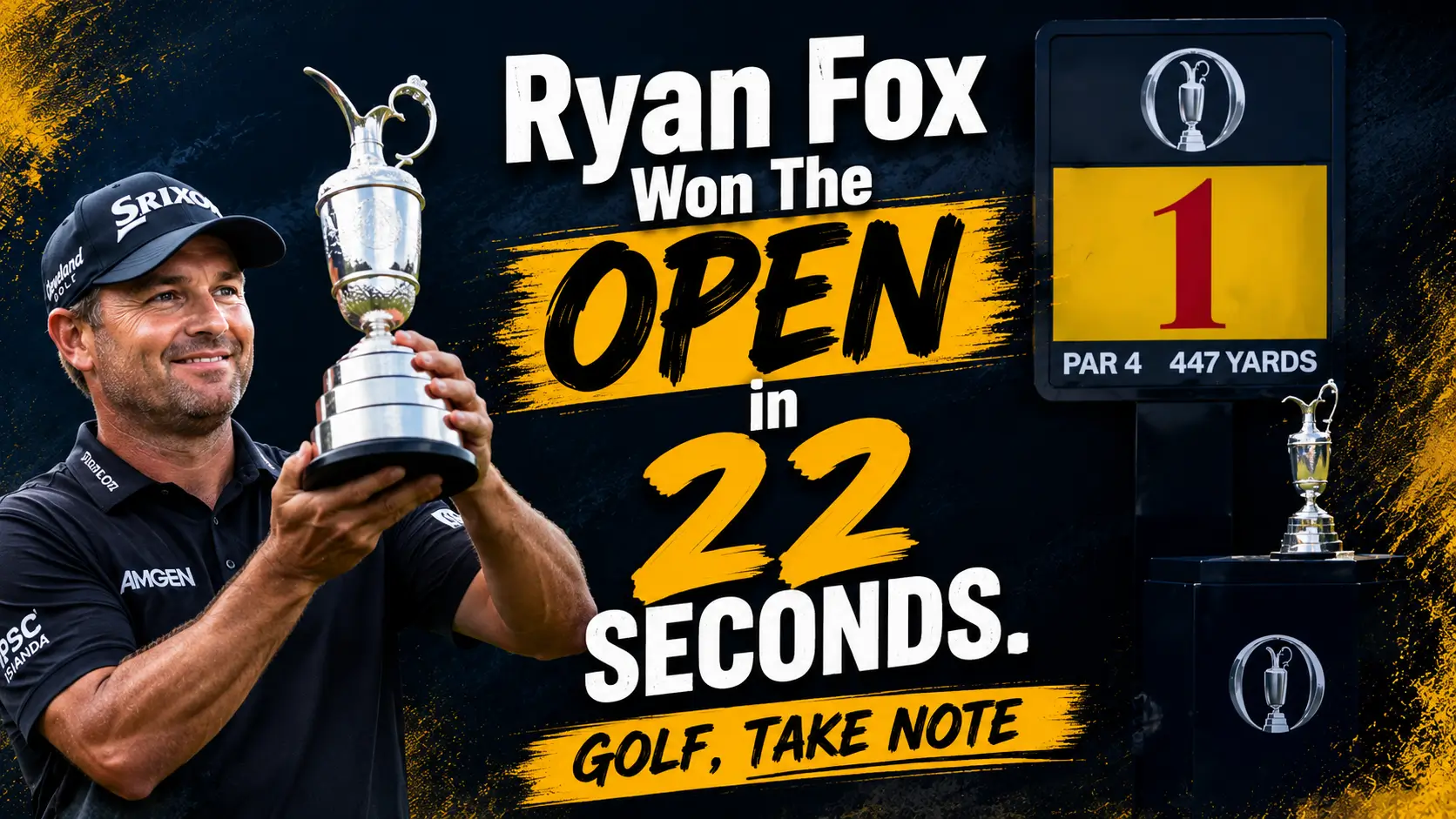
Ryan Fox says playing fast in golf is “not that difficult,” and he backed it up by winning the 154th Open Championship at Royal Birkdale without changing the rapid routine that got him there. On the 72nd hole, Fox took only 22 seconds after Sam Burns had holed out to roll in the 11-foot birdie putt that won the Claret Jug.
You do not need seven practice swings, a yardage-book séance and a committee meeting with your caddie to hit a golf shot. Fox just showed the rest of professional golf that speed is not recklessness. Sometimes it is the cleanest form of nerve.
What did Ryan Fox say about fast golf?
Fox’s message is simple: see the shot, choose the club, and get on with it. He said he sees the shot quickly, chooses quickly, and gives doubt less time to creep into his head.
“It’s not that difficult to pick a shot and pick a club,” Fox said. “I get in there, and it all happens quick.”
There is the whole argument, right there.
Modern pro golf has sold players the idea that every shot needs a full forensic investigation. Walk it off. Re-check the wind. Glance at the grass. Back away. Start over. Somewhere in that slow-motion routine, a golfer can turn a seven-iron into a hostage negotiation.
Fox does the opposite. He calls it “see shot, hit shot.” That is not carelessness. It is commitment before the mind has time to invent a disaster.
“I was never methodical at anything, to be honest. The less time I have to think about it, the less bad stuff can creep in there.”
That sentence should be taped inside every amateur golfer’s glove.
How fast did Fox win The Open?
Fox took 22 seconds to hit the putt that won The Open Championship. Burns had just finished on the 18th green at Royal Birkdale when Fox stepped in and struck his 11-foot birdie putt; it dropped, and the championship was over.
No extra lap around the hole. No dramatic staring contest with the ball. No theatre.
Fox had a decision to make from the 18th fairway: play safely for par and a possible playoff, or hit driver and try to win the thing outright. He chose driver, then hit a 9-iron to a few feet.
That is not fast for the sake of fast. That is a player who had already decided what he wanted.
Royal Birkdale Moment Log
| Royal Birkdale moment | What Fox did |
|---|---|
| Final-hole strategy | Took driver rather than laying back for a safer route |
| Approach shot | Hit a 9-iron to a few feet |
| Winning putt | Holed an 11-footer |
| Time after Burns finished | Took 22 seconds to hit it |
You can dress it up with sports psychology if you want. Fox would probably hate that. He saw the line, trusted it, and hit the bloody putt.
Did fast play help Ryan Fox win?
Fox’s speed appears to have been a genuine competitive advantage because it kept him from spiralling into doubt during a chaotic final round. His caddie, Dean Smith, said Fox’s pace removes doubt, while Fox himself said the routine had never changed across roughly 250 tournaments together.
The crucial moments came late.
Fox made his second bogey in three holes and fell two behind Cameron Young with six to play. Then his ball settled against the front edge of a bunker at the 15th. That is exactly where a slower player can start writing a tragedy in his own head.
Fox did not linger. He played backward from the bunker edge, got up and down for bogey, and kept walking.
He did not pretend the shot was good. He did not freeze because the tournament was slipping. He handled the mess, accepted the bogey, and moved to the next problem.
That is what fast golf really does at the highest level. It prevents a bad hole from renting space in your skull for the next four.
Is quick golf the same as rushed golf?
No. Rushed golf is panicked; Fox’s golf is decisive. He plays quickly because he has made a choice, not because he is unaware of the moment or blind to risk.
The difference matters.
A rushed golfer grabs the wrong club because he wants the moment over. A fast golfer chooses the club, commits to the shape, and refuses to reopen the case once the decision is made. Fox’s game is built on that second version.
His caddie called him “probably the fastest player in the world.” That sort of pace only works if the player trusts his reads, trusts his swing, and does not need to negotiate with himself before every shot.
Fox’s philosophy is not a licence for you to sprint around your Saturday medal swinging at whatever comes to hand. It is a challenge: make a decision you can live with, then stop trying to outsmart it.
What did Scottie Scheffler say about Fox’s pace?
Scheffler told Fox that, while playing together at the WM Phoenix Open, Fox hit shots so quickly it felt like Scheffler and Zecheng Dou were playing as a two-ball. Fox said he could not tell whether it was an insult or a compliment.
It was a compliment.
Scheffler is not exactly unfamiliar with tournament golf or pressure. If the world’s elite players notice that Fox’s pace is unusual, it tells you how far the professional game has drifted toward over-analysis.
Fox’s pace may look alien because too much modern golf has become slow by default. Five-hour rounds. Endless routines. Players acting as if the next four-footer needs clearance from air-traffic control.
Then comes Fox, moving with intent, winning the oldest championship in the sport, and making the whole thing look embarrassingly simple.
Can amateur golfers learn from Fox?
Yes: most golfers would improve their pace—and may improve their decision-making—by reducing the time between selecting a shot and hitting it. Fox’s method works because it shuts down the negative thought cycle before it gains momentum.
Try this next time you play:
- Get your yardage before it is your turn.
- Choose a clear target, not five different “safe” targets.
- Pick the club and commit to it.
- Take one purposeful rehearsal, if you need one.
- Step in and hit before anxiety starts offering opinions.
You do not need to copy Fox’s exact rhythm. You are not trying to play like a 2026 Open champion. You are trying to stop turning every ordinary approach shot into an argument with yourself.
Slow play is not always about selfishness. Sometimes it is fear wearing a very expensive golf glove.
The Raw Take
Ryan Fox did not win The Open because he played fast. He won because, when the pressure got vicious, he did not give his own brain enough time to poison the shot.
That is the lesson.
Golf has become obsessed with routines, data, process, visualisation, breath work and every other respectable way to avoid pulling the trigger. Fox walked into Royal Birkdale, played at one speed, and took 22 seconds to finish the job.
The rest of golf can keep staring at the putt. Fox already made it.