
Scottie Scheffler and Ted Scott: How They Find the Number
He passed Hovland for good with a birdie at the 16th. What goes into that club decision, and the rule stopping your rangefinder doing it for you.
Key Takeaways
- Scheffler's birdie at the 16th separated him from Hovland for good, but the shot began with a landing number rather than a flagstick yardage.
- He hit 15 greens in regulation and closed with a 66 for 16-under 264, a process win as much as a scorecard win.
- Rule 4.3a permits distance information but bans slope, wind and club recommendations from a measuring device during a round.
Where the Tournament Turned
Viktor Hovland had the 54-hole lead, but Scottie Scheffler kept the pressure attached to every tee shot. He caught Hovland at the 10th, then passed him for good with a birdie at the 16th. The decisive difference was not a heroic guess: Scheffler hit 15 greens in regulation and closed with a 66 for 16-under 264.
The official PGA TOUR final-round account records the 16-under 264 and the three-stroke win. The score is the visible result of a quieter job done before the swing: decide which number actually deserves the club.
Yardage Math: The Amateur Habit vs Tour Pro Protocol
| Variable | Amateur Habit | Tour Pro Protocol |
|---|---|---|
| Target Distance | Laser straight to flagstick | Front edge, back edge, exact landing zone |
| Club Selection | Maximum distance hit once in summer | Average carry distance matched to green depth |
| Environmental Factors | Visual glance at wind | Altitude wind, jet streams over trees, turf roll-out firmness |
| Target Line | Fire directly at tucked pins | Fat side of green / safe quadrant dispersion |
| Rules Constraint (USGA 4.3a) | Slope modes often enabled | Strict raw yardage only, manual math calculation |
The Definition of "Finding the Number"
The landing number is not the distance printed by a rangefinder. It is the number that gives the ball a realistic chance to finish on the useful part of the green. Start with the front edge and back edge. Add or subtract elevation. Check whether wind above the tree line is doing something different from the breeze at the ball. Then estimate how firm the turf will be when the ball lands.
That stack of adjustments is why a caddie can say “the number” while holding a yardage book. The target is a landing zone with a tolerance, not a pin with a single decimal attached to it. Scheffler's edge is the repeatability of the decision, especially when the Sunday pin is tempting him to aim at the flag.
USGA Rule 4.3a Breakdown
Distance-measuring devices are allowed when the Committee permits them. The line is crossed when the device measures or calculates conditions beyond distance or supplies advice: slope, wind speed, elevation-adjusted distance, recommended club or recommended line of play. A breach carries the applicable penalty under the Rules; in stroke play, the standard penalty is a two-stroke penalty.
The USGA distance-measuring-device guidance states the practical rule plainly: use distance, but do not use a slope or wind function. The player and caddie can still do their own manual course math from permitted information. The machine cannot make the recommendation for them.
Ted Scott's Preparation Dynamic
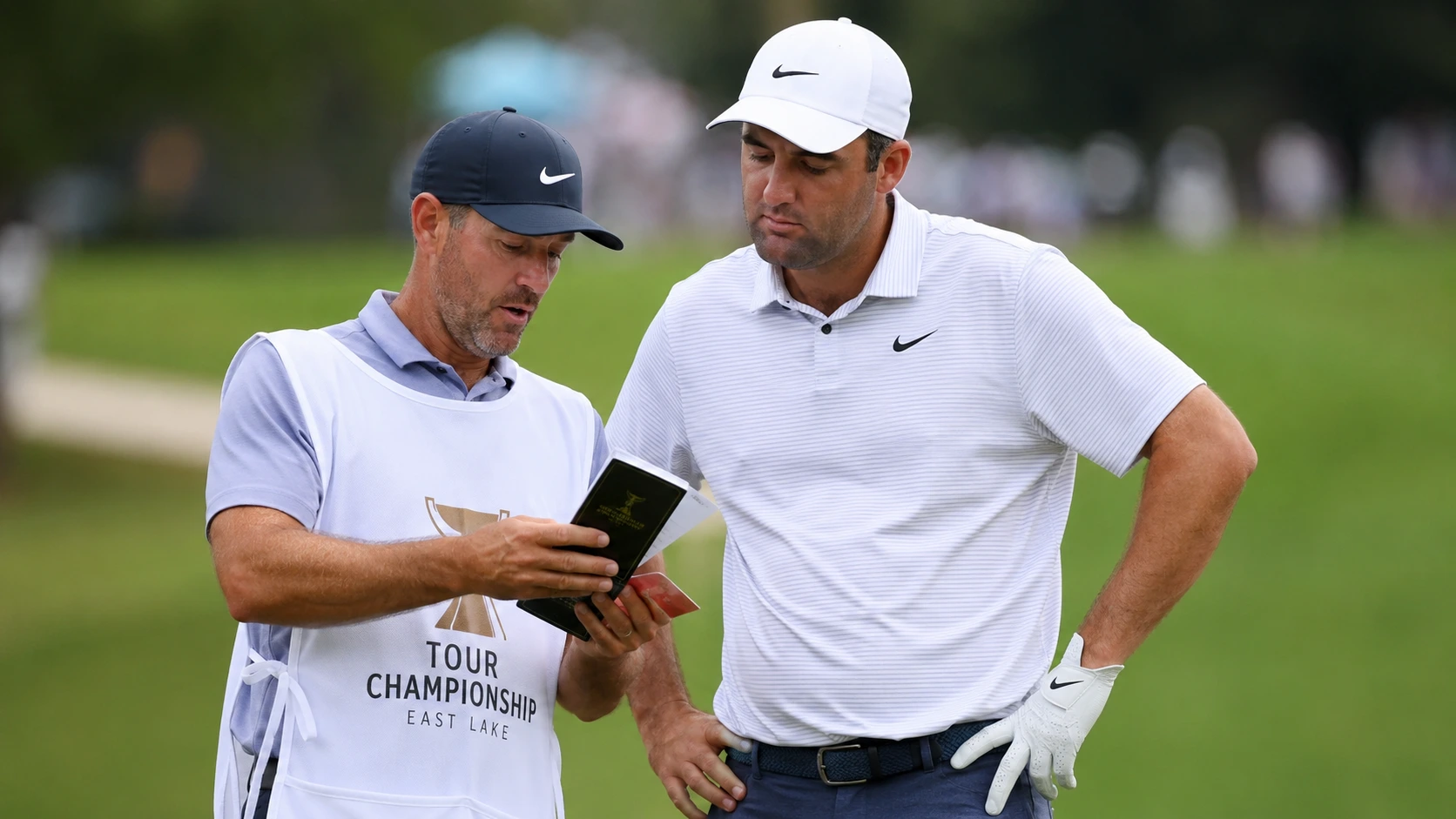
Ted Scott's value is not that he can read a number faster than a rangefinder. It is that he and Scheffler have already built a shared language for what the number means: the carry, the preferred landing window, the miss that keeps par in play, and the shot shape that survives the wind. That trust is built in the homework before the round, not improvised beside a green.
It also explains why Scheffler did not suddenly become a different player when Scott was absent. In 2025, he won the BMW Championship with Michael Cromie and used Brad Payne as a fill-in at the FedEx St. Jude Championship: two wins or near-wins that made the value of backup caddies impossible to reduce to superstition. The PGA TOUR account of the BMW win and its report on Scott's return show the distinction: the partnership matters, but Scheffler's process is not stored in one person's head.
5 Club Selection Myths Fact-Checked
- “Always take enough club.” Take the club that carries the intended landing zone, not the club that wins a distance argument on the range.
- “Aim at the flag.” The flag is one point. A safe quadrant is a larger target with a better miss pattern.
- “The rangefinder gives you the answer.” It gives you permitted distance information. Green depth, wind and rollout remain a judgment call.
- “Sunday was cruising.” A 66 and 15 greens can look easy only after the club decisions have removed the avoidable trouble.
- “A caddie is just a yardage carrier.” The useful job is turning raw inputs into a shared, repeatable decision without taking the stroke away from the player.
The Three-Number Protocol for Your Home Course
You do not need a tour yardage book to steal the useful part of Scheffler and Scott's process. Before choosing a club, write down three numbers:
- Front: the carry needed to reach the putting surface.
- Finish: the distance to the back edge or the point where long becomes expensive.
- Landing: the exact window you want, adjusted for wind, elevation and rollout.
Then choose the club whose normal carry reaches the landing number with room for the miss. Turn slope mode off, make the adjustment yourself and aim at the safe side of the green. The point is not to copy a professional's distances; it is to stop pretending that the flagstick is the whole problem.
The Raw Verdict
Scheffler's birdie at 16 was the moment the scoreboard settled, not the moment the strategy began. The real advantage was the disciplined conversion of six environmental inputs into one usable landing number. Ted Scott helps make that process shared and calm. Scheffler still has to hit the shot, but he is rarely asking the shot to solve a question he should have answered before taking the club back.
Frequently Asked Questions
What does “finding the number” mean in golf?
It means converting raw distance, green depth, elevation, wind and expected rollout into a specific landing target and club choice.
Can golfers use slope mode on a rangefinder?
Not when the Committee has adopted the relevant Rule 4.3a restrictions. Distance information may be allowed, while slope, wind and club recommendations are not.
What was Scottie Scheffler's final score at the 2026 Tour Championship?
Scheffler closed with a 66 to finish at 16-under 264 and beat Viktor Hovland by three strokes.
Sources
- PGA TOUR: Tour Championship final-round score and payout report
- USGA: distance-measuring-device Rule 4.3a guidance
- USGA: distance-measuring-device FAQ
- PGA TOUR: Scheffler's 2025 BMW Championship win without Ted Scott
- PGA TOUR: Ted Scott returns to Scheffler's bag
Read the Hovland runner-up breakdown, the Scheffler and Brandel Chamblee arc, or Tour Championship points and payouts.