
The Quick Verdict
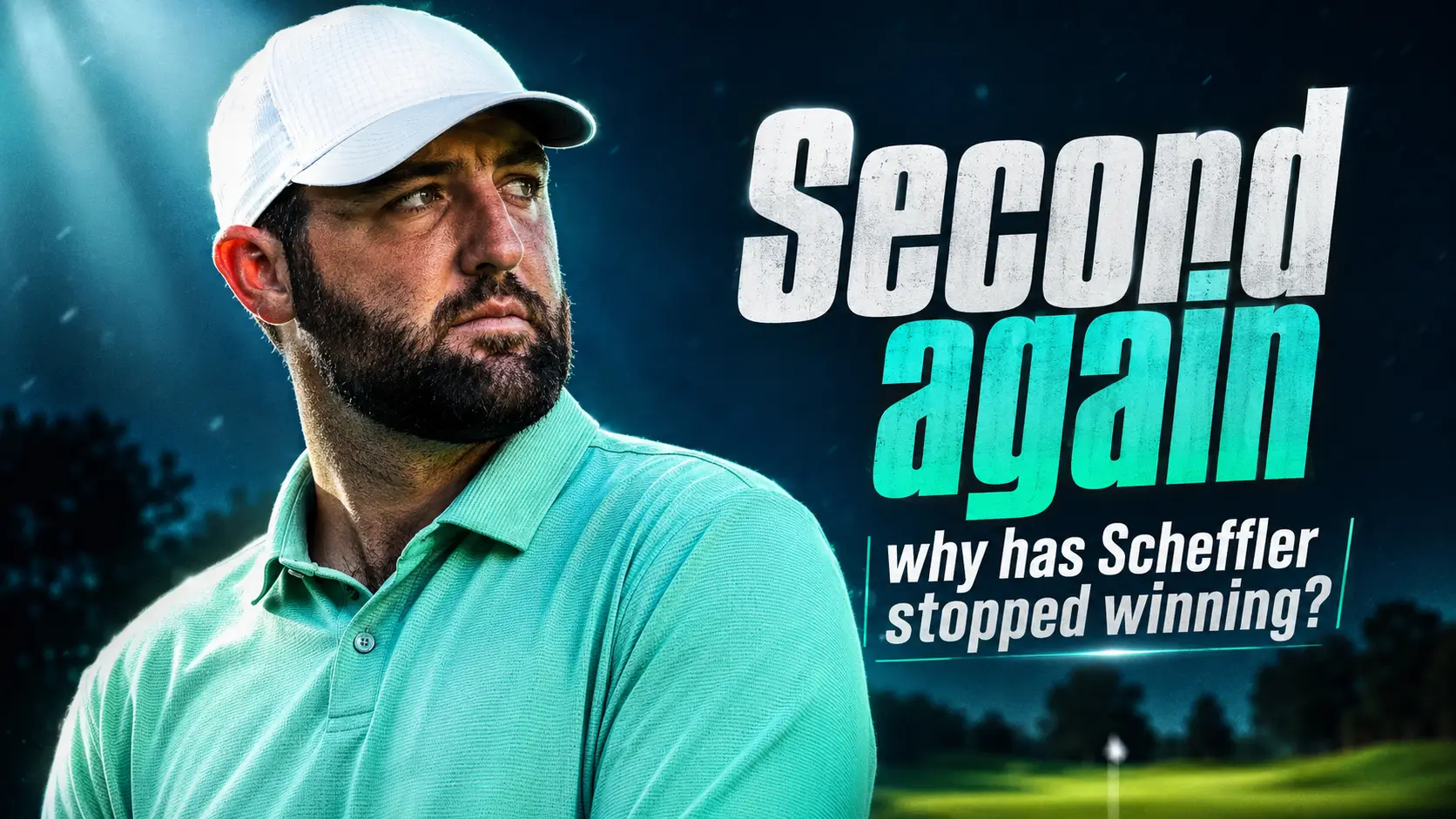
Scottie Scheffler has won once in 2026, at The American Express in January, and finished second five times. He still leads the FedExCup and still has the Tour's lowest scoring average. His strokes gained per round has slipped from 3.31 last year to 2.84 — which is a real decline and also still about half a stroke clear of the second-best player in the world.
The two numbers that actually explain the win column are these: in 2025 he played in five final groups and won all five. In 2026 he's played six and won one. And he's gone from leading the Tour in bounce-back rate to 66th.
Nobody, as far as I can find, has demonstrated why.
Start with what's true
He hasn't collapsed. The picture people carry around — Scheffler struggling — doesn't match his own scorecard.
Through mid-July he had nine top-10s in 14 starts. Two thirds. Five second places. He was in the final pairing at the U.S. Open on Sunday. He shot 63 on the last day at the 3M Open and still lost. The PGA Tour headlined its own piece on him "what's different (not wrong)", which is self-serving from the organisation that promotes him but isn't inaccurate.
CBS put the strokes-gained series plainly: 3.22 in 2024, 3.31 in 2025, 2.84 now. That last figure is still better than his own 2022 and 2023 seasons — the ones where he became world No. 1. It's also roughly half a stroke a round better than McIlroy, who is second.
Do the arithmetic yourself: 3.31 minus 2.84 is 0.47 a round. Over four rounds that's under two shots a tournament. That's the whole decline. Two shots.
Two shots is also, more or less, exactly the difference between winning and finishing second.
The number that actually hurts
Here's the one I keep going back to, from golf.com.
In 2025, Scheffler played in five final groups and won all five tournaments. In 2026, he's played in six and won one.
That's not a slump in ball-striking. That's a conversion rate falling off a cliff. And the list of people who beat him is not a list of flukes — McIlroy at the Masters by one, Fitzpatrick in a playoff at Harbour Town, Cameron Young by six at the Cadillac, Hovland in a Monday playoff at the Travelers that lasted thirteen minutes, and a 21-year-old rookie at the 3M Open eight days into his professional career.
I have to be honest about that statistic, though, and most people quoting it aren't. Five-for-five is not a repeatable skill. It's a spectacular run. One-for-six isn't a diagnosis either. Six trials cannot tell you the difference between a player who's declined and a player who's been unlucky. Anyone claiming otherwise is doing storytelling with a spreadsheet open.
What you can say is that the two seasons feel completely different for a reason, and the reason is mostly located in about eight Sunday afternoons.
The one stat that isn't just luck
Bounce-back rate. It's how often you make birdie on the hole right after a bogey.
Scheffler led the Tour in it. He's now 66th.
That one I find harder to wave away, because it's measured across every hole he's played rather than six Sundays, and because it describes something specific: the ability to answer immediately after a mistake. He also, per the Tour, still gets off to slow starts on Thursdays, which was true last year too and mattered less when he was making up the ground.
Caveat where it's due: bounce-back rate is noisy, and a rank of 66th can hide a very small percentage gap. The Tour didn't publish the underlying number. But it's the most concrete change anyone has put on the table.
Then 10 July happened
At the Genesis Scottish Open he shot 68-72 and missed the cut by two.
That ended a streak of 78 consecutive cuts made — the longest active run in professional golf, 51 starts longer than the next man, Matt Fitzpatrick. His last missed weekend was the FedEx St. Jude in August 2022, which works out at 1,428 days. In the same afternoon a second streak died: he'd finished top-25 in 35 straight starts, going back to the 2024 BMW Championship.
The Tour's own read on that week was unsentimental. Below average with his approach play, not enough fairways, so no easy birdie looks. Scheffler said he didn't feel he played that badly and that the course can be tough.
A practical warning while you're reading around on this: a lot of what's currently on page one of Google was written before 10 July and says he's made every cut this season with nothing worse than a T24. Both of those were true and neither is now. Check the date before you trust the season line. Same goes for the runner-up count, which was four until the 3M Open made it five — I've seen at least one wire report from Sunday still carrying the old number.
So why is it happening?
Here's where I have to stop, because the honest answer is that nobody knows and several people are pretending otherwise.
The most-cited theory came out of the 3M Open, where a writer watched him short-side himself twice on Friday chasing flags at the 14th and 17th, and concluded he's pressing — taking on shots he wouldn't take on if he'd already won three times. It's a plausible read from someone who was watching. It's also a theory built on two holes, with no aggression data behind it, published under a headline claiming the reason had become clear.
And it runs straight into an awkward fact. Two days later, at the same tournament, he gained 4.6 strokes on approach and nearly six shots putting. That's a man striping it and holing everything. He still lost by three.
There's a bigger absence worth naming: I couldn't find a single swing coach, statistician or sports psychologist on the record about any of this. Every explanation in circulation is a golf writer's inference or a fan's hunch. For the most analysed player in the sport, that's a strange gap.
The most defensible answer is the unsatisfying one. A small real decline — about two shots a tournament — has landed on top of a run of Sundays where the other guy went low. Those two things are hard to separate with the evidence available, and they might not be separable until he's played another thirty events.
What he says about it
He's been consistent and unbothered about it all year. Before the Scottish Open he said he'd been close and that it's frustrating, but that a fourth and a second aren't bad results. After the missed cut: "I'm definitely proud of the consistency." After the Hovland playoff, he said it was some of the best he'd hit it all season.
The line he keeps returning to is that the margins in golf are really small. Which, from a man who's lost by one, in two playoffs, and by three while shooting 63, reads less like a platitude than a description of his year.
FAQ
How many times has Scheffler won in 2026?
Once, at The American Express — the first event of the season.
How many second-place finishes?
Five, after the 3M Open. The Tour says only he and Cameron Young in 2022 have had five or more in a season in the last forty years.
Who has beaten him?
McIlroy, Matt Fitzpatrick, Cameron Young, Viktor Hovland and Jackson Koivun.
Is he still the best player in the world?
By the numbers, yes. He leads the FedExCup and has the Tour's lowest scoring average, and his strokes gained per round is about half a shot clear of second.
Has he actually got worse?
Slightly. From 3.31 strokes gained per round in 2025 to 2.84 now — still better than his 2022 and 2023 seasons.
Did he miss a cut?
Yes, at the Genesis Scottish Open on 10 July. It ended a run of 78 straight, the longest in the game.
How many did he win in 2024 and 2025?
Seven and six on the PGA Tour. You'll also see "nine" for 2024 — that figure includes his Olympic gold medal and the Hero World Challenge, neither of which is an official Tour win.
What's the single biggest change?
Final-group conversion: five-for-five in 2025, one-for-six in 2026. Bear in mind six is a very small sample.
Does anyone know the cause?
No. The theories in circulation are inferences, not findings.
GolfRaw's Take
The reason this story exists at all is that Scheffler set a standard almost nobody in history has met, then dropped two shots a tournament off it. He's having the year most players on Tour would frame and hang on the wall — nine top-10s in fourteen starts, second five times, top of the money list — and it's being written up as a crisis because he isn't lapping the field any more. The part I'd actually watch is the bounce-back number. Everything else in this story might be six unlucky Sundays. Going from first to 66th at making birdie after bogey is a different kind of signal, because it happens on every hole of every round, and it's the closest thing to evidence that something real has shifted. If that rank climbs back over the next few months, this was variance and we all wasted our time. If it doesn't, then somebody should ask him about it — because so far, nobody has.