
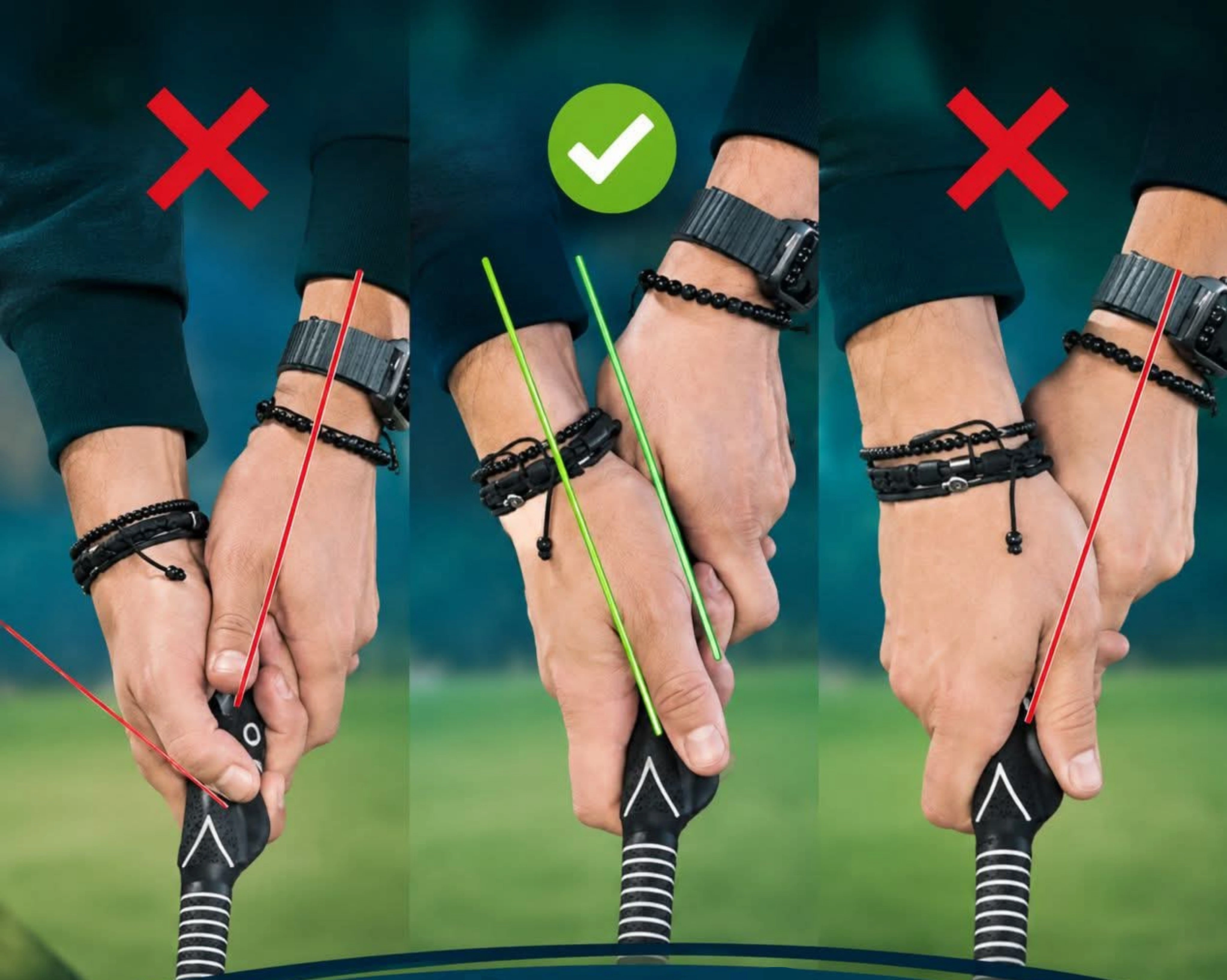
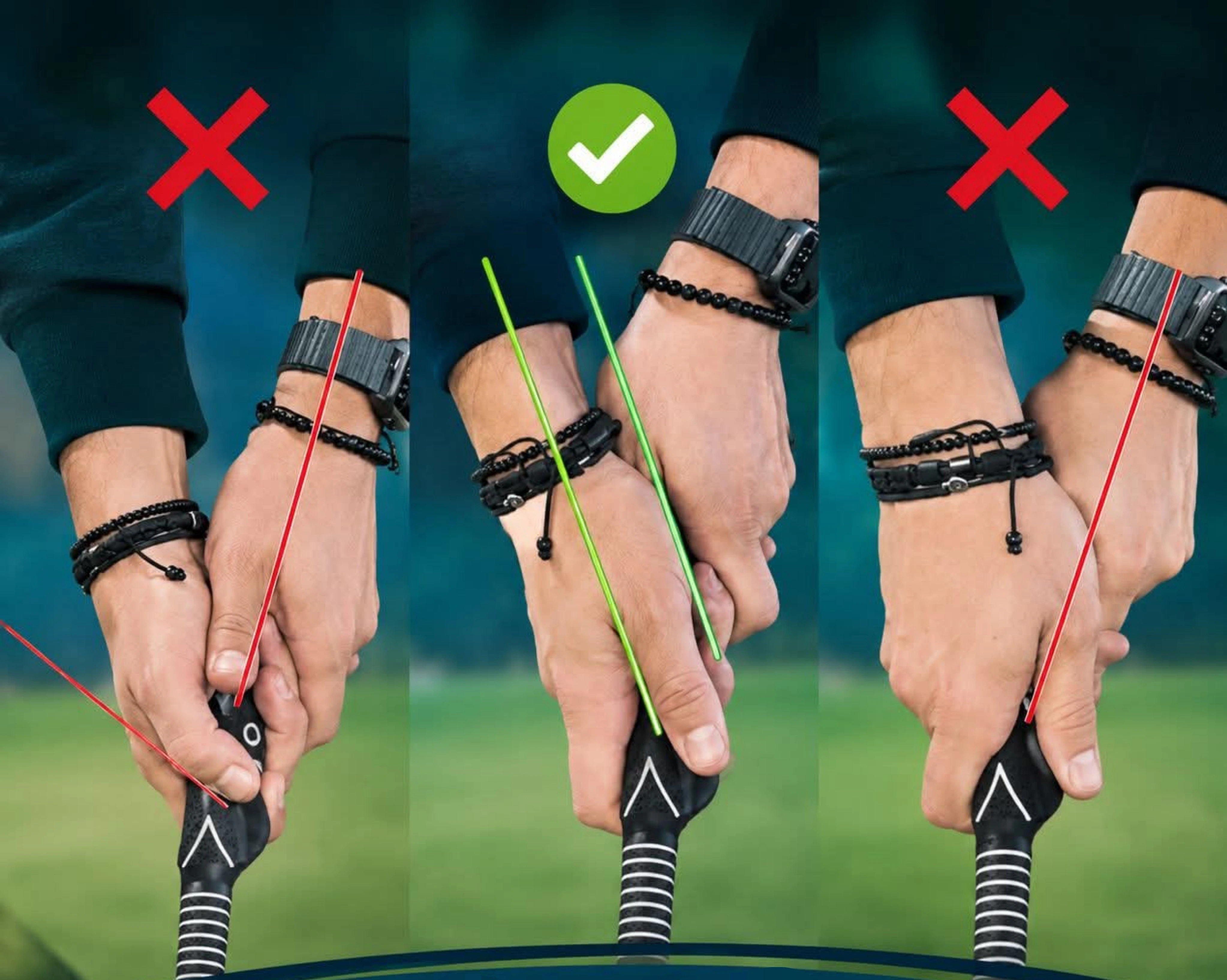
Look down at your lead hand right now as you take your standard setup. If you cannot see at least two knuckles on your left glove (for a right-handed player), you have preset an open face and encourages a slice before the backswing even starts.
That answer is true and incomplete. It solves half of the equation while ignoring the mechanical trap that so many weekend players fall into when attempting to fix ball-flight errors through hand position alone. Here is the unvarnished breakdown of what counting your knuckles actually achieves, what launch monitors prove, and what a grip change leaves out.
Why the grip matters more than any other setup detail
Your hands are your only physical connection to the golf club. Every ounce of kinetic energy, rotational torque, and face orientation is transmitted through roughly six square inches of contact area on rubber and leather.
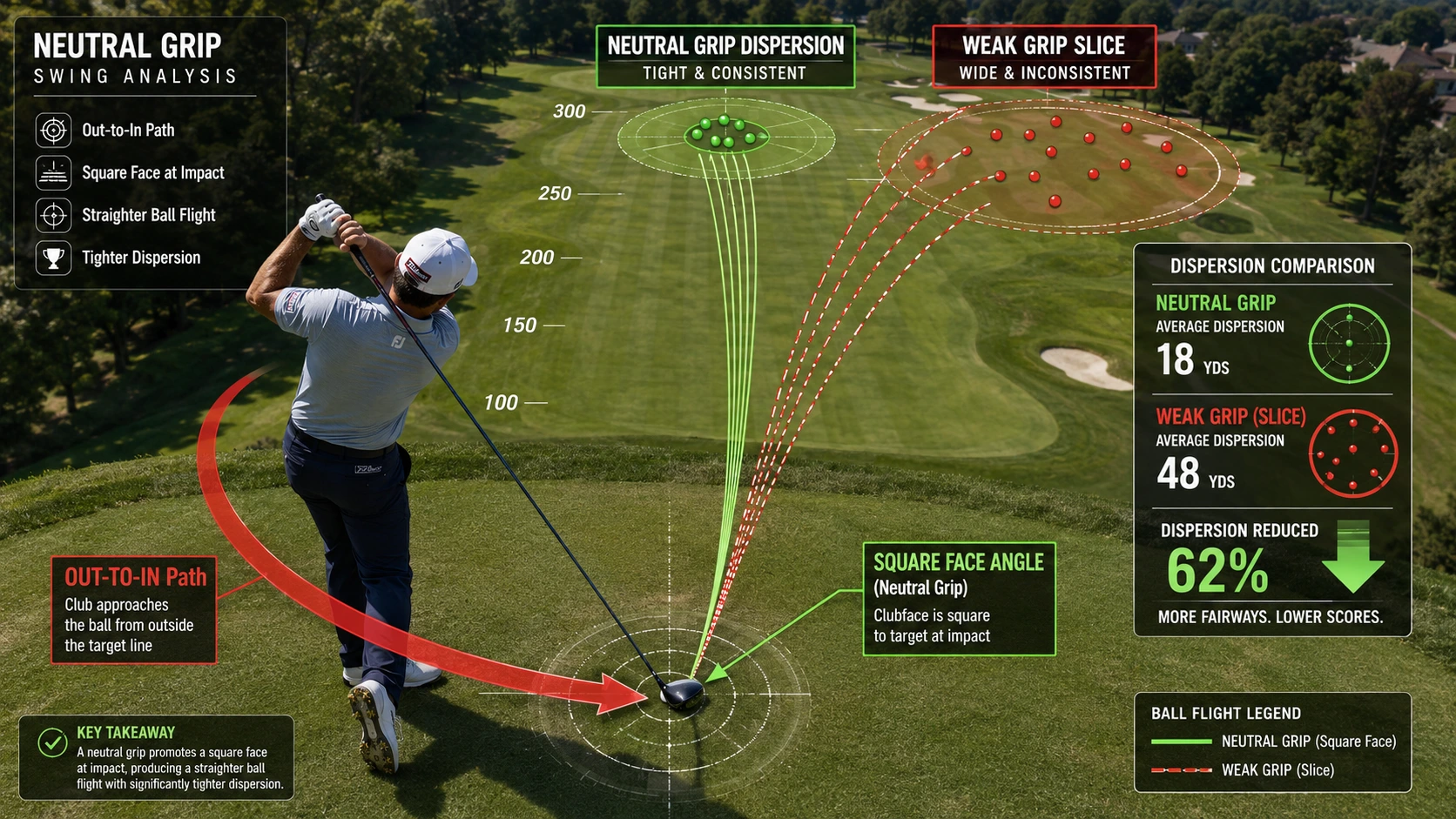
Launch monitor physics demonstrate that clubface angle at impact accounts for roughly 75% to 85% of initial ball direction. If the face is open by just two degrees at separation, no amount of hip rotation or shallowing will prevent the ball from starting right of your intended target line.
The knuckle test, in four seconds
Take your regular grip and look straight down at your lead hand without tilting your head. Count the visible knuckles at address:
- 0 to 1 Knuckle (Weak Grip): Presets the clubface wide open relative to the wrist angle. This requires rapid, unrepeatable forearm flip through impact and is the root cause of what causes a slice, in plain English.
- 2 to 2.5 Knuckles (Neutral Grip): The standard modern tour baseline. It aligns the back of the lead hand with the clubface, allowing body rotation to square the strike effortlessly.
- 3 to 4 Knuckles (Strong Grip): Presets a closed face. Popular among power hitters, but requires aggressive body rotation to avoid duck hooks.
What the testing actually shows
When high-handicap golfers switch from a 1-knuckle weak grip to a solid 2.5-knuckle neutral-to-strong position, TrackMan testing reveals immediate, measurable shifts:
- Dynamic face-to-path angle narrows by an average of 4.2 degrees.
- Side-spin is cut by over 600 RPM on driver swings.
- Ball speed increases by 2 to 3.5 mph due to more centered, flush face contact.
The thing a grip change will not do
Here is where golf instruction often sells false promises: a stronger grip will not fix an out-to-in swing path. If your swing path travels 6 degrees across the ball from outside to inside, strengthening your grip simply turns a high banana slice into a low, screaming pull-hook directly into the left trees.
To eliminate ball curvature permanently, you must pair face control with learning how to fix your swing path through proper hip depth and shallow transition moves.

Grip pressure and the other detail nobody mentions
Most amateur golfers strangle the grip at a pressure level of 9 out of 10. White knuckles freeze forearm muscles, preventing the wrists from naturally cocking at the top and releasing through the hitting zone.
The goal is a constant 4 out of 10 pressure—holding the club like a fresh tube of toothpaste without squeezing any paste out. Furthermore, placing the grip across the base of the fingers rather than high in the palm adds an immediate 10 to 15 yards of effortless speed.
What the rules let you do about it
Under the USGA and R&A Rules of Golf (Rule 4.1a and Equipment Rules), standard round or ribbed grips are completely conforming. However, training grips with pre-molded finger channels or pronounced thumb indentations are strictly non-conforming for competition.
You can use training grips on the range or in practice sessions, but you must ensure your tournament bag contains standard grips conforming to the rules.
Five things about the grip that don't hold up
- “A strong grip is wrong and bad technique.” False. Multiple major champions—including Zach Johnson, Paul Azinger, and Dustin Johnson—have won at the highest levels with strong grips.
- “Interlocking is superior to overlapping.” Overlap (Vardon) and interlock are purely personal comfort choices based on hand size and finger length.
- “Grip pressure should change during the downswing.” Squeezing harder at impact disrupts face alignment; maintain steady, relaxed pressure from takeaway to finish.
- “You should grip the club in your palms for stability.” Palm grips restrict wrist hinge and cost substantial clubhead speed; fingers provide mobility.
- “Fixing your grip will immediately feel natural.” Any grip modification feels foreign for the first 100 swings; commit to muscle memory before judging results.
The Raw Verdict
Counting your knuckles is the fastest four-second diagnostic test in golf. Moving from one knuckle to two and a half will instantly tame your clubface, but don't expect it to magically fix a steep over-the-top swing. Fix the face first with your hands, then fix the path with your pivot.
FAQ
What does a weak golf grip cause?
A weak grip—where zero or only one knuckle is visible at address—presets the lead wrist in an open orientation, making it difficult to square the clubface at impact and causing weak, high slices.
Can strengthening your grip fix a slice?
Strengthening the grip closes the clubface to reduce slicing side-spin, but it will not fix an out-to-in swing path on its own. It turns a weak slice into a pull or hook unless path is addressed.
How much does clubface angle affect the ball's start line?
Launch monitor physics prove that the clubface angle at impact accounts for approximately 75% to 85% of the ball's initial launch direction with a driver and irons.
How tight should you hold a golf club?
On a scale of 1 to 10, grip pressure should be around a 4 or 5—firm enough to maintain control and prevent slipping, but relaxed enough in the wrists to allow fluid hinging and speed release.
Are training grips or molded grips legal under the Rules of Golf?
No. Under the USGA/R&A Equipment Rules (Part 2, Section 3), grips with molded finger indentations or training ridges are non-conforming for competitive rounds.
Sources
- USGA & R&A Equipment Rules: Rule 4.1 Club Conformance & Grips. Standard specifications for competitive grips.
- GolfRaw: Beginner Grip Guide. Fundamentals of lead and trail hand grip placement.
- GolfRaw: How to Fix Over the Top. Swing path diagnosis and correction for recreational golfers.
- GolfRaw Rating Manual. Ball flight physics, launch direction laws, and ball striking analytics.