
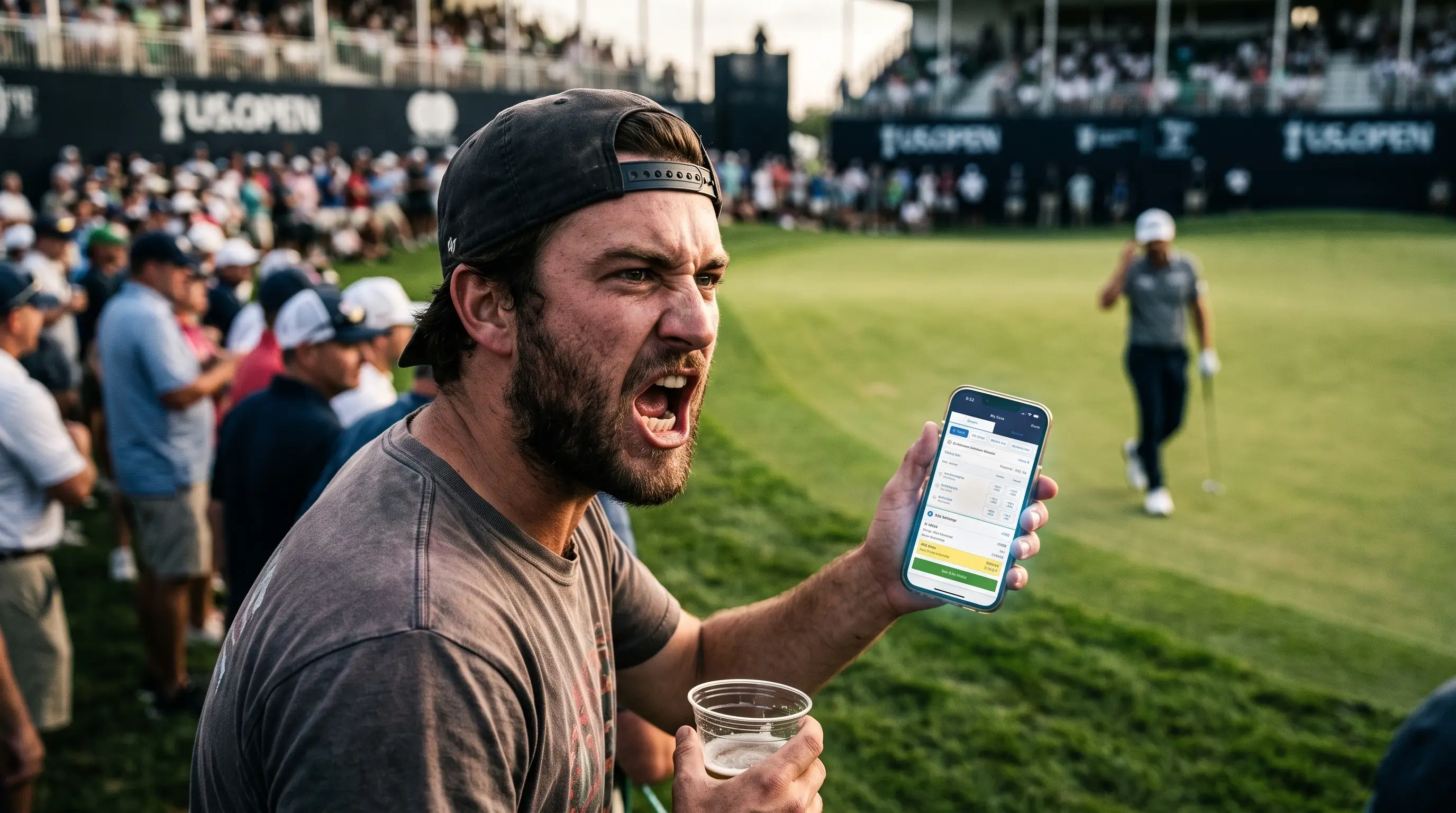
Quick answer: A growing share of the abuse players hear inside the ropes is not random rowdiness. It is money. The explosion of mobile sports betting has filled galleries with app-wielding fans who treat golfers as a bet that owes them, heckling missed putts they had the under on and even chasing players for losses online. Wyndham Clark's hostile U.S. Open was the loud version, but pros say it now happens weekly. The uncomfortable part: the same PGA Tour trying to police it is also cashing in on the betting that fuels it.
Is sports betting ruining golf?
Yes, the unchecked rise of in-app sports betting has fundamentally changed golf galleries, turning respectful crowds into rowdy bettors heckling players to protect their wagers.
It has not ruined the game itself, but it has poisoned the experience around it. The betting boom rewired the incentive of the average spectator: instead of pulling for a good shot, a meaningful slice of the crowd is now rooting against a player to protect a live wager. That single shift is what turned polite galleries into hostile ones, and it is why players now hear their bad shots met with cheers.
The Financial Heckle: How Wagers Replaced Heckling
A shift is occurring inside the ropes on the PGA Tour, and the players are the ones bearing the brunt of it. What used to be simple, alcohol-fueled rowdiness or a good-natured ribbing has transformed into something much more specific, personal, and financial. The defining tell is in the words being yelled from the gallery. Fans are no longer just shouting generic insults; they are yelling detailed details of their financial wagers.
Tour professionals report hearing gambling-related abuse at least once a week—and often once a day—regardless of their position on the leaderboard. Spectators are now shouting that a player just cost them money, demanding birdies to cash a ticket, or cheering missed par putts because they bet the over. This behavior has a distinct motive, and that motive is money. By adding a financial stake to every shot, golf has converted the casual spectator into a hostile counterparty.
The Micro-Betting Loophole: Why Golf is a Gambler’s Paradise
How did golf galleries become so volatile? The answer lies in the legal sports betting boom, which saw Americans wager over $166 billion in 2025 across more than 35 states. More importantly, it is driven by the shift from traditional tournament-winner wagers to micro-bets and prop bets.
Golf is almost uniquely vulnerable to micro-betting. A typical tournament features roughly 30,000 individual shots, and the sport’s slow, deliberate pace—with minutes between shots and 15 minutes to play a single hole—provides app-wielding fans with all the time they need to place live wagers. When a bettor wagers on whether a player will find a fairway or sink a ten-footer, the action isn't occurring on a distant field; it is happening right in front of them. When the bet goes bust, the athlete responsible is standing just ten feet away.
The Shifting Target: Wyndham Clark and the Shinnecock Fallout
The hostile gallery that Wyndham Clark encountered during his U.S. Open victory at Shinnecock Hills was the betting-era crowd playing at full volume. Clark, a heavy -280 favorite entering Sunday, was a prime target for fans who had significant money riding on the outcome on their phones. The crowd cheered his misses, yelled "get in the bunker" on his tee shots, and forced security and police to eject multiple spectators.
While Clark's existing on-course reputation gave the crowd a convenient excuse to target him, the real driver was the gambling culture behind the ropes. The systemic nature of the issue was highlighted by another Tour player, who noted that a fellow pro was heckled at an entirely different event in Detroit by a fan yelling that he had money on Clark. When players are being abused because of bets placed on other golfers at other tournaments, it is clear that golf has a gambling problem disguised as fan engagement.
From the Fairway to Venmo: The Rise of Digital Harassment
The abuse isn't confined to the physical boundaries of the course; in fact, the off-course harassment is often worse, raising serious player safety concerns. The heckling on the fairways is merely the visible tip of a larger crisis. The uglier encounters are happening directly on players' personal devices.
Max Homa has publicly discussed receiving angry direct messages and Venmo requests from disgruntled sports bettors demanding that he pay them back for their losses. This digital entitlement reflects a broader sports trend where athletes are subjected to insults, financial demands, and even threats from losing gamblers. The psychology is toxic: because a fan placed a bet on a player, they believe the player owes them a return, and the step from a hostile Venmo request to a physical security threat is alarmingly short.
The Tour’s Defensive Playbook: Reporting Tools and Account Bans
In response to rising player complaints, the PGA Tour has recently introduced new reporting guidelines. Caddies and players now have channels to report gambling-related harassment both on the course and online, allowing security to target and eject disruptive spectators.
Additionally, the Tour's sportsbook partners have begun taking retaliatory measures. DraftKings and BetMGM have updated their terms of service to prohibit athlete harassment, allowing them to suspend or ban accounts of bettors who target players online. While these are reasonable defensive measures, they are ultimately reactive. They treat the harassment as an inevitable cost of doing business rather than addressing the root cause.
The Double Standard: Cashing In While Policing the Fans
The real obstacle to solving this crisis is the PGA Tour's deep financial ties to the gambling industry. The Tour has leaned aggressively into sports betting because the revenue growth is staggering, with the golf betting handle growing by 30 to 35 percent annually.
The Tour’s actions reveal a striking double standard. It has built a massive 13,000-square-foot DraftKings sportsbook at TPC Scottsdale, introduced betting-focused broadcast streams, launched live prop-betting features, and is working toward offering bets on every single shot. The Tour is actively accelerating the prop-betting boom that turns fans into angry bettors, while simultaneously handing players a form to report the inevitable abuse. Until the Tour is willing to prioritize player safety over a share of the gambling handle, its anti-harassment policies will remain a bucket under a widening leak.
"You cannot floor the accelerator on prop betting and credibly promise to keep the prop-betting crowd polite."
The Raw Read
The heckling that ruined the mood at Clark's U.S. Open was not just New York being New York. It was a preview of golf in the betting age, where a meaningful slice of the crowd is not there for the golf at all. They are there for the bet, and a player who misses a green has not disappointed a fan, he has lost someone money, and that someone is right there with a phone and a grudge.
The honest reckoning is that golf cannot have it both ways forever. It wants the engagement, the revenue, and the relevance that gambling brings, and those are real prizes. But it is now discovering the cost: galleries full of people who see athletes as ATMs, and players getting Venmo requests from strangers who lost a parlay. The Tour's reporting tools are a decent start and nowhere near enough. The real fix would mean choosing the dignity of the player over a slice of the handle, and so far no major sport, golf included, has shown it is willing to make that trade. Clark just happened to be the one standing in the storm when everyone finally noticed it was raining.
If you want the bigger picture on our approach to all of this, here is why we cover golf this way — no PR spin, no looking away from the ugly parts of the sport we love.