
Quick Summary: Donald Trump toured East Potomac Golf Links on Sunday, claiming the planned redevelopment will make this public course capable of hosting major championships like the U.S. Open, PGA Championship, and Ryder Cup. Renowned architect Tom Fazio is attached to the project, with reconstruction scheduled to begin on September 1, drawing on the site's original 1920s Walter J. Travis design. However, an objective analysis of the logistics, low-lying flood-prone terrain, and political/legal challenges suggest that bringing a major to this compact municipal island is a highly unrealistic ambition.
A Bold Capital Vision: The Announcement
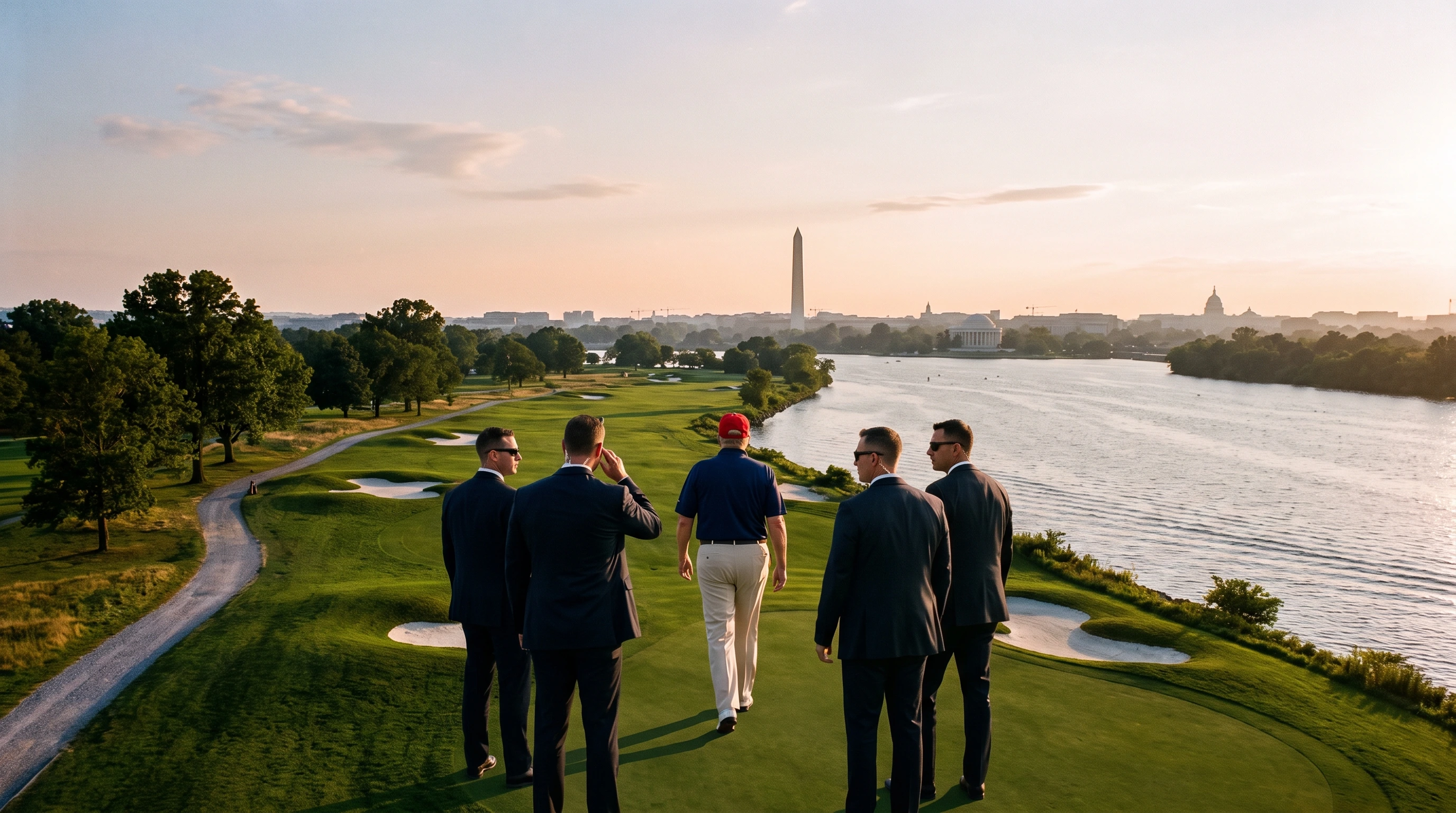
While surveying federal construction projects around the capital on Sunday, Donald Trump toured East Potomac Golf Links and laid out an ambitious, headline-grabbing vision for the modest municipal course. Taking to social media afterward, Trump declared that once the planned redevelopment is complete, the venue will be capable of hosting golf's grandest tournaments, explicitly naming the U.S. Open, the Ryder Cup, and the PGA Championship.
Unlike standard political chatter, this announcement carries immediate operational weight. Trump toured the site alongside Interior Secretary Doug Burgum and renowned golf course architect Tom Fazio, as well as Fazio's son Gavin. According to official reports, reconstruction of the course along the Potomac River is slated to begin on September 1. With a legendary designer, a firm start date, and direct backing from a sitting administration, the redevelopment itself is set in stone—even if the tournament claims are not.
The Heritage of Hains Point: East Potomac's Humble Roots
East Potomac Golf Links is about as far from an exclusive country club as golf gets. Situated on East Potomac Park—a slice of federal parkland on a peninsula (commonly referred to as an island) in the Potomac River near the National Mall—it is an affordable, walk-up city facility that local golfers have relied on for generations. It is a true municipal hub, beloved for its access rather than its prestige.
Yet, the site is steeped in architectural history. The proposed redevelopment plans to incorporate strategic themes from the original design by Walter J. Travis, a legendary early-1900s amateur champion and architect. The stated objective is to build a top-tier, 18-hole championship layout that honors Travis's classic design principles while remaining playable and affordable for everyday golfers in the heart of Washington, D.C.
The Fazio Factor: Architectural Ambition vs. Site Constraints
Bringing Tom Fazio into the fold gives this project immediate design credibility. As one of the most prolific and respected golf course architects in American history, Fazio’s involvement means this is no mere cosmetic touch-up. It indicates substantial financial backing and a genuine desire to build a high-caliber golf course. Fazio’s name alone signals that the physical layout will be designed to challenge the best players in the world.
However, even the greatest golf architects must work within the constraints of the land. A brilliant 18-hole layout does not automatically equal a modern championship venue. While Fazio can craft demanding greens complexes and strategic bunkering, he cannot expand the physical boundaries of the site or relocate the surrounding D.C. infrastructure. The gap between a world-class public layout and a major-ready tournament site is vast, and that is where the logistics fall apart.
Infrastructure and Hydrology: The Reality Check
To understand why a major at East Potomac is an extreme long shot, one must look at the modern footprint of these events. Hosting a U.S. Open, PGA Championship, or Ryder Cup is no longer just about the 18 holes of play. It requires hundreds of acres of adjacent land for corporate hospitality villages, massive TV broadcast centers, media hubs, security perimeters, and parking for tens of thousands of daily spectators. East Potomac Park is a narrow, compact strip of land surrounded by water, leaving virtually no room for this level of heavy staging.
Then there is the environmental reality. Hains Point sits on incredibly low-lying riverfront land that has historically been plagued by severe drainage issues and tidal flooding. Turning this swampy peninsula into a pristine, dry venue capable of holding up under heavy gallery foot traffic during a tournament week is a monumental hydrological challenge. Furthermore, majors are awarded years, sometimes over a decade, in advance by independent governing bodies like the USGA and the PGA of America. These organizations operate on their own timelines and standards, and they have made no declarations regarding East Potomac.
Legal Challenges and the Public Interest
Beyond the physical and geographical hurdles, the project must navigate ongoing legal disputes. The redevelopment is currently subject to a lawsuit, meaning the legal pathway forward is not entirely clear. The initiative is also tied to a broader and sometimes controversial administrative effort to reshape and modernize federal waterfront properties in Washington, D.C.
Crucially, the D.C. municipal courses are managed by the National Links Trust (NLT). The trust's founders have expressed optimism about the renovation, emphasizing that the primary mission remains keeping public golf open, accessible, and affordable for the local community. While major championship claims make for flashy headlines, the true victory for D.C. golfers will be the preservation of a revitalized, affordable muni in the nation's capital.
The Raw Read: Separating Headlines From Hard Ground
Stripping away the political spectacle reveals a familiar pattern: a bold, theatrical claim attached to a genuinely exciting, positive project. A Tom Fazio renovation that restores the Walter Travis bones of East Potomac is fantastic news for golf. It has the potential to transform a tired municipal course into a strategic masterpiece that locals and visitors alike will cherish. That is a massive win for public golf.
However, claims of hosting the U.S. Open or the Ryder Cup must be taken with a heavy dose of salt. Proclaiming a venue major-ready is easy; securing an event is a decades-long process governed by strict logistical and infrastructural demands that this compact, flood-prone site simply cannot satisfy.D.C. golfers can look forward to a beautiful, upgraded municipal track, which is a great result. But expecting Rory McIlroy or Scottie Scheffler to compete for a major trophy on Hains Point remains a very distant dream.
Frequently Asked Questions
What did Donald Trump claim about East Potomac Golf Links?
Trump claimed that following a comprehensive redevelopment, the municipal East Potomac Golf Links in Washington, D.C., would be capable of hosting major championships, including the U.S. Open, the PGA Championship, and the Ryder Cup.
Who is leading the redesign of the Trump DC golf course project?
Acclaimed golf course architect Tom Fazio, alongside his son Gavin, is designing the renovation. The new layout will draw on the historic 1920s design by Walter J. Travis.
When is the renovation of East Potomac Golf Links scheduled to start?
Reconstruction is scheduled to begin on September 1, according to official statements made during the site tour.
Can East Potomac Golf Links realistically host a major championship?
It is highly unlikely. Modern major championships require massive acreage for corporate hospitality, media hubs, parking, and security, which Hains Point's compact island site cannot easily support. Additionally, the site faces severe drainage and flooding issues, and major venues are awarded by governing bodies (USGA and PGA of America) years in advance.
Will East Potomac remain a public golf course?
Yes. The course is operated by the National Links Trust, which remains committed to keeping Washington, D.C.'s municipal courses accessible and affordable for everyday golfers.