
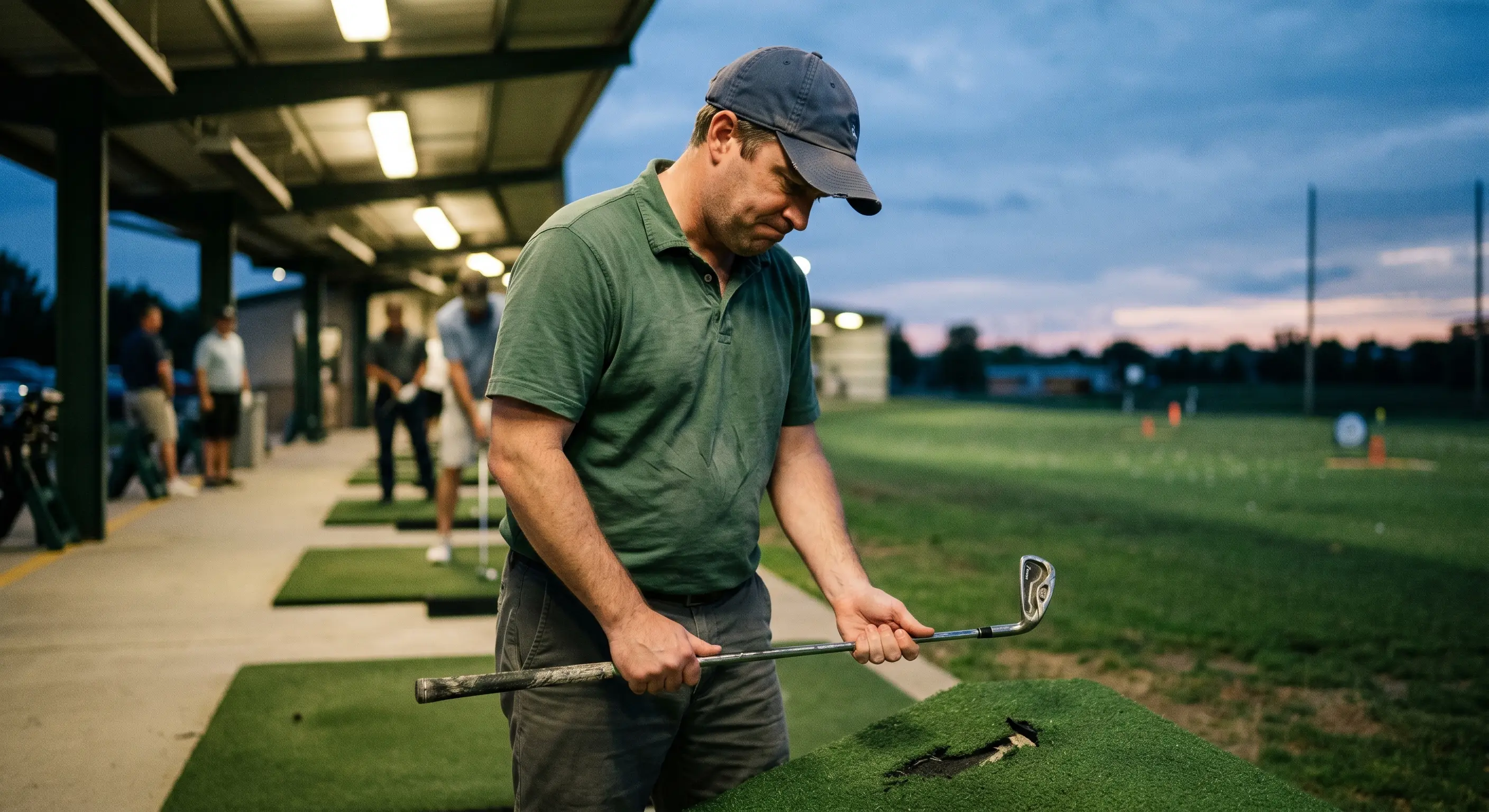
Here is a scene you have probably lived. You arrive at the driving range with a bucket of balls and high intentions. You've been watching swing breakdowns on YouTube all week. You've just read about someone's incredible experience with the Orange Whip golf swing trainer — that big, flexible thing with the orange ball on the end that promises tempo, rhythm, and a tour-quality feel — so naturally you bought one. It arrived on Tuesday. You warmed up with it in your garden on Wednesday. You are ready.
You proceed to hit 90 balls into roughly the same patch of trees you were hitting into three weeks ago.
This is raw golf. Not in the aspirational sense — in the brutally literal sense. This is what the game actually feels like for most people who play it. And the entire golf improvement industry is built on making you forget that and buy something else instead.
The Performance of Improvement vs. Actual Improvement
There is a difference between getting better at golf and looking like you are getting better at golf. The modern golfer has become extremely sophisticated at the latter.
We track our stats in apps. We post our handicap movement on Instagram. We obsess over how to increase golf swing speed, watching our number tick up on the launch monitor while completely ignoring the fact that our accuracy is so poor that the extra 8 yards we've gained is just 8 more yards in the rough. We talk about our "swing journey" like it's a personality trait.
None of this is improvement. It's the costume of improvement. And the tragic thing is that it feels almost exactly the same — the sense of busy-ness, of working hard, of being invested in the process — without any of the results.
Raw golf starts when you strip that costume off and look honestly at what's underneath.
Stop Buying Gear, Start Tracking Shots
Golf is the only sport where mediocre players have better equipment than most professionals did twenty years ago. The technology in a standard modern iron is genuinely extraordinary. The forgiving face, the tungsten weighting, the vibration dampening — it's all real, and it all works.
And yet every other week, someone is searching for a 2nd Swing Golf discount code, picking up yet another driver or a wedge with a slightly different grind, hoping that this purchase is finally the variable that was holding them back. Spoiler: it never is. The equipment isn't the problem. The equipment has been good enough for years. What's missing is an honest reckoning with your actual tendencies — the shots you hit when nobody is watching, the misses you never talk about, the distances you've been lying to yourself about.
Before you spend another penny on gear, do this instead: for four rounds, write down every shot. Every chunked chip. Every three-putt. Every tee shot that went left and then kept going left. At the end of those four rounds, you will know exactly what you actually need to work on. And I promise you, it will not be "a new driver."
Track 3 things for your next 4 rounds: fairways hit, greens in regulation, and putts per hole. You'll have a clear picture of where your shots are actually bleeding — without spending a single penny.
The Body You Have vs. The Body You're Pretending to Have
Here is another honest conversation nobody wants to have: your physical limitations matter. A lot. And ignoring them is one of the most common reasons club golfers plateau for years.
Proper golf swing exercises — hip mobility work, thoracic spine rotation, glute activation — aren't glamorous. They don't look impressive on social media. But they are the difference between a golfer who keeps getting tighter and more restricted as they age, and one who is still generating effortless speed at 55. The range session doesn't build the body. The boring twenty minutes of mobility work before it does.
The irony is that most golfers who are desperately searching for ways to add distance would gain more yards from six weeks of consistent mobility training than from any equipment change they could make. The limitation isn't your shaft. It's your lead hip. But nobody sells a subscription for that, so nobody talks about it.
"The golf industry sells you the swing you wish you had. Raw golf makes you honest about the swing you actually have."
Playing to Your Actual Game, Not Your Fantasy Game
Every golfer has a fantasy game and an actual game. The fantasy game is the one where you bomb it 280 down the middle, hit a crisp 7-iron to 12 feet, and hole the putt. The actual game is the one that shows up on Saturday morning, with its cut that curves ten yards more than you expect and its tendency to thin it through the back of the green under pressure.
Raw golf means making decisions based on your actual game. This means several things in practice:
- Play the right ball for your swing speed. If your driver speed sits below 90 mph, the best golf ball for slow swing speed is a low-compression model — something in the 60–80 compression range. It will feel better, fly straighter, and give you better distance. The $65-a-dozen tour ball you're using right now requires speed you don't currently have to compress properly. It is actively hurting you.
- Stop obsessing over your golf swing speed on the range and start obsessing over how often you find the fairway. More speed is only useful if you have the accuracy to make use of it. Accuracy first, speed second.
- Leave the technical thoughts in your bag on the course. The obsession with perfecting an inside-out golf swing is something to work on in a practice session with a coach, with a camera, with deliberate repetition. On the course, that kind of technical thinking shuts down your instincts and kills your rhythm. On the course, you pick a target, you visualise the shot, and you swing. That's it.
What Honest Practice Actually Looks Like
Honest practice is uncomfortable in a specific way. It targets your weaknesses, not your strengths. It means going to the range and hitting the shot you hate the most — the 165-yard carry over water, the tight draw off the tee into a gap — rather than the shot you love. It means practising three-foot putts for forty minutes even though they are boring, because your stats show you miss them 30% of the time under pressure.
Honest practice doesn't feel like warming up. It doesn't feel like a groove session. It feels like being slightly bad at something in a controlled environment where you are safe to be bad at it. That discomfort is the signal that you are doing something genuinely useful.
Play fewer holes with full attention than more holes on autopilot. Hit fewer balls with real intent than more balls on autopilot. Stay shorter on the range and more honest with yourself about what you saw. That is the whole system. It is not complicated, and it does not require a subscription.
The Scorecard Doesn't Lie
At the end of every round, the only honest document is the scorecard. Not your feelings about the round. Not the three shots that were actually great. Not the unlucky bounce on 14. The number.
Raw golf means accepting that number without narrative. It means looking at it clearly — not beating yourself up, not making excuses — and asking a single honest question: what pattern does this reveal? That question, asked consistently over months and years, is the engine of actual improvement.
The golfer who fakes it never asks that question. They are too busy looking for the next gadget, the next tip, the next thing that will finally unlock the swing they already know is in there somewhere. They will be looking for it for the rest of their golfing life.
The raw golfer knows it is not in there waiting to be unlocked. It has to be built, shot by shot, with honesty as the only tool that matters.