Let's talk about the Ego Trap. You know exactly what I mean. You walk into the golf shop. You grab the shiny, $600 driver that your favourite Tour Pro is gaming on television. The salesman asks what flex you want, and something deep in your subconscious immediately revolts against the word "Regular." So you puff out your chest, grab the X-Stiff model with the low-spin tour head, and march to the first tee feeling invincible.
And then you slice it two fairways over into the trees — the exact same trees you were slicing into before you dropped six hundred dollars. Your playing partner watches in silence. Your bag feels heavier on the walk to the drop zone.
This is the core paradox of golf equipment: the gear marketed most aggressively is almost always the wrong gear for the person buying it. Knowing how to improve golf swing results has far less to do with buying professional-grade clubs and far more to do with playing equipment that's actually matched to your body. A stiff-shaft, low-compression driver built for someone swinging 115 mph is actively working against you at 90 mph. It's the mechanical equivalent of putting Formula 1 tyres on a Honda Civic and wondering why it handles poorly in the rain.
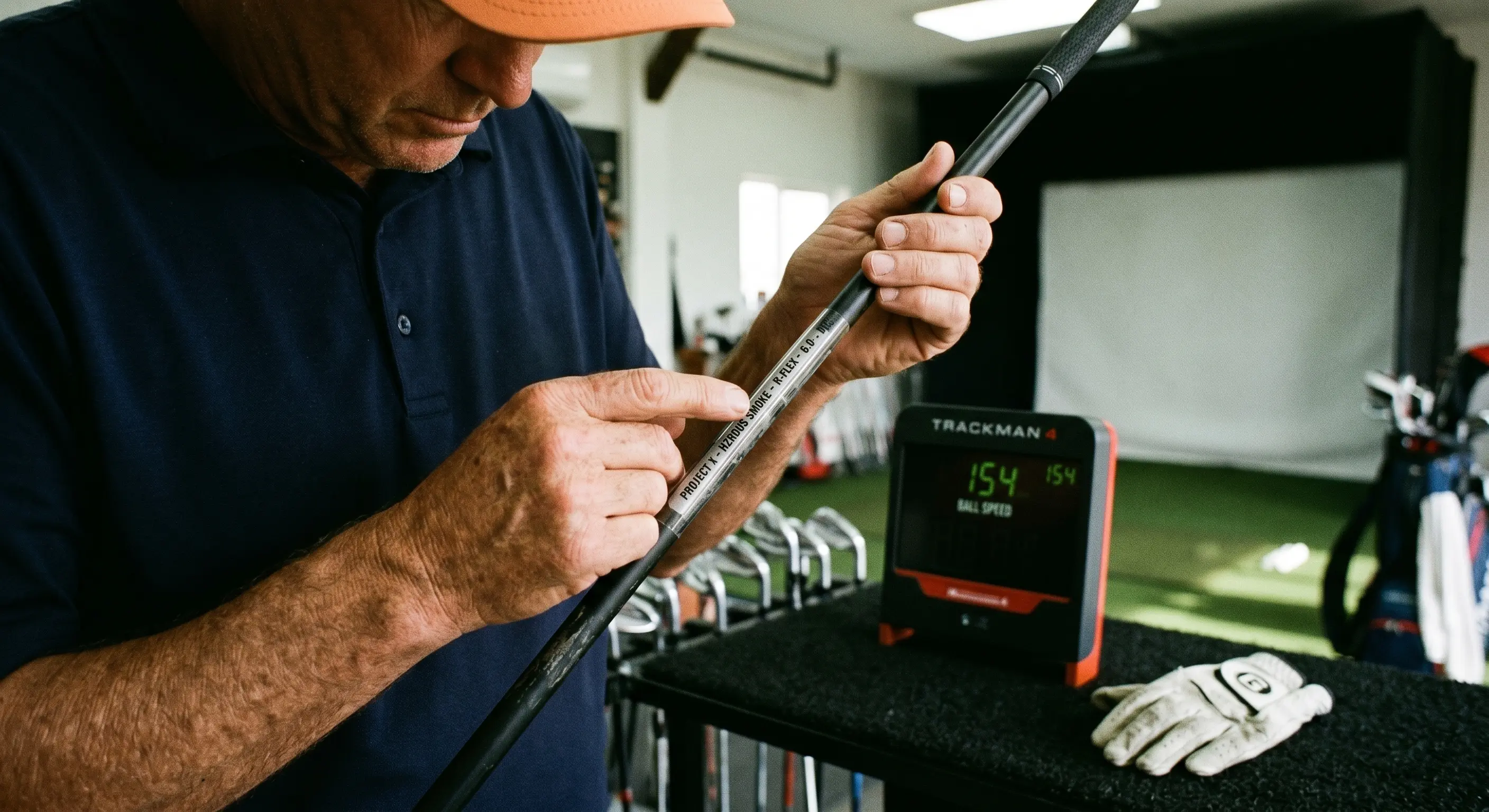
Stop Guessing: Know Your Actual Number
The first step out of the Ego Trap is a simple act of honesty: you need to know your real swing speed. Not the number you hit it that one time with a 20 mph tailwind. Not the speed you imagine when you're swinging well. Your actual, repeatable, measured clubhead speed.
The honest answer to how to measure golf swing speed is: find a certified fitter with a high-quality launch monitor. TrackMan, GCQuad, or Foresight are the industry standards — and they don't lie. They measure your clubhead speed, ball speed, smash factor, launch angle, and spin rate with surgical precision. Most decent golf shops and fitting studios will run you through a session for free or for a nominal fee.
If you find out your driver speed is 91 mph, don't be disappointed. Don't round up to "the low 90s" and keep buying Stiff shafts. Embrace the number. That 91 is now the golden key to finding equipment that will finally work with your swing instead of fighting it every single time.
The Shaft Flex Matrix
Once you have your true speed, finding the right shaft becomes straightforward. A golf swing speed chart for shaft flex is the most useful single reference document in golf equipment — and yet most golfers have never looked at one.
Here is the reality, laid out plainly:
A shaft that is too stiff will feel like hitting through concrete. It won't load and release properly at your speed. The clubface will arrive at impact slightly open, your ball will start right, curve further right, and no amount of swing thought will reliably fix it — because the issue is not your swing, it's your equipment. A shaft matched to your speed loads smoothly, stores energy, and snaps through impact exactly when you need it to. The difference in consistency is immediate and obvious.
"Stiff" is not a regulated standard. A Stiff shaft in one brand may test as a Regular in another. A shaft's true stiffness is measured by its CPM (cycles per minute) frequency. Always get fitted on a launch monitor, not by brand labelling alone.
Balance Over Hype: What Swing Weight Actually Means
Here is another piece of jargon that gets thrown around pro shops like it should mean something to a casual golfer: golf club swing weight. Most golfers nod along and have absolutely no idea what it means. Let's demystify it in thirty seconds.
Swing weight is not the total weight of the club. It's a measurement of how the club feels in motion — specifically, the distribution of mass between the grip end and the clubhead end. It's expressed on a letter-number scale (C7, D0, D2, D5, etc.). A higher number means the head feels heavier relative to the grip.
Why does this matter to a normal golfer? Because swing weight directly affects your tempo and your ability to square the face:
- If your swing weight is too heavy (D5+): The head feels like an anvil. Players with moderate swing speeds struggle to get the face around in time, producing a push or a block to the right.
- If your swing weight is too light (C7 or below): The club feels weightless, which kills feel and can cause an early release, flipping the face over at impact.
- The sweet spot for most club golfers: D0 to D2. Light enough to control, heavy enough to feel where the head is throughout the swing.
Adjusting swing weight is a cheap, quick alteration any fitter can make. It's arguably the most overlooked variable in amateur equipment setups — and fixing it often produces more immediate improvement than changing shaft flex entirely.
The Truth About Your Ball
We need to talk about the rock you're hitting — because it may be the biggest, most expensive mistake you make every single round.
Those premium, four-layer, $65-a-dozen Tour balls? They are engineered specifically for players generating enormous clubhead speed. They use a high-compression urethane core that requires around 105+ mph to activate fully. Hit them at 90 mph, and you are not compressing them properly. The result: the ball feels like a stone off the face, the spin is mismatched to your speed, and you are losing distance and control simultaneously.
The best golf ball for 90 mph swing speed is a mid-compression ball in the 75–85 compression range. These balls are designed to compress properly at moderate speeds, giving you a soft feel off the face, better greenside control, and maximum distance within your actual swing parameters. You don't need to play a range ball — just stop paying premium prices for a product that needs 15% more speed than you have to perform as advertised.
"Playing the wrong ball is like paying for premium unleaded and running it through an engine that only needs regular. The engine doesn't know the difference. Neither does your slice."
The bottom line is simple. The fastest way to lower your handicap isn't a swing overhaul — it's putting your ego in the boot and playing the equipment your actual swing demands. Get fit. Know your speed. Embrace Regular flex if that's what you are. The number on the shaft doesn't say anything about who you are as a golfer. Hitting fairways does.