The Quick Verdict
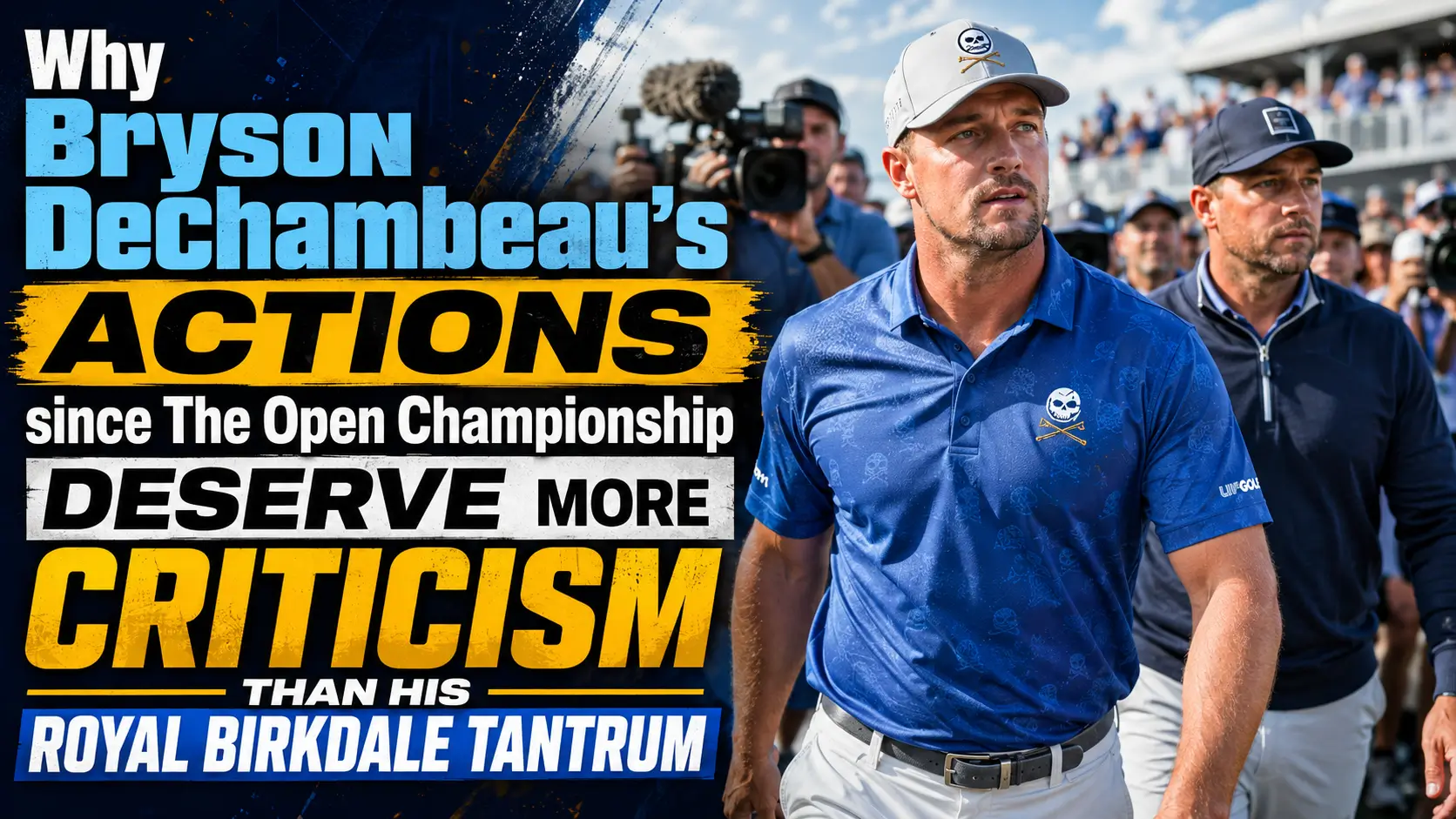
The argument doing the rounds is that Bryson DeChambeau's behaviour since The Open deserves more criticism than what he did at Royal Birkdale. I spent a while checking that against what he has actually done in the eight days since, and it doesn't hold up. One thing does — the six-day media blackout. The rest of it is a man playing very good golf and saying fairly gracious things, plus one incident where the player who nearly got hit publicly cleared him.
The criticisable stuff is still Friday 17 July. It hasn't moved.
What actually happened at Birkdale
Worth getting straight, because a lot of the commentary has drifted from it.
He drove into the fescue on the short par-4 fifth in round two, walked around his ball, hacked out and made bogey. Nothing happened at the time. After he'd finished — a 66 that had him at seven under, one off Lucas Herbert's lead — officials stopped him in the scoring area before he signed.
At his own request, per Golf Digest, they drove him back out to the fifth. He and his caddie Gregory Bodine spent at least twenty minutes out there arguing the case on camera. They didn't shift. Two strokes under Rule 8.1a.
The R&A's Grant Moir explained it plainly: he was penalised for "inadvertently improving the area of his intended swing", and the rule bites whether or not you meant it. That is the entire ruling. Not a cheating finding, not a sanction — a referee applying a rule that doesn't care about intent.
The bogey became a triple-bogey seven, the 66 became a 68, seven under became five. He threatened to walk. Round-three tee times were held up. He played on and finished T14, six behind Ryan Fox.
That last detail is the one that keeps getting lost. He shot two more rounds and finished the tournament.
What McIlroy said, and how fair it was
Saturday, after his own 69, Rory McIlroy was asked and didn't dodge. He said he wouldn't pretend to defend him, that he's "not particularly fond of him", that a lot of it is performative and for attention, and that having players, volunteers and everyone else waiting around wasn't a good look.
He also — and this bit gets quoted less — made the sensible point that not every player is on camera, that policing everyone is impossible, and that golf is largely self-policing anyway. That's a more thoughtful answer than the headline version suggests.
On the delay, though, three things are all true at once and most coverage picks one. McIlroy is right that the wait annoyed a lot of people. Golf Digest is right that DeChambeau asked to go back out. And Kevin Kisner, who was following the group for NBC, is right to ask why the walking official wasn't near the ball when a large search party had already been thrashing about in that grass. Kisner says he didn't like the stomping either. He also can't get comfortable with the ruling.
None of that erases the others. It just means "he held the tournament hostage" is a clean line about a messy hour.
So what has he actually done since?
Here's the eight days, in order.
Saturday and Sunday at Birkdale: he wouldn't engage with the media. Signed autographs, posed for photos, declined to talk. Asked about McIlroy's comments, he gave a five-word non-answer — and I'll be honest, I can't tell you what those five words were, because two reporters filed two different versions and neither original was available to me. Golfweek's Adam Schupak had one, Expressen's Johan Larsson had another. Both amount to the same thing: not answering.
Wednesday: Scheffler, at TPC Twin Cities, said he's never liked personal jabs in golf, and that a golfer's real weekly rival is the course. He'd already said he didn't think the breach was intentional.
Thursday 23 July, LIV Golf UK at JCB: he broke the silence. First media availability since before The Open. He shot 8-under 64, the second-best round of the day, birdied his first three holes, and then talked about it — adversity happens, "I was passionate about what I believed and thought was right", it is what it is, he's moving on. He also did the maths out loud: three over on the fifth, more damage at the 11th, six shots in two holes, which he reckons would have put him tied for the lead.
That's not a man doubling down. That's about as close to letting it go as anyone gets in public.
Same day: his tee shot on the blind par-4 seventh came within inches of Ian Poulter, Poulter's caddie and a cameraman, and grazed Poulter's ear. Poulter roared "fore" and glared back at the tee. It looked awful.
Then Poulter, after the round, said DeChambeau was "not at fault at all" and put it down to miscommunication. DeChambeau was unsighted from the tee. It's understood he apologised. The Telegraph's write-up made the additional point that failing to shout is now depressingly common across professional golf, which is a story about the sport rather than about him.
Sunday: he finished solo third at 21 under, six behind Lucas Herbert.
And most recently: he hasn't ruled out playing the Irish Open, after McIlroy suggested during The Open that he'd get a good reception there.
So where's the case?
I looked for it and it isn't there.
Read that timeline back and the direction is unmistakable. Silence, then a considered explanation, then good golf, then an incident he was cleared of, then an open door to the country of the man who criticised him. If the argument is that things got worse after Birkdale, the evidence points the other way.
The one thing that does hold up: the six days of not talking. He kept signing autographs and posing for pictures while declining to answer a single question about the biggest story in the sport. You can construct a defence — cooling off, advice from his team, not wanting to say something worse — but I don't know which, because he hasn't said, and I'm not going to invent a reason. Taking the fan-facing half of the job and skipping the accountability half is a fair thing to criticise. It's just a much smaller thing than the premise needs.
One more thing worth saying plainly: several outlets report that he raised speaking to Donald Trump in the hope of influencing the ruling. I couldn't find primary sourcing for that anywhere, and the outlets carrying it don't look independent of each other. One of them hedges it as "reportedly," the other states it flat. Until someone who was in the room says so on the record, I'd leave it alone — and if it is true, it belongs in the Friday column with everything else, not the week that followed.
The bit that undercuts the whole framing
The criticism of DeChambeau didn't start at Birkdale.
Before The Open even began, Nick Faldo was saying he lacks the strategy for links golf and hits driver hopefully rather than threading it, and Brandel Chamblee was arguing he's spent more time chasing YouTube collaborations than chasing McIlroy and Scheffler. Chamblee and McGinley were then critical on air during the incident itself.
Which suggests the appetite to criticise him is fairly constant and Birkdale was an occasion rather than a cause. That's worth knowing before deciding whether the last eight days represent an escalation. Mostly they represent the same people, with a fresher clip.
What I couldn't do: I never watched the footage. Everything about what the video shows comes to me through people who did watch it, and they don't agree — Chamblee and McGinley thought it looked damning, Kisner thought the officiating was the real failure. That's a real limit on how confident I can be about the underlying act, as opposed to the ruling, which is documented.
FAQ
Why was Bryson DeChambeau penalised at The Open?
Under Rule 8.1a, for inadvertently improving the area of his intended swing in the rough on the fifth hole during round two.
Does it matter that it was accidental?
No. The R&A specifically stressed that the rule applies even when the action is unintentional.
What did it cost him?
A bogey became a triple-bogey seven, his 66 became a 68, and he went from seven under to five under. He finished T14.
Did he actually withdraw?
No. He threatened to and then played the weekend.
What did Rory McIlroy say?
That he wouldn't defend him, isn't particularly fond of him, thinks much of it is performative, and that making everyone wait wasn't a good look.
Did anyone stick up for him?
Yes. Sam Burns did. Scheffler said he didn't think it was intentional and separately said he dislikes personal jabs. Kevin Kisner criticised the officiating.
What has DeChambeau said since?
He stayed quiet until Thursday 23 July, then spoke after his first round at LIV Golf UK, said he'd been passionate about what he believed, and said he's moving past it.
Did he nearly hit Ian Poulter?
Yes, on the blind seventh at JCB. Poulter was furious in the moment, then said afterwards that DeChambeau wasn't at fault at all.
Did he ask Donald Trump to intervene?
It's been reported. I found no primary sourcing for it, so treat it as unconfirmed.
How did he play at LIV Golf UK?
Opened with a 64 and finished solo third at 21 under.
GOLFRAW's Take
I was handed the premise that DeChambeau's last week is worse than his meltdown, and I couldn't make it stand up. What I found instead was a guy who lost his head for an hour on a Friday, went quiet for six days, came back, said the right things without grovelling, shot 64, nearly decapitated Ian Poulter by accident, got publicly forgiven for it, and finished third. That's a normal week for a professional golfer who happens to be the most-watched man in the sport. The blackout was the misstep, and it's a small one next to the argument on the fifth. Everything else here is the golf internet doing what it does with him — deciding the verdict first and going looking for the evidence after. Which, given that's roughly what he's accused of doing with a rules official, is a bit rich.