
Justin Thomas's 'Mental Capacity' Line, Six Months On
He shot 79-79 and couldn't concentrate on the back nine. Two months later he finished fourth in a major. What that gap teaches about coming back.
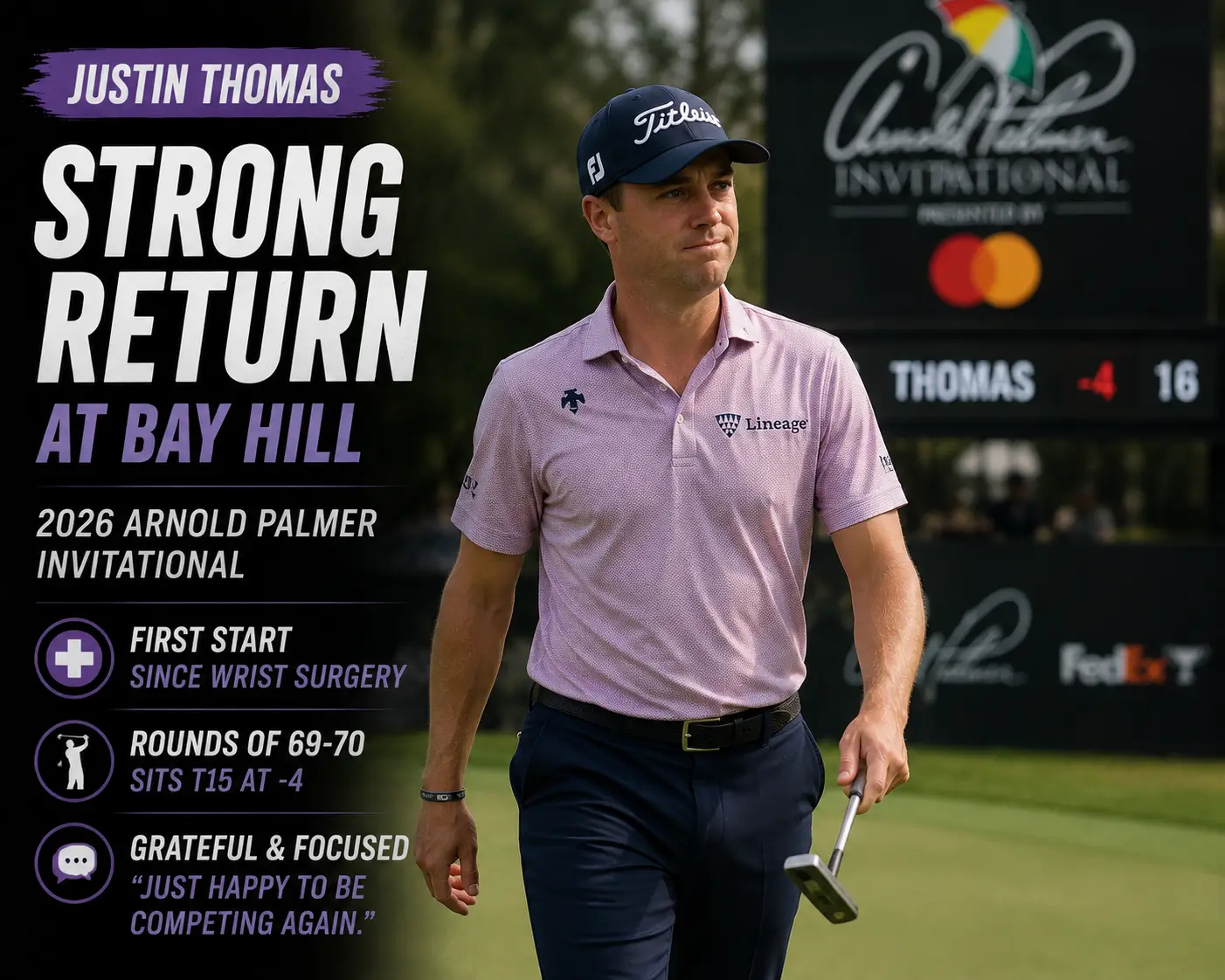
Key Takeaways
- Thomas's Bay Hill quote described concentration and preparation after a long layoff; it was not a diagnosis of mental weakness.
- The 79-79 missed cut exposed competitive rust, but his around-the-green quality survived the return: the problem was sustaining a complete tournament week.
- Two months later, a closing 65 helped Thomas finish T4 at Aronimink—the exact kind of evidence a comeback needs: repeated rounds, not one good practice session.
Justin Thomas 2026 Comeback Timeline & Progression
| Stage | Date / Event | Details |
|---|---|---|
| Surgery | Nov 2025 (HSS New York) | Microdiscectomy for disc/hip pain; world rank fell from #8 to #14 |
| Indoor Return | Feb 2026 (TGL Simulator) | Cleared for full swings with Atlanta Drive; zero tournament walking |
| PGA Tour Return | March 2026 (Arnold Palmer Invitational) | 79-79 (+14, MC, Dead Last); ranked 4th in SG: Around Green; “mental capacity” quote |
| Major Breakthrough | May 2026 (PGA Championship, Aronimink) | T4 finish; best major result since 2022 PGA win |
Decoding the Quote: Concentration Stamina, Not Mental Weakness
Thomas's exact explanation came after the first round at Bay Hill. He said he had struggled to keep his concentration on the back nine and had to back away from shots because he no longer knew what he was trying to do. Later, when asked about the evening, he said he did not have the “mental capacity” to do much more than a few minutes of practice before physio and sleep. The officially distributed Bay Hill transcript makes the context clear: he was describing the length of the day and the rust of returning, not diagnosing himself.
Four hours of tournament golf is a repeated-focus task. After six months away, the missing skill is often not a swing pattern but the ability to reset after a poor hole, make a decision, and do it again for 18 holes. That is an editorial interpretation of his quote—not a medical conclusion.
The Scorecard & Hidden Stat
The visible headline was 79-79, a +14 missed cut. The less visible story was that Thomas's short-game floor had not disappeared. The PGA TOUR's Bay Hill return report records five missed putts from inside 10 feet and only 58 feet of putts made on Thursday; the Around the Green ranking still placed him fourth for the week.
That combination is why “the swing is broken” was too blunt. He could still produce high-level recovery shots, but the complete scorecard was undermined by putting speed, decision fatigue, and a back-nine concentration leak. The first start measured tournament readiness more than it measured whether the operation had “worked.”
The Bay Hill Hazard
Bay Hill was a harsh place to test a returning body and brain. It was a Signature Event with a strong field, a demanding course, and the pressure of a limited-field week. Its 36-hole cut took the top 50 and ties plus anyone within 10 shots of the lead, a format the PGA TOUR's Signature Events overview documents. Thomas also had to walk and make decisions in an actual tournament rather than in a controlled practice block. The PGA TOUR's report described the 79 as his first start since surgery and noted that he had expected rust.
That matters for interpreting the result. A missed cut in a brutal return spot is evidence of a gap between readiness to swing and readiness to compete, not proof that recovery had failed. The better comparison is not Thursday's number with his old peak; it is the next two months of evidence.
The Microdiscectomy Precedents
Thomas was not the first elite player to find that “cleared” and “ready for a four-round tournament” are different milestones. The PGA TOUR's returning-player preview places his recovery beside Tiger Woods and Will Zalatoris. Woods returned from a microdiscectomy in less than three months in 2014, while Zalatoris's 2023 comeback took seven months after surgery and required a gradual rebuild.
Those are precedents, not prescriptions. A three-month medical clearance can answer whether a player may hit full shots; it cannot promise that the player has rebuilt walking tolerance, competitive rhythm, or confidence under consequence. The comparison is useful precisely because it argues against a universal recovery clock.
The Aronimink Vindication
Two months later, Thomas's week at Aronimink supplied the missing sample. He started with 69-69-72 and closed with a 65 to finish tied for fourth at 5 under. The PGA Championship account of his final round records the 5-under 65, six birdies, and his 29-place leap into the early clubhouse lead. The official PGA TOUR leaderboard confirms the 69-69-72-65, 275 total.
The family context is relevant without becoming a diagnosis. Thomas's father Mike and grandfather Paul were both PGA of America professionals, and a Louisville Public Media report details the family's history with back pain and teaching golf. That history helps explain why Thomas talks about maintenance and patience; it does not prove a genetic cause or tell another golfer what to do.
Fact-Checking 5 March Narratives
- “The swing was broken.” The return produced a poor score and rust, but the same week included fourth-ranked Around the Green play. A broken result is not automatically a broken motion.
- “He was mentally weak.” His quote described concentration fatigue after a long absence. It is not evidence of a character defect.
- “The operation should have made him tournament-ready immediately.” Medical clearance and competitive readiness are separate milestones; the Bay Hill and Aronimink gap is the evidence.
- “Thomas has 18 PGA TOUR wins.” The official player record commonly counts 16 PGA TOUR wins; 18 can refer to a broader professional total. The categories should not be collapsed.
- “A missed cut erased his major-championship level.” It did not. His T4 at Aronimink two months later was his best major result since his 2022 PGA Championship win.
The Raw Verdict
Thomas's “mental capacity” line was a precise description of a return problem: the body had been cleared to play, but the competitive week had not yet become normal. Bay Hill exposed the gap. Aronimink narrowed it. The useful lesson is not that elite golfers should ignore a missed cut; it is that a first result after surgery is a data point about readiness, not a final verdict on a career.
Frequently Asked Questions
What did Justin Thomas mean by mental capacity at Bay Hill?
He was describing how difficult it was to sustain concentration and preparation after a long layoff, not making a diagnosis or declaring that his career was over.
Did Justin Thomas finish fourth at the 2026 PGA Championship?
Yes. He closed with a 5-under 65 at Aronimink and finished tied for fourth at 5 under.
Does a slow post-surgery return prove a golfer is mentally weak?
No. A difficult return can reflect competitive rust, physical rebuilding, and the challenge of repeating focus for four tournament rounds; it is not a reliable measure of character.
Sources
- PGA TOUR: Thomas undergoes microdiscectomy and updates his health
- PGA TOUR: Thomas returns at TGL and sets Bay Hill as his TOUR comeback
- PGA TOUR: Thomas struggles to 79 in his TOUR return
- Arnold Palmer Invitational: Justin Thomas quick-quote transcript
- PGA Championship: Thomas saves his best for last at Aronimink
- PGA TOUR: 2026 PGA Championship leaderboard
- PGA TOUR: What was fair to expect from Thomas at Bay Hill
- PGA TOUR: Signature Event format and cut rules
- Louisville Public Media: Thomas's back-surgery recovery and family history
- PGA of America: Thomas's father and grandfather
Read the Brandt Jobe comeback analysis, Scheffler's True Strokes Gained breakdown, or Hovland's Tour Championship runner-up analysis.