
LIV Golf Bankruptcy: The Deadlock Nobody Can Break
The investor won't commit until players sign. Players won't sign for cents on the dollar. That standoff is why Chapter 11 is now the likeliest exit.
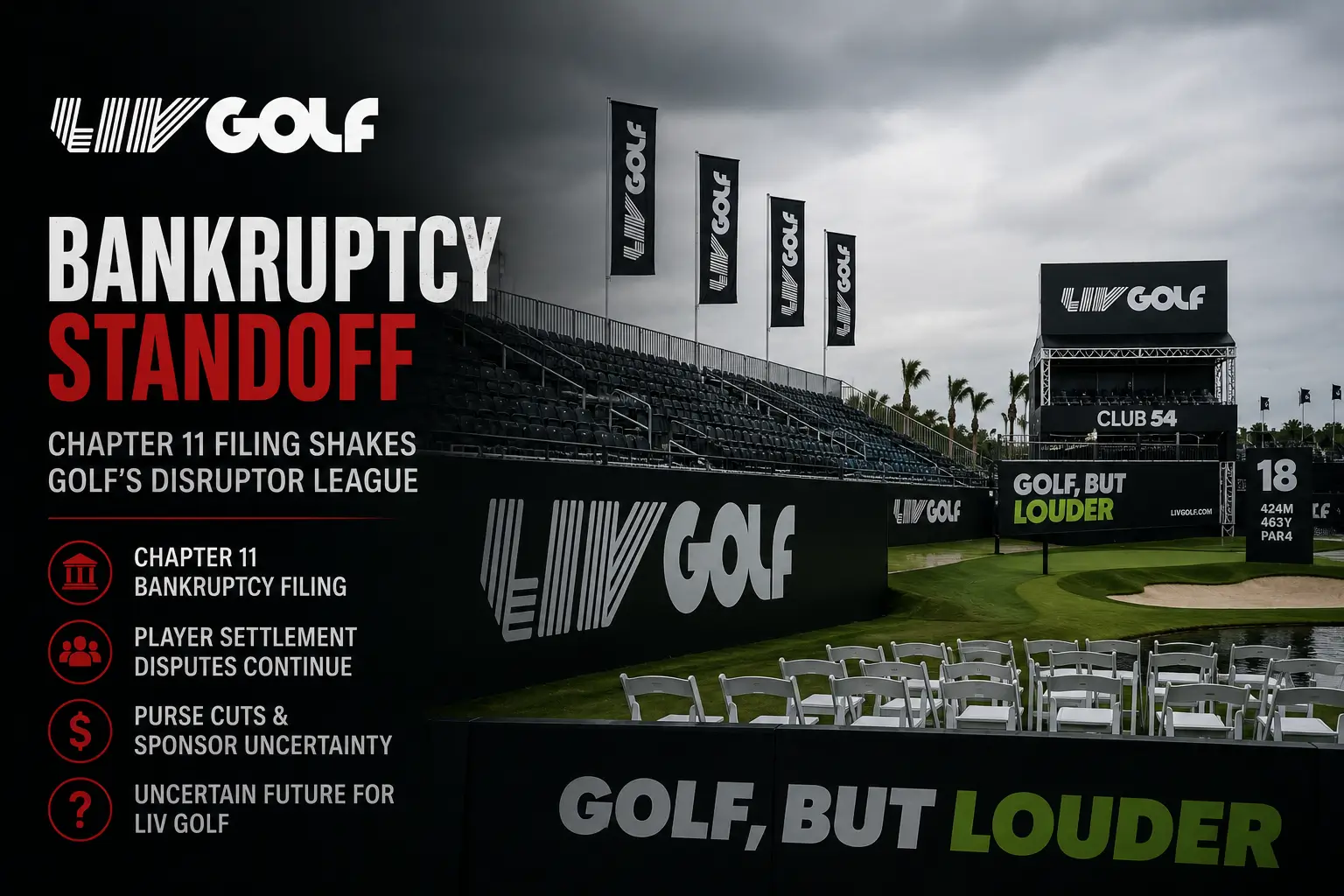
Key Takeaways
- The central deadlock is simple: new private capital wants signed marquee-player commitments, while players reject settlement terms that leave them with cents on the dollar.
- A Chapter 11 restructuring could impose a creditor process, but it would not automatically mean LIV Golf is liquidated.
- The reported under-$100M DIP facility is bridge financing, not proof that the league has recovered the more than $5B invested since 2022.
The LIV Golf Bankruptcy Standoff Matrix
| Stakeholder | Position | Legal Reality |
|---|---|---|
| Private Equity (BC Partners) | Won't commit full capital without committed marquee stars | Waiting on signed restructurings |
| LIV Golf Players | Rejecting initial settlement offers at a few cents on the dollar | Risk becoming unsecured creditors behind PIF debt |
| PIF (Saudi Wealth Fund) | Halting funding post-2026; offering <$100M DIP bankruptcy loan | Senior secured ranking in Chapter 11 |
| League Operations | Cancelled 2 events (Michigan); major staff terminations underway | Transitioning toward ~10-event model ($10M purses) |
The Anatomy of the Standoff
The reported deadlock is a sequencing problem. Bloomberg Law's report on the proposed bankruptcy terms says BC Partners has been waiting for LIV and PIF to resolve player payments and bankruptcy terms before committing new capital. That is a report about negotiations, not evidence that a filing has already occurred.
The player side has a different clock. A Reuters report carried by Business Times described settlement offers to players owed money beyond 2026 as only a few cents on the dollar. A player who accepts may trade a disputed guarantee for speed and certainty; a player who rejects it may preserve a claim but face a longer process.
The Legal Mechanics of Chapter 11
Chapter 11 is a restructuring forum, not a synonym for liquidation. If LIV filed in New Jersey, the court would supervise the debtor's financing, creditor claims and any proposed plan. The filing itself would not decide whether tournaments continue, whether contracts are assumed or rejected, or what any player ultimately recovers.
The practical leverage comes from priority. New debtor-in-possession financing can keep an operating company alive while a case proceeds, but its ranking, collateral and repayment terms would be set by financing documents and court orders. “Bankruptcy” describes the legal process; it does not turn a reported term sheet into a completed transaction.
The Financing Nuance
The reported under-$100M facility matters because it would be bridge money, not a recapitalization of the league. Bloomberg Law described a possible PIF-backed DIP loan below $100M and separately reported BC Partners was exploring an equity-like investment. Those are different instruments with different risk and priority profiles.
For scale, AP's report on PIF funding says the Saudi fund had spent more than $5.3B on LIV through the end of 2026. That historical spend does not prove that another round of funding is committed, nor does a proposed DIP loan tell us what unsecured players will recover.
What Has Already Been Cut
The pressure is visible before any court filing. LIV cancelled its Michigan team event, and Golf Monthly's report on Scott O'Neil's update described the cancellation, an investor deadline and a dispute over an unpaid vendor bill. Those facts show operating retrenchment; they do not by themselves establish insolvency.
Golf Monthly also reported that a majority of the workforce was expected to leave around the season finale, alongside a proposed smaller schedule. Staff cuts can reduce burn while a transaction is negotiated, but they are not proof that a Chapter 11 petition has been filed.
The LIV 2.0 Reality
The proposed next version of LIV is smaller and more conditional: reporting has described roughly 10 events with purses around $10M, subject to investment and player commitments. The central commercial question is therefore not simply whether LIV can stage golf; it is whether a new owner can obtain enough signed player participation to make the schedule financeable.
The PGA TOUR's Returning Member Program announcement gives the parallel deadline context: eligible LIV players had a defined route back to the PGA TOUR, with a published application window. That route is not a guarantee for every player and should not be confused with a completed settlement.
Debunking 5 Viral Bankruptcy Myths
- “Chapter 11 means immediate liquidation.” No. It is a court-supervised restructuring process; liquidation is only one possible outcome.
- “LIV has already filed.” Not on the evidence available for this article. The reporting describes a possible or expected filing, not a confirmed petition.
- “A sub-$100M DIP loan solves a $5B funding gap.” No. DIP financing would be operating bridge capital with its own priority and terms.
- “A settlement offer is a signed settlement.” No. A reported offer is not an accepted deal, released claim or court-approved plan.
- “Players can simply veto the next LIV.” Their signatures are valuable leverage, but the final result also depends on contracts, financing, creditor priority and court approval.
The Raw Verdict
The deadlock is real enough to explain the reported Chapter 11 path, but the legal conclusion must stay narrower than the headline. BC Partners wants player certainty; players want more than a few cents on the dollar; PIF is reported to be stepping back from open-ended funding. Until a filing, financing order or signed restructuring is public, this is the likeliest reported exit scenario—not a completed bankruptcy.
Frequently Asked Questions
Does a Chapter 11 filing mean LIV Golf is being liquidated?
No. Chapter 11 is a restructuring process; liquidation is a separate outcome, and the final result would depend on a court-approved plan and available financing.
What is DIP financing?
Debtor-in-possession financing is new money used while a company remains in Chapter 11; its priority and terms are set by the court and financing documents.
Why are player settlement offers central to the deadlock?
The reported standoff is that new private capital wants marquee-player commitments while players are weighing whether a proposed settlement gives up too much of their guaranteed compensation.
Sources
- Bloomberg Law: LIV Golf bankruptcy and BC Partners negotiations
- Reuters via Business Times: reported filing and player settlement offers
- AP News: PIF funding and LIV's next phase
- Golf Monthly: investor deadline, cancellation and vendor dispute
- Golf Monthly: workforce and proposed schedule changes
- PGA TOUR: Returning Member Program
Read the earlier LIV Golf bankruptcy analysis, Scott O'Neil's LIV update breakdown, or the Tour Championship payouts analysis.