Trey Mullinax Is Banned for Six Months. That Barely Matters.
He tested positive, accepted a six-month ban, and hasn't played since April. So the suspension costs him almost no golf. It costs him his card.
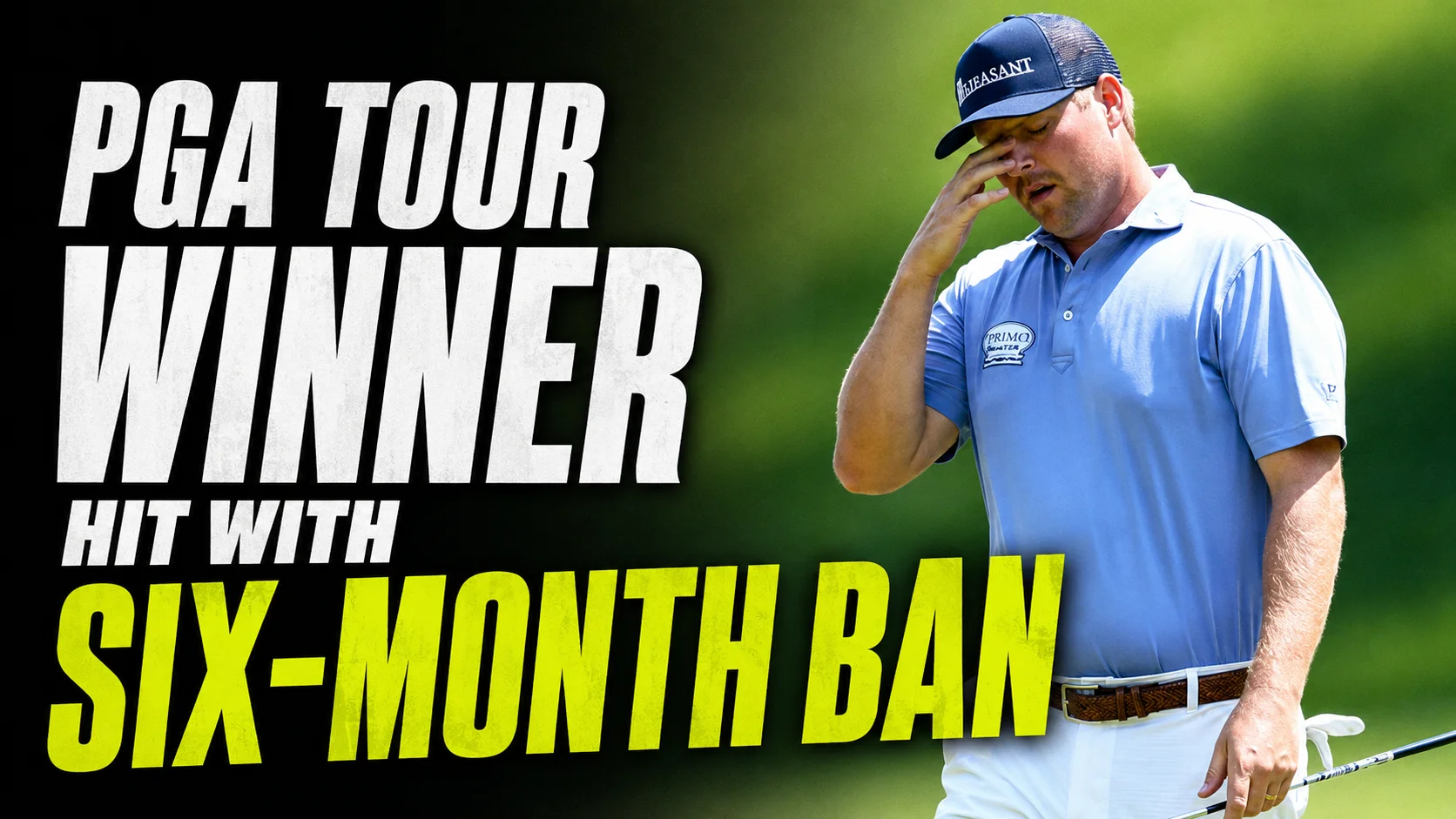
The PGA TOUR said on Wednesday 29 July 2026 that Trey Mullinax, 34, tested positive for a substance banned by the World Anti-Doping Agency. Six-month suspension. He can play again on 16 January 2027.
The Tour says he cooperated throughout and accepted the sanction. No appeal.
Mullinax put out his own statement the same day, and it's worth reading before anyone decides what happened. He took a medication for a condition diagnosed back in his college years, and he took it without getting it approved first. His words: lack of knowledge is no excuse, it was his job to know the rules, and he never took anything meaning to gain an advantage.
He hasn't teed it up since April. So the six months costs him almost nothing. What it costs him is his card.
The bit at the bottom of every report
Read the standings and the sanction becomes something else entirely.
The ban runs straight through the FedExCup Fall, the run of tournaments where players scrapping for their livelihoods sort out who plays next year. Top 100 keep a card. Top 125 get conditional status. Mullinax sits 150th.
Which means the fall was the last door open to him, and it's now shut.
Now look at the return date. He's back on 16 January 2027, by which point the new season has barely got going, so he misses almost nothing he'd want to play. He loses the qualifying stretch instead. Six months of suspension, a year of playing rights gone, and only one of those numbers made the headlines.
What the Tour said, and what it carefully didn't
The Tour's wording: he tested positive for "a substance prohibited by the World Anti-Doping Agency." That's the whole description.
It didn't name the substance. It didn't say when the test happened. Yahoo put it flatly: it's unclear what the substance was or when he tested positive, and nothing since has clarified either.
One outlet has already rendered that as a positive test for "a banned performance-enhancing drug." Small shift, big difference. A prohibited substance and a performance-enhancing drug are not synonyms, and when a man has admitted a paperwork failure while denying any intent to cheat, the gap between those two phrases is his reputation.
The thing this whole case turns on
Mullinax says he used the medication "without seeking approval."
That approval is the entire mechanism. Across WADA-governed sport, an athlete who genuinely needs a banned substance for a medical reason applies in advance, declares what they're taking and why, and gets it cleared before a pill goes anywhere near them. Miss that step and a positive test is a violation no matter how legitimate the prescription.
I couldn't find a single source explaining how the PGA Tour's version of that process actually works, so I'm not going to describe procedures I haven't checked. But the principle is what he's confessing to. The medication may have been exactly right for his condition. The failure was administrative.
He said as much himself, and rather more bluntly than his lawyers would have liked.
Leave the condition alone
Mullinax told us it was diagnosed while he was in college. That's roughly fifteen years ago, and it's the only detail he offered.
He gave the minimum needed to explain his own violation, which is the correct amount, and every extra inch beyond it belongs to him rather than to us. If somebody starts connecting the dots to a later episode in his playing career, check the dates before you believe it. They don't line up.
How rare this actually is
Almost nobody gets suspended for this in golf.
When Ben An got three months in 2023 for a prohibited substance sitting inside an over-the-counter cough medicine, the Associated Press reported that An was "believed to be" the eighth player suspended since testing started in 2008, and the first since Matt Every in 2019.
Hang on to that hedge. AP wrote "believed to be" because the Tour hasn't always announced these, and nobody outside the building can give you a definitive count.
An got three months for something off a pharmacy shelf. Mullinax got six for a prescription treating a real diagnosis. Neither substance has been named, so if anyone tells you why the numbers differ, they're making it up.
Where he was already
Mullinax has one PGA Tour win, the 2022 Barbasol Championship, where he beat Kevin Streelman by a shot. Two Korn Ferry titles before that. He came out of Alabama.
This season he's made three starts across both tours and missed the cut in all three. His last PGA Tour appearance was the Zurich Classic in April. He's 544th in the world and hasn't played a major since 2023.
Nobody is removing a contender from the leaderboard here. A 34-year-old clinging to the edge of his own career just lost the rope.
FAQ
What did Trey Mullinax do?
Tested positive for a WADA-prohibited substance. He says he took a medication for a condition diagnosed in college and never got it approved.
How long is the ban?
Six months. He returns on 16 January 2027.
What was the substance?
Nobody has said. The Tour didn't name it and neither did Mullinax. The date of the test is also unknown.
Did he fight it?
No. The Tour says he cooperated fully and accepted the suspension.
What's the condition?
His business. He said only that it was diagnosed in college.
Why does the timing hurt so much?
The ban swallows the FedExCup Fall, which is where players earn status for next season. Top 100 get cards, top 125 get conditional status, and he's 150th.
Does this happen often?
Barely ever. AP reckoned in 2023 that Ben An was probably only the eighth player suspended since testing began in 2008.
Has he won?
Once, the 2022 Barbasol, by a single shot.
GOLFRAW's Take
He could have hidden behind the medical explanation. It was right there, it was true, and most people would have used it. Instead he wrote that not knowing the rules was on him, that it was his job to know them, and that he'd failed. The only defence he allowed himself was the one he'd earned, which is that he never took anything to get an edge. Doesn't change a day of it, of course. What stays with me is the arithmetic. A man who hasn't hit a competitive shot since April gets banned for six months, serves nearly all of it during a period he wasn't playing anyway, and still loses his card, because the calendar happened to eat the only stretch that could have saved him. Rough luck stacked on top of a genuine mistake. And if you go reading around on this, watch the verbs. The Tour said "a substance prohibited by WADA" and left it there. By this morning some outlets had promoted that to "performance-enhancing drug." Those sentences describe two different men. Use the Tour's.