
Less than 5 percent. That’s the share of fan ejections at PGA Tour events this season that were tied to sports betting, according to the Tour’s own VP of gaming, Scott Warfield. And the Tour is still tearing up its fan code of conduct over it.
The quick answer. The PGA Tour is rewriting its fan code of conduct for the 2027 season. It’s adding trained volunteer “ambassadors” in the galleries to flag bad behavior to security and building tools to track harassment that starts on the course and moves online. The trigger is a 2026 season of betting-linked heckling, and Tour executives say one incident is too many.
What that answer skips is who’s selling the bets. The Tour has official deals with two sportsbooks, and the player who sounded the loudest alarm has been paid by one of them since 2021. That’s covered further down.
Key takeaways
- The change is real but narrow. The Tour is adding trained volunteer “ambassadors” in the galleries and an online-harassment tracking program for 2027, on top of a rewritten code.
- The trigger stat undercuts the framing. The Tour’s own VP of gaming says under 5 percent of this season’s ejections were betting-related. The other 95 percent is ordinary rowdiness.
- The Tour is on both sides of the line. It holds official books with DraftKings and FanDuel, and the player who sounded the loudest alarm has been a FanDuel ambassador since 2021.
- Golf is uniquely exposed. One word timed to a backswing can move a shot, and the Rules of Golf govern players, not galleries, so nothing in them touches a shout.
- The online-tracking piece is undefined. Nobody has said who does the tracking, what counts as harassment, or what happens when the Tour finds it. Until then it’s a headline, not a policy.
What the PGA Tour fan code of conduct actually changes for 2027
The current code already lets the Tour throw you out. The rewrite is about catching you sooner.
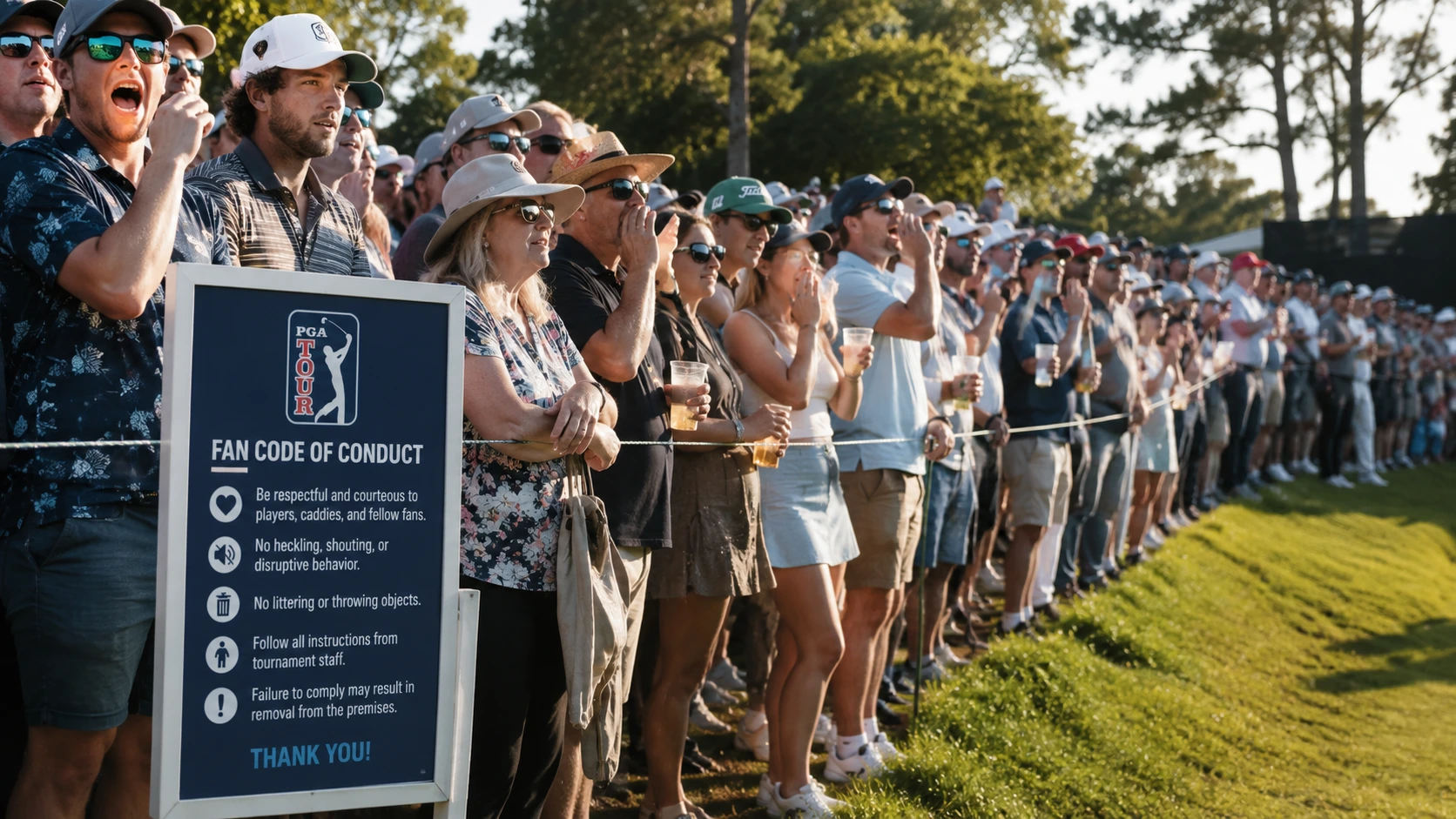
Right now, the Tour’s published fan guide for the 2026 Tour Championship reserves the right to deny entry or remove anyone for yelling, heckling, throwing objects, making rude comments or gestures, or doing anything that disrupts the competition. Get tossed and you don’t get your money back.
Andy Levinson, the PGA Tour’s senior VP of tournament administration, told reporters at the Tour Championship in late August 2026 that the Tour is revamping that code for 2027, per Front Office Sports. He described three moving parts.
First, an ambassador program. These are volunteers being trained to stand inside the crowds, watch for specific types of behavior, and tip off security. Second, a revised written code with, in Levinson’s words, a lot of effort behind it. Third, and this is the interesting one, new programs to track and monitor what fans say online about players they’ve bet on.
Warfield said the Tour spent the summer collecting player feedback, which led to the online-tracking idea. His framing was blunt: “One is one too many for us.”
Here’s my problem with the third piece. Nobody has said who does the tracking, what counts as harassment, or what happens when the Tour finds it. Until those answers exist, it’s a headline, not a policy.
How did the PGA Tour get here?
Sunday at Shinnecock Hills, June 2026. Wyndham Clark is walking toward his second U.S. Open title and a large chunk of the crowd wants him to lose. Fans shout for his shots to find bunkers. They cheer his missed putts. Some of them get walked out by police.
That’s the scene Front Office Sports described, and it’s the one that pushed Jordan Spieth to speak two weeks later at the John Deere Classic. Spieth said he couldn’t tell how much of the Clark treatment came from people who’d bet the field against him in a legal betting state, with anywhere from $100 to $10,000 on the line.
The Shinnecock Sunday wasn’t the first entry in the ledger. The 2025 Ryder Cup at Bethpage Black, also on Long Island, was dominated by stories of home fans turning ugly on the European team. Then in February 2026, at the WM Phoenix Open, an influencer paid a fan $100 to yell during Mackenzie Hughes’s backswing. Front Office Sports reported both were ejected, and the clip traveled fast because phones are allowed at every pro tournament except the Masters.
By July the Englishman Matt Fitzpatrick was saying it at Royal Birkdale. He told reporters that every golfer who’s played a professional tournament has received a gambling-related abusive message, and that if you search a struggling player’s name on social media you’ll find “abuse after abuse after abuse,” per Golf Digest. The R&A introduced its own fan code of conduct at that same Open, according to Golf Monthly.
Why golf is the easiest sport to fix from outside the ropes
How much does it take to move a golf tournament? One word, timed right.
Spieth put it plainly in June: “you could impact a shot if you wanted to,” and he said he doesn’t know another sport where a fan can do that. Fitzpatrick said the same thing a month later, that shouting on a backswing or a putting stroke would be an easy way to influence a bet and a hard thing to monitor.
The Rules of Golf back them up in an uncomfortable way. Under Rule 11.1 of the current USGA and R&A Rules of Golf, a ball in motion that accidentally hits a person is played as it lies, with no penalty to anyone. Rule 11.2 handles deliberate deflection differently, requiring an estimate of where the ball would have finished. But notice what’s missing. Nothing in the Rules touches a shout, because the Rules govern players, not galleries.
Which means a fan doesn’t need to touch anything. This has been happening for years. At the 2023 BMW Championship at Olympia Fields, Max Homa said a heckler with three dollars riding on his putt yelled “Pull it!” at the top of his stroke, per Sports Illustrated. Homa made it. Jon Rahm said at the time that players hear that kind of thing every round. That was three seasons ago.
The part the Tour won’t say out loud
May 14, 2018. The U.S. Supreme Court voted 6 to 3 in Murphy v. NCAA that the federal ban on state-authorized sports betting was unconstitutional, according to Britannica, which counts 39 states plus the District of Columbia with some form of legal sports betting as of 2025.
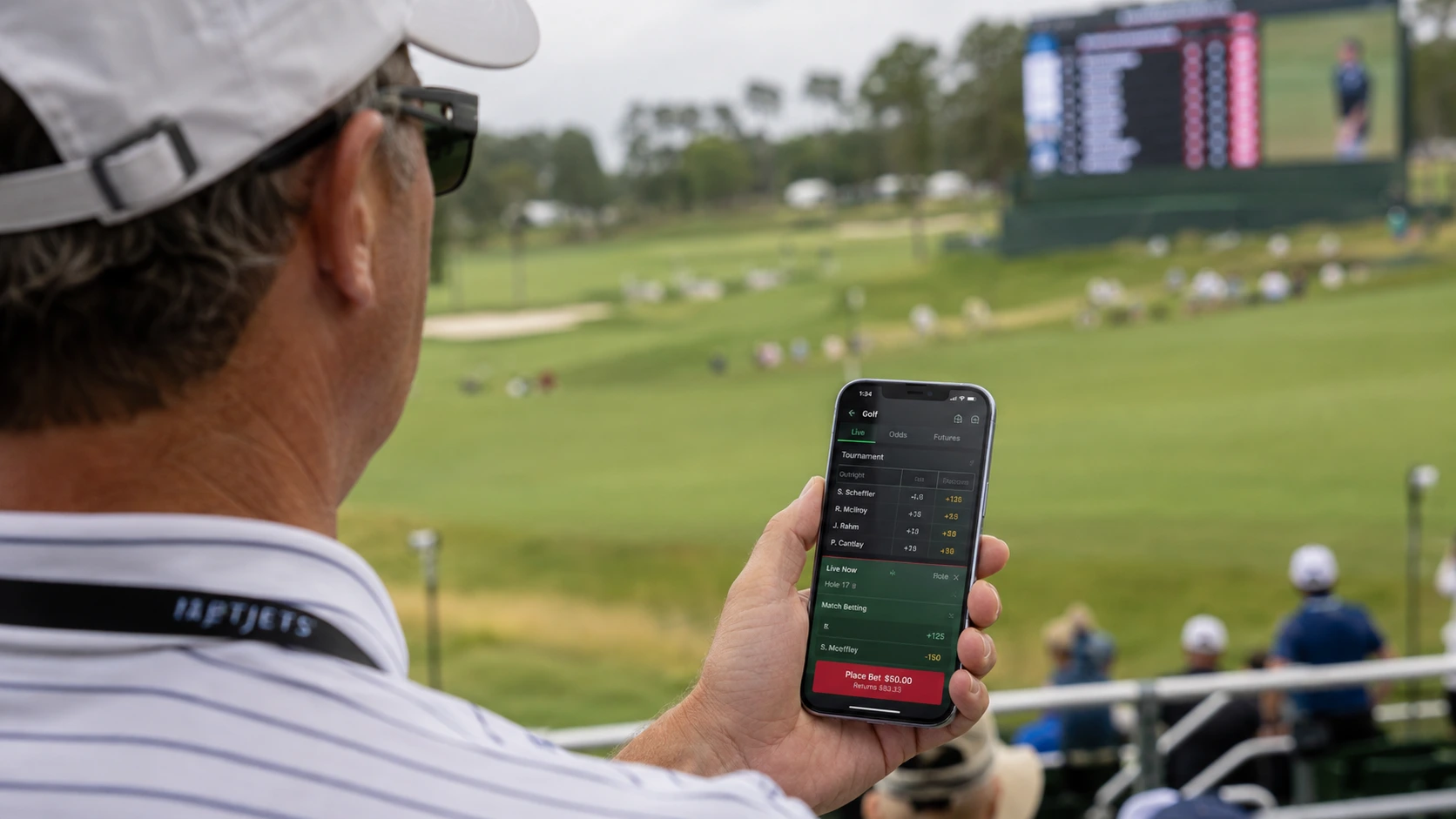
The PGA Tour did not sit that out. Front Office Sports reports the Tour holds official betting deals with DraftKings and FanDuel. Spieth, the player who said betting “is going to have to be tackled here soon,” has been a FanDuel ambassador since 2021, when he became the first PGA Tour player to partner with a sportsbook. Fitzpatrick, while calling the abuse a problem, told reporters at Birkdale he had a small wager on England to win the World Cup.
None of that makes them wrong. It does mean the Tour is policing the downstream of a revenue line it built on purpose, and you should hold that in mind when an executive says one incident is too many.
The Tour has drawn one line so far. Warfield said it has no prediction-market partner and players can’t sign sponsorship deals with prediction markets, with the Tour waiting until the regulatory fights between the CFTC and the states shake out. That’s caution about the next wave, not a rethink of the current one.
Three things people get wrong about rowdy golf fans
Myth one: this is all gambling.
The Tour’s own number says otherwise. Under 5 percent of ejections this season were betting-related, per Warfield. The other 95 percent is the same thing it’s always been, which is beer and a microphone-sized ego. Spieth himself said he’s played with guys who were treated badly 10 or 15 years ago and that the betting version is a last-five-years development. The rewrite targets a slice, not the pie.
Myth two: the Tour is only now waking up.
ESPN reported in 2021 that Commissioner Jay Monahan warned at that year’s Tour Championship that fans shouting “Brooksy” at Bryson DeChambeau could be expelled and lose their credentials. A code with teeth has existed for at least five years. What’s new is enforcement, not the idea.
Myth three: a code of conduct fixes it.
Levinson said it himself. Put 10,000 people around a green and one person decides to blurt something, and there’s not much you can do. He said the Tour relies on decorum and that in some markets decorum has deteriorated. Fitzpatrick called it really hard to monitor. Volunteers in the crowd will catch the repeat offender. They won’t catch the one guy, one time, one word.
Myth four: it’s an American disease.
The R&A wrote its own fan code for Royal Birkdale in July 2026. Fitzpatrick framed the online abuse as something footballers and tennis players deal with too. Golf just has thinner ropes.
What this means if you’re buying a ticket
You can still yell. You can’t yell at the wrong moment.
The published PGA Tour fan rules already cover yelling, heckling, throwing objects, rude comments or gestures, and anything that disrupts play, and the penalty is expulsion without a refund. Starting in 2027, expect trained volunteers in the crowd whose entire job is to notice you. And since phones are allowed everywhere but Augusta, your bit will be online before you reach the parking lot.
GolfRaw has never been a fan of the hush. The 16th at Phoenix is the best hole in golf precisely because it’s loud. Loud isn’t the problem. Screaming into a backswing because you have $20 on a parlay is the problem, and it’s a bad trade, because the Tour’s answer to a few hundred of those people is going to land on the rest of us.
The Raw Verdict
The Tour is doing the cheap, visible thing first. Volunteers in the crowd and a rewritten code are fine, and they’ll thin out the repeat offenders. But the honest fix is one the Tour won’t touch, which is the live in-play market on a single putt while the guy holding the ticket is standing eleven feet from the hole.
You can’t sell that product and then act surprised by the customer. Until the Tour says what its online tracking actually does and who it answers to, treat 2027 as a press release with a volunteer badge attached.
Frequently asked questions
What is the PGA Tour fan code of conduct?
It’s the Tour’s published rulebook for spectators. The current version bans yelling, heckling, throwing objects, rude comments or gestures, and any behavior that disrupts competition, with removal and no refund as the penalty. The Tour announced at the 2026 Tour Championship that it’s revamping the code for the 2027 season.
Can you get kicked out of a PGA Tour event for heckling?
Yes, and it already happens. The published rules list heckling as grounds for expulsion without refund. At the 2026 WM Phoenix Open, an influencer who paid a fan $100 to yell during a player’s backswing was ejected along with the fan, per Front Office Sports. Police removed spectators at the 2026 U.S. Open.
Is sports betting really causing the fan problems in golf?
Some of them. PGA Tour VP of gaming Scott Warfield said fewer than 5 percent of ejections this season were betting-related. Players like Spieth and Fitzpatrick say the betting-driven abuse, especially online, is a real and recent shift, but the Tour’s own number says most bad behavior has other causes.
Can a fan actually affect the outcome of a golf tournament?
Players say yes. Spieth said in June 2026 that a fan could impact a shot if they wanted to, and Fitzpatrick said shouting during a backswing or putting stroke is an easy way to influence a bet. Under Rule 11.1, an accidental deflection off a spectator is played as it lies with no penalty.
Sourcing
Built on Front Office Sports reporting from the 2026 Tour Championship, PGA Tour executive comments, the current USGA and R&A Rules of Golf, Britannica’s Murphy v. NCAA record, Golf Digest’s Open Championship coverage, and the PGA Tour’s published fan conduct rules. Quotes and figures are attributed to those outlets in the text; GolfRaw has not independently verified the ejection statistics, which come from the Tour.
Author. GolfRaw Editorial is GolfRaw’s golf news and verification desk.
Corrections. None at publication. Corrections policy.
Last updated. .