
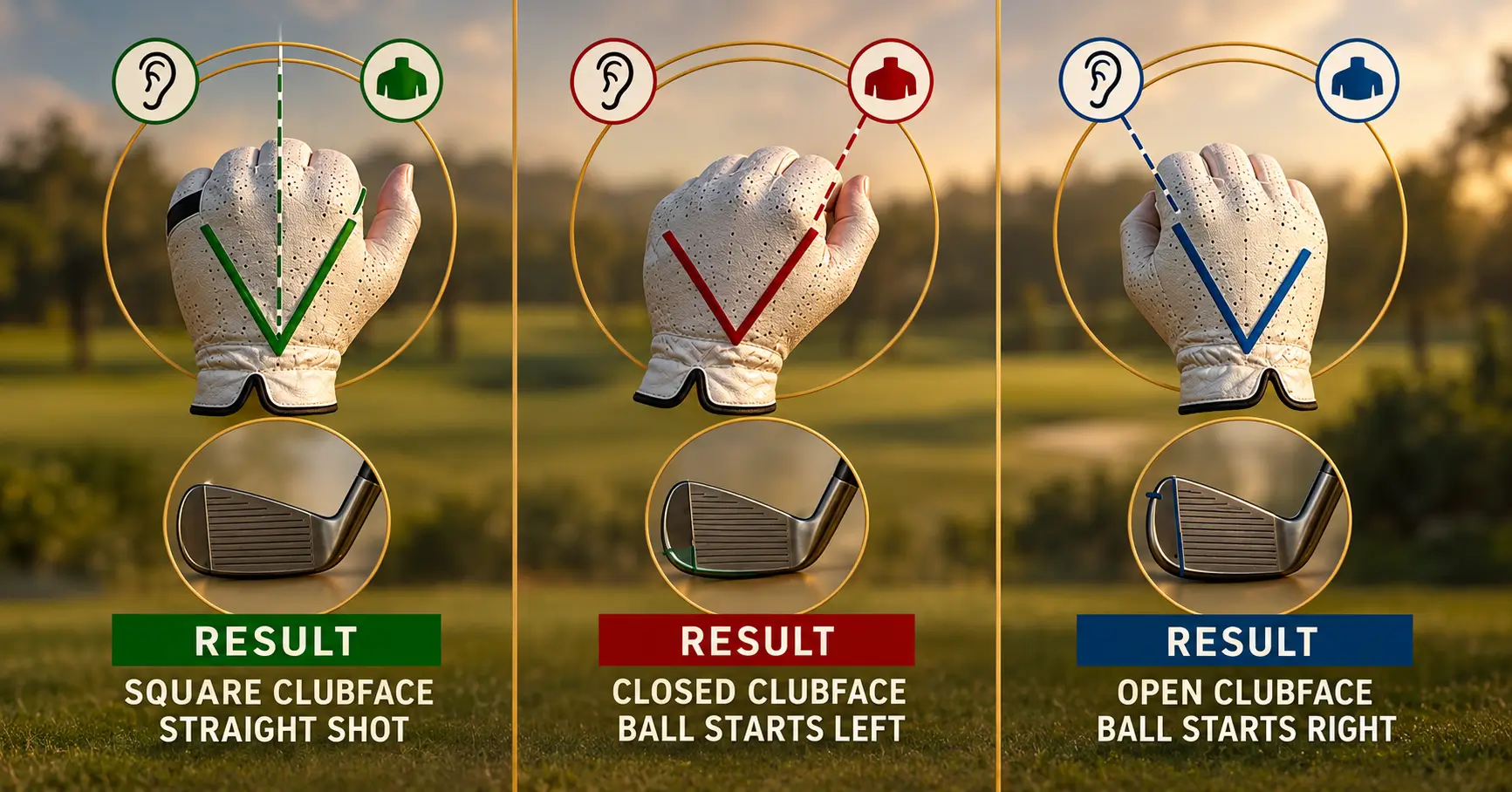
A neutral grip is a sensible place to start if you're new to golf. Turning both hands a little away from the target can make it easier to close the clubface; turning them toward the target can make it harder. Neither position guarantees a straight shot or a ball that starts left or right. The face you deliver to the ball has far more to say about its starting direction than the position your hands held at address.
That explains a frustrating sight at the range: both Vs point where a coach told you to aim them, and the ball still slices.
Methodology: Golf Raw compared published instruction from named coaches with Trackman's explanations of ball flight. We did not measure shots or test a golfer's swing for this guide.
What do strong, neutral and weak mean?
These words describe how you rotate your hands on the handle. They don't describe how hard you squeeze it.
For a right-handed golfer, a stronger grip turns the hands farther right, away from the target. You see more of the knuckles on your left, or lead, hand. A weaker grip turns the hands left, toward the target, so fewer lead-hand knuckles show. Neutral sits between those positions. Golf instructor Kellie Stenzel described the stronger and weaker directions in 2023.
If you play left-handed, your right hand leads and the directions reverse. Think lead hand and trail hand as you follow the steps below.
There is another set of grip names you'll hear: interlock, overlap and ten-finger. Those describe how your hands connect. You can use an interlock and still hold the club in a strong, neutral or weak position. Stenzel's 2026 grip guide separates that choice from hand position. Pick a connection that lets both hands stay secure, then check where those hands sit on the handle.
How do you build a neutral starting grip?
PGA coach Alex Elliott's guide, updated in September 2026, puts the lead hand mainly in the fingers. Use that as your starting point:
- Hold the club in front of you and place the handle diagonally across the fingers of your lead hand. Wrap your fingers around it.
- Look down at that hand. Elliott suggests seeing roughly two to three lead-hand knuckles as a neutral checkpoint.
- Add your trail hand so it rests against the lead hand. Choose an interlock, overlap or ten-finger connection that feels secure.
- Hold the club firmly enough that it won't slip, without squeezing as hard as you can.
Now look at the line between each thumb and index finger. Golfers call it a V. Elliott aims the lead-hand V toward the trail ear. It's a useful visual check while you learn where your hands go.
It isn't a universal measurement. In Nathalie Filler's 2020 instruction, the Vs of a neutral grip point closer to the nose. Coaches also account for the way a player's arms hang and hands move. If your V lands between those cues, you haven't failed a grip test. Start in a comfortable middle position and pay attention to the shots it produces.
Why can a good-looking V still produce a slice?
Your V shows where your hands are before you swing. The ball responds to the club you deliver at impact.
Trackman defines face angle as the direction the clubface points at impact and says it is the main influence on where the ball starts. For a right-handed golfer, a face pointing right of the target will usually start the ball right. A face pointing left will usually start it left.
The curve needs another piece of information. Trackman's 2024 face-to-path explanation describes the difference between the face angle and the direction the clubhead travels through impact. With a centered strike, that relationship is a key factor in whether the ball curves left or right. Trackman's 2022 launch-direction guide makes the distinction clear: the direction a ball starts does not describe its later curve.
Picture a shot that starts right and bends farther right. Its start gives you a clue about the face at impact; its curve tells you to consider the face relative to the path. A stronger grip might help you present the face differently. It cannot promise to fix the path. With a driver, contact toward the heel or toe can complicate the picture further, as Trackman's impact-location guide explains.
That is why the tidy advice that neutral goes straight, strong goes left and weak goes right is wrong. It treats a hand position at address as though it were a reading taken at impact.
Should you turn your hands stronger or weaker?
Watch several shots at the range before changing anything. One mishit is poor evidence for a new grip. Keep the same club and target so you can see whether a pattern repeats.
| Observed pattern | Small change to try | Keep in mind |
|---|---|---|
| Observed patternShots start right and lead hand looks weak | Small change to tryTurn both hands a little right | Keep in mindPath and strike may also contribute |
| Observed patternShots start left and lead hand looks strong | Small change to tryTurn both hands a little left | Keep in mindCheck whether face, path or strike is driving it |
| Observed patternShots start near target but curve a lot | Small change to tryKeep the grip steady for now | Keep in mindLook at face relative to path and strike location |
This table is a practice decision, not a diagnosis from launch-monitor data. It combines the grip tendencies described by Stenzel with Trackman's impact definitions. Left-handed golfers should reverse the left and right directions.
Make one small rotation, then hit more shots with the same club toward the same target. Compare where they start, how they curve, and whether contact feels sound. If the miss shrinks and the strike holds up, you've found a change worth practicing. If the ball now misses the other way, return toward your starting position. Avoid changing your grip, aim and swing thought in the same handful of balls; you won't know which change produced the result.
When should you leave the grip alone?
If your shots scatter in both directions, the ball flight isn't giving you a clean reason to rotate your hands. Stick with a grip you can repeat while you check contact and setup. A persistent curve may involve the club's path or your release as well as your hands.
A neutral grip also isn't a requirement for a good swing. Coach Christy Longfield told GOLF.com in 2025 that the right position depends on how your body moves and how you swing. If a small change produces confusing results, a lesson can show you what happens at impact. Guessing at a stronger and stronger grip every time you slice can send you chasing a new miss.
The Raw Verdict
Golf Raw would start a new player near neutral, then leave that position alone until a repeated miss gives them a reason to experiment. Try a small change at the range and keep it only if the shots improve. The V helps you put your hands on the club; your next group of shots shows whether that position suits your swing.
Sources
- GOLF.com, Kellie Stenzel, 10 golf grip fundamentals that can improve your game, May 13, 2023.
- GOLF.com, Kellie Stenzel, 5 considerations when learning how to grip the golf club, March 8, 2026.
- Golf Monthly, Baz Plummer with Alex Elliott, Step-By-Step Guide To The Perfect Golf Grip, updated September 22, 2026.
- GOLF.com, Nathalie Filler, What's the difference between a strong, weak and neutral golf grip?, April 17, 2020.
- Trackman, The ultimate guide to understanding Trackman, October 18, 2024.
- Trackman, What is Face to Path?, September 23, 2024.
- Trackman, What is Launch Direction?, February 17, 2022.
- Trackman, 6 Trackman numbers all amateur golfers should know, October 21, 2024.
- GOLF.com, Zephyr Melton reporting Christy Longfield, Should you use a weak grip or a strong grip?, June 25, 2025.