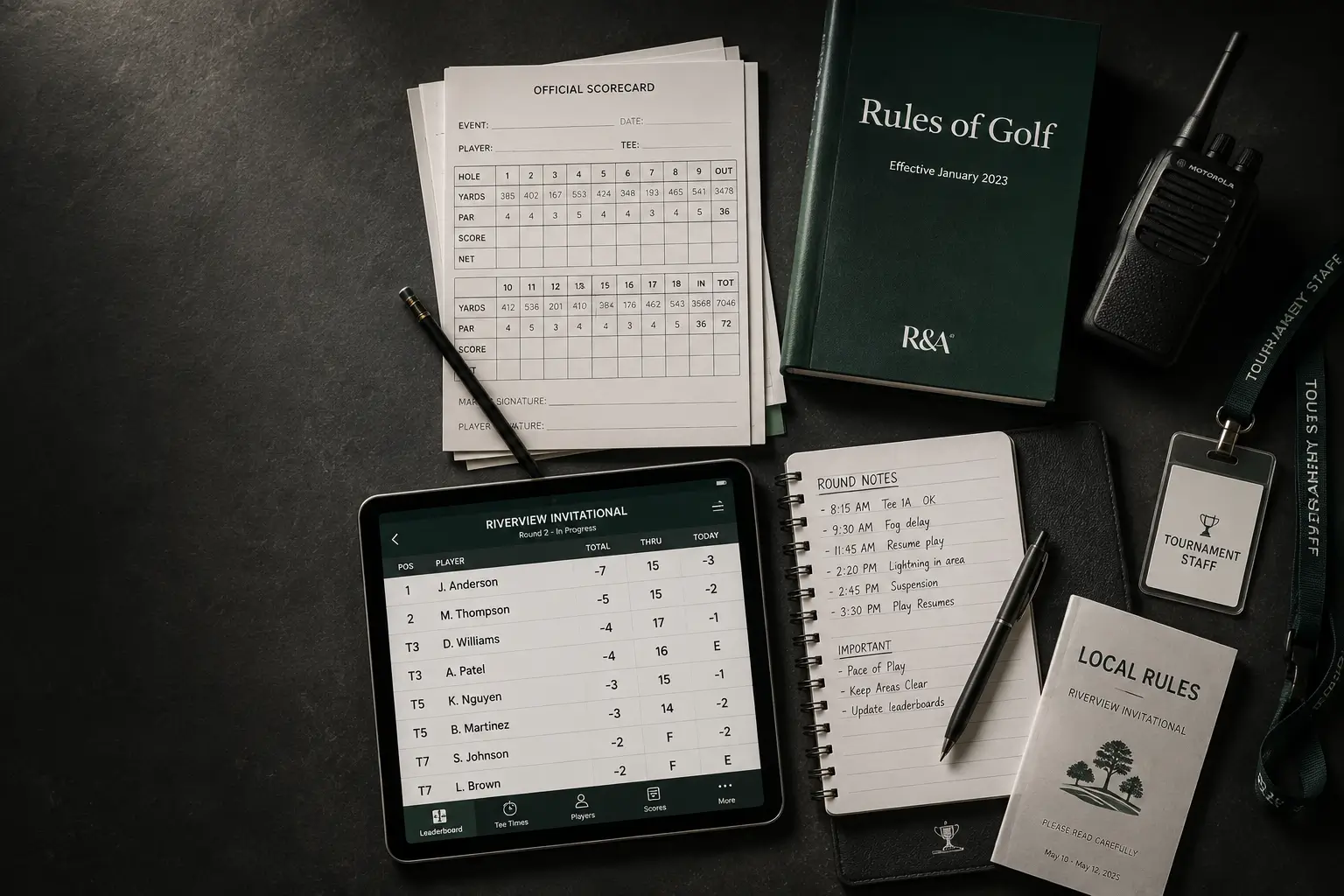
Every weekend across the world, thousands of club championships, invitationals, and member-guests descend into administrative chaos over three predictable issues: incorrect handicap percentages, improperly certified scorecards, and confusion regarding prize limits.
Whether you are organizing a regional pro-am or standing on the 18th green with a signed card in your hand, competitive golf is governed by exacting mathematical tolerances and strict tax compliance regulations.
This manual breaks down the governing USGA/WHS handicap allowances, official competition formats, scorecard protocols under Rule 3.3b, and the financial reporting thresholds required by the IRS.
Table 1: Official USGA & WHS Handicap Allowances
Under the World Handicap System (WHS Appendix C), players do not simply receive 100% of their Course Handicap in multi-ball or team formats. Handicap allowances exist to equalize equity across differing skill distributions, preventing high-handicap duos from statistically dominating team net events.
| Tournament Format | Type of Play | Recommended Allowance | Calculation Methodology |
|---|---|---|---|
| Individual Stroke Play | Stroke Play / Medal | 95% – 100% | 95% for fields > 30 players to compress variance; 100% for casual. |
| Individual Match Play | Match Play | 100% | Full difference from the lowest player's Course Handicap. |
| Four-Ball (Better Ball) | Stroke Play | 85% | Applied directly to each player's individual Course Handicap. |
| Four-Ball (Better Ball) | Match Play | 90% | 90% of the difference from the lowest Course Handicap in the foursome. |
| 4-Person Scramble | Stroke Play Team | 25/20/15/10% | Sum of 25% lowest CH + 20% 2nd + 15% 3rd + 10% highest CH. |
| 2-Person Scramble | Stroke Play Team | 35% / 15% | 35% of low Course Handicap + 15% of high Course Handicap. |
| Chapman (Pinehurst) | Stroke Play (2-Person) | 60% / 40% | 60% of low player's Course Handicap + 40% of high player's Course Handicap. |
| Individual Stableford | Points Scoring | 95% – 100% | Points based on net score (Double Eagle 5, Eagle 4, Birdie 3, Par 2, Bogey 1). |
For more details on flight breakdowns and net divisions, consult our comprehensive breakdown on club championship flights and divisions. To check whether your playing partners' handicaps conform to statistical distributions, use our interactive Handicap Detector tool.
Tournament Formats & Tactical Execution
Choosing the right format dictates pace of play, field engagement, and scoring integrity. Here is how the primary competitive structures operate:
1. Stroke Play (Medal Play)
The purest and most punitive format in golf. Every stroke counts, and Rule 3.3c mandates that the ball must be holed out on every green. In amateur tournaments, playing under a 95% handicap allowance is standard practice to prevent high-handicap outlier scores from sweeping the net prizes.
2. Match Play
Scored hole-by-hole rather than stroke-by-stroke. Concessions of strokes, holes, or entire matches are permitted under Rule 3.2b. Read our complete comparison on Match Play vs Stroke Play tactics to understand why approach angles and risk tolerance shift radically when competing directly against an opponent rather than the card.
3. Four-Ball (Better Ball)
Two partners play their own ball throughout the round. The lower net score of the two partners serves as the team score for that hole. The 85% allowance prevents partner teams from "ham-and-egging" into runaway 58s.
4. Scramble vs. Shamble
In a traditional 4-person scramble, all players hit from the chosen location on every shot. In a Shamble, players take the best drive, but then play their own ball individually into the cup. Explore our guide on charity scrambles and corporate outing strategy for course management blueprints.
"In team four-ball stroke play, the 85% handicap allowance is not a penalty. It is the mathematical boundary that keeps the tournament from descending into a farce."
Rule 3.3b: Scorecard Administration & Disqualification Traps
Nothing sours a tournament faster than a post-round disqualification in the scoring tent. Under Rule 3.3b, the responsibilities of the player and the marker are strictly defined:
- Marker Verification: The marker is responsible solely for recording the correct gross score for each hole and signing the card.
- Player Certification: The player is responsible for verifying their gross hole-by-hole scores, signing the card, and prompt submission to the committee.
- The Cardinal Rule: Under Rule 3.3b(3), submitting a gross score on any hole lower than actually taken results in immediate disqualification. Submitting a score higher than taken means the higher score stands.
- Handicap & Addition Errors: The player is NOT responsible for adding up the totals or applying handicap strokes—that is the committee's duty under the Rules of Golf.
For settling Nassau bets, skins pots, and side wagers after submitting your card, check out our automated Settle Up Calculator.
Amateur Status Prize Limits & IRS Tax Compliance
Tournament payouts are subject to dual jurisdictions: the sporting governing bodies (USGA / R&A) and the tax authorities (IRS).
The $1,000 Amateur Status Limit
Effective with the modernized Rules of Amateur Status, amateur golfers may accept cash prizes, gift cards, and merchandise credits up to a maximum value of $1,000 per event (or £700 / €850). Exceeding this threshold results in immediate loss of amateur status.
The Only Exception: Hole-in-one contests during a tournament are completely exempt from the $1,000 ceiling. You can legally win a $90,000 sports car or $25,000 cash for an ace and remain fully eligible for amateur state opens.
IRS Tax Reporting on Prize Winnings (Form 1099-MISC)
Many amateur golfers incorrectly believe that pro shop gift certificates and merchandise vouchers are non-taxable perks. Under Internal Revenue Code Section 61, all gross income from whatever source derived—including tournament prizes, Calcutta auctions, skins pools, and pro shop credit—is legally taxable.
- The $600 1099-MISC Threshold: Tournament organizers and country clubs are legally required to issue IRS Form 1099-MISC to any individual who receives $600 or more in cumulative prize payouts during a calendar year.
- Pro Shop Scrip: Merchandising credit redeemed for drivers, apparel, or bags must be reported at fair market value.
- Gambling vs. Skill Prizes (Form W-2G): Payouts from pari-mutuel wagering, Calcutta pools, or 50/50 raffles exceeding $600 (at 300-to-1 odds) or $5,000 require Form W-2G and mandatory federal withholding.
- Hobby Loss Rules (IRC Section 183): Amateur golfers cannot deduct entry fees, travel, or equipment against tournament prize income unless they operate as a registered trade or business with a verified profit motive.
For more tournament strategy and preparation, explore our complete Amateur Tournament Preparation Guide.
Frequently Asked Questions
What is the maximum prize money an amateur golfer can accept under USGA rules?
Under Rule 3 of the USGA Rules of Amateur Status, an amateur golfer may accept cash or non-cash prizes up to $1,000 (or £700 in R&A jurisdictions) per event in a scratch or handicap competition. The only exception is hole-in-one prizes, which have no monetary limit.
How are USGA handicap allowances calculated in four-ball stroke play?
Under the World Handicap System (WHS) Appendix C, men and women receive 85% of their Course Handicap in four-ball stroke play (better ball). In match play four-ball, allowances are 90% of the difference from the lowest Course Handicap in the match.
Do amateur golf tournament prize winnings need to be reported on federal tax returns?
Yes. Under US tax law (IRC Section 61), all prize winnings, gift certificates, pro shop merchandise credits, and tournament payouts are considered taxable gross income. Tournament organizers must issue Form 1099-MISC for non-employee prize payments of $600 or more.
What is the penalty under Rule 3.3b for signing an incorrect tournament scorecard?
Under Rule 3.3b(3), if a player returns a scorecard with a recorded hole score lower than actually taken, the penalty is disqualification. If the player returns a score higher than actually taken, the higher score stands with no additional penalty.
What is the difference between a Scramble and a Shamble format?
In a Scramble, all players hit from the chosen best shot location for every stroke until the ball is holed out. In a Shamble, all players hit tee shots, select the best drive, and then play their own ball individually into the hole from that spot.
The Raw Take
Competitive golf is unforgiving by design. The player who masters the rulebook and understands handicap mathematics arrives on the first tee with an immediate psychological advantage.
Calculate your allowances correctly before you tee off. Protect the field by verifying your marker's figures. And when you pick up that $800 pro shop voucher on Sunday afternoon, make sure your accountant knows about it.